
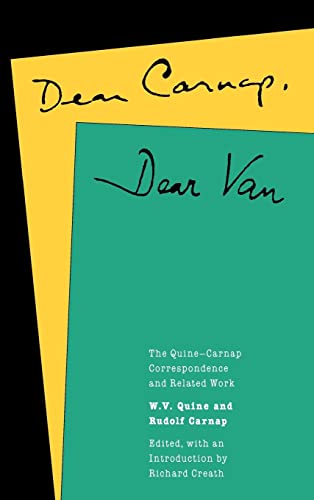
Dear Carnap, Dear Van: The Quine-Carnap Correspondence and Related Work: Edited and with an introduction by Richard Creath (Centennial Books) - Tapa dura
Sinopsis
Rudolf Carnap and W. V. Quine, two of the twentieth century's most important philosophers, corresponded at length - and over a long period of time - on matters personal, professional, and philosophical. Their friendship encompassed issues and disagreements that go to the heart of contemporary philosophic discussions. Carnap (1891-1970) was a founder and leader of the logical positivist school. The younger Quine (1908) began as his staunch admirer but diverged from him increasingly over questions in the analysis of meaning and the justification of belief. That they remained close, relishing their differences through years of correspondence, shows their stature both as thinkers and as friends.The letters are presented here, in full, for the first time. The substantial introduction by Richard Creath offers a lively overview of Carnap's and Quine's careers and backgrounds, allowing the nonspecialist to see their writings in historical and intellectual perspective. Creath also provides a judicious analysis of the philosophical divide between them, showing how deep the issues cut into the discipline, and how to a large extent they remain unresolved.
"Sinopsis" puede pertenecer a otra edición de este libro.
Acerca del autor
Richard Creath is Associate Professor of Philosophy at Arizona State University.
Fragmento. © Reproducción autorizada. Todos los derechos reservados.
Dear Carnap, Dear Van: The Quine-Carnap Correspondence and Related Work
By W.V. Quine and Rudolf CarnapUniversity of California Press
Copyright 1991 W.V. Quine and Rudolf CarnapAll right reserved.
ISBN: 0520068475
[Lecture I]
The A Priori
These three lectures are to be concerned with Carnap's very recent work only. His earlier book, Der Logische Aufban der Welt , must be excluded entirely, because, although a very important piece of work, it lies outside the direction of Carnap's latest book and articles; these lectures must, for lack of time, be confined to the new Carnap.
Carnap's central doctrine, which is the main concern of these lectures, is the doctrine that philosophy is syntax. In this hour I shall lead up to that doctrine by discussing the analytic character of the a priori . I will present none of Carnap's actual work this time, but will attempt only to put the mentioned doctrine in a suitable setting. In the remaining two lectures we can get into the details of Carnap's own developments.
The efforts of Carnap and his associates in the Viennese Circle have been directed in large part to showing us how to avoid metaphysics. Perhaps it will bear poor testimony to their success if I start out by discussing Kant. But a discussion of the analytic and the a priori starts us off with Kant.
According to Kant, a priori judgments and analytic judgments do not entirely coincide; for him all analytic judgments are of course a priori , but not all a priori judgments are analytic. A judgment is a priori if it has "the character of an inward necessity," as Kant says, and holds independently of any possible experience.
An analytic judgment is a judgment the truth of which may be established directly by analysis of the concepts involved. An analytic judgment can do no more than call our attention to something already contained in the definitions of our terms. Analytic judgments are consequences of definitions, conventions as to the uses
of words. They are consequences of linguistic fiat. Clearly they are a priori ; their truth does not depend upon experience, but upon vocabulary. Among analytic judgments are to be reckoned logic and the bulk, at least, of mathematics.
Analytic judgments are a priori ; but the converse, according to Kant, does not obtain. He holds that there are a priori truths, not dependent upon experience, which yet do not follow merely from the definitions of terms. He thus recognizes synthetic , or nonanalytic, a priori judgments. Among these a priori synthetic judgments he reckons the propositions of geometry.
But the development of foundational studies in mathematics during the past century has made it clear that none of mathematics, not even geometry, need rest on anything but linguistic conventions of a definitional kind. In this way it becomes possible to relegate geometry to the analytic realm, along with the rest of mathematics. This empties out the a priori synthetic. The analytic and the a priori become coxtensive. Thus Professor Lewis writes: "The a priori is not a material truth, delimiting or delineating the content of experience as such, but is definitive or analytic in its nature."1
It will be worth while, by way of examining this doctrine, to consider in detail the nature of the analytic. To begin with, let us distinguish two kinds of definition. First there is explicit definition, which is merely a convention of abbreviation. For example the definition of momentum as mass times velocity is an explicit definition: it is a linguistic convention whereby the word "momentum" is introduced as an arbitrary abbreviation for the compound expression "mass times velocity." The explicit definition is perhaps what we ordinarily think of as a definition.
An implicit definition is of an entirely different form. An implicit definition of a notion K is a set of one or more rules specifying that all sentences containing the word K in such and such a way are to be accepted, by convention, as true; their truth constitutes the meaning of K. For example, a set of postulates containing an undefined word K can be construed as an implicit definition of K: the postulates are adopted as true by convention, and the sign K is
Mind and the World Order , p. 231.
thereby partially or completely defined. An implicit definition, like an explicit definition, is a convention as to how the word in question is to be used. An explicit definition stipulates our use of the word, say "momentum", by referring us to our uses of certain other words, in this case "mass", "times" and "velocity", where the use of these words has presumably been already stipulated in the past. An explicit definition, unlike an implicit definition, is thus necessarily relative.
Often the word "definition" is restricted to explicit definition, and that has been my procedure elsewhere. But it will be convenient at present to use the word in the broader sense, covering both implicit and explicit definitions. This usage also has precedent; for the phrase "implicit definition" is not my own.
The analytic depends upon nothing more than definition, or conventions as to the uses of words. But in the ordinary uncriticized language of common sense we have little to do with deliberate definition. We learn our vocabulary through the usual process of psychological conditioning. We proceed glibly to use our vocabulary, and so long as we move among compatriots we get on without much difficulty: for their conditioning has been substantially the same as ours. At this level we feel no need of defining our terms, or introducing deliberate conventions as to the use of language. This comes only at a more sophisticated stagefor example in mathematics and in science.
Suppose now we start at a common-sense level, or an ultra-common-sense level, at which no conscious or deliberate definition has taken place. Then suppose we schematically run through the whole process of thoroughly defining the terms which we had been using without definition all along.
Let K be any word mathematical, logical or otherwiseperhaps the word "if", or perhaps "two", or "cat". Now let us consider the whole range of admittedly true sentences in which K occurs: true sentences, I mean, under the usual implicit, common-sense use of the word K, and true according to the given stage in the progress of science. The distinction between a priori and empirical does not concern me here. Let us call these accepted sentences the accepted K-sentences .
Now suppose we are confronted with the job of defining K. If we can frame a definition which fulfills all the accepted K-sentences,
then obviously we shall have done a perfectly satisfactory job. Nobody who was inclined to dispute the definition could point to a single respect in which the definition diverged from the accepted usage of the word K: for all accepted K-sentences would be verified.
Such a definition of K would be easily accomplished if there were only say three dozen accepted K-sentences. K could be given implicit definition by setting down those three dozen sentences, by fiat, and declaring that this was how you proposed to use the word K. Of course the definition might not be completely determinate; there might be several distinct notions all of which satisfied all thirty-six sentences, and the definition would not tell us which of these notions the word K was intended to represent. To that extent the definition would be only a partial definition, and to that extent the word K would retain ambiguity. But nobody could object to this ambiguity, since, by hypothesis, the definition is near enough to being complete so that it satisfies all accepted K-sentences.
But as a matter of fact this easy method is closed to us, since, for any word K, there will be an indefinite multitude of accepted K-sentences. If we are to find a definition of K which will satisfy even a fair representation of the accepted K-sentences, we must first develop a technique for organizing the accepted K-sentences and providing for them with finite means.
For one thing, we shall not be called upon to define any one word K in a vacuum. In defining K we must take into consideration the accepted K-sentences, and in defining another word H we must take into consideration the accepted H-sentences; but these sentences will overlap to some extent, and there is no need to consider the overlapping sentences twice. Namely, among the accepted K-sentences there will be some which are at the same time H-sentences: sentences involving both the word K and the word H. In defining K we might ignore some of the accepted K-sentences which are at the same time H-sentences; these can be picked up later when we come to define H.
For example, suppose that K is the word "two", and that H is the word "apple". Then these accepted sentences are at once K-sentences and H-sentences.
a) Within any class of two apples there is at least one apple .
b) Every apple weighs at least two grams.
Each of these is both an accepted "two"-sentence and an accepted
"apple"-sentence. In defining the word "two" and the word "apple" there is no need to consider these sentences twice. We may apportion these one way or the other: we may take them into consideration in defining "apple", or we may take them into consideration in defining "two". Or, third, we might provide for the first one in defining "two", and provide for the second one later in defining "apple".
There is an important distinction between a) and b). Note that a) is just one case of a general form all cases of which are true. All sentences of the form of a) will be accepted two-sentences, regardless of what noun may occur in sixth and last place instead of "apple". "Within any class of two so-&-so's there is at least one so-&-so": any sentence of this form is true, no matter what "so-&-so" may be. Let us describe such a sentence as a) by saying that it involves "apple" vacuously . Any sentence which contains a word H (say "apple"), and which remains unaffected in point of truth or falsity by all possible substitutions upon the word H (as a) does), will be said to involve H vacuously.
Unlike a), b) involves "apple" materially , or non-vacuously: for there are substitutions for "apple" which would turn b) falsefor example "mustard-seed".
Now in defining "two" we might provide at one stroke for all sentences of the general form of which a) is a special case: we might provide once and for all, in our definition of "two", for the truth of all sentences of the form "In any class of two so-&-so's there is at least one so-&-so". If on the other hand we were to provide for a) rather under the definition of "apple", we would thereby succeed in providing for a) alone, while all the other sentences of the same form would remain to be provided for. It therefore behooves us in the interests of economy and simplicity not to handle a) under the definition of "apple", but to provide for it rather under the definition of "two", by providing there for the more general form of which a) is a special case.
This same reasoning applies in the case of any sentence involving a given word vacuously. Given any accepted sentence which involves both the word K and the word H, but involves K materially and H only vacuously, it will be simplest to provide for the sentence when defining K rather than when defining H.
But there remains the case of sentences involving both K and H
materially. Whereas, for example, it is decided that a) is to be awarded to "two", it remains to be decided whether b) is to be awarded to "two" or to "apple". This is a question to be decided by arbitrary choice. It is the question of whether to define the word "two" first, independently of the word "apple", and then to define the word "apple" later, or vice versa .
Let us suppose that the word K is to be defined prior to defining a word H. At this stage then we need consider only such accepted K-sentences as involve K materially without involving H materially. Subsequently, when we come to define H, we shall have to pick up the sentences involving H and K together materially, as well as others involving H materially.
K, we suppose, is given precedence over H. Now here is another word G. The question repeats itselfshould K be given precedence over G, or vice versa ? If it be decided that K is to be given precedence over G, then in defining K we need look only to accepted sentences which involve K materially but involve neither G nor H materially.
Relatively to every concept, either individually or at wholesale, the priority of every concept must be favorably or unfavorably decided upon. In each case the choice of priority is conventional and arbitrary, and presumably to be guided by considerations of simplicity in the result. Such considerations seem to point in any case to giving general or abstract notions priority over special or concrete notions, and to giving so-called logical and mathematical notions priority over so-called empirical notions. Thus for example "two" may be expected to be given precedence over "apple". Hence the accepted sentences to be dealt with in defining "two" will comprise none which materially involve "apple". The sentence b) will therefore not be taken into consideration in defining "two", but will have to wait until we come to define "apple".
If we decide then to give the word "two" precedence over all so-called empirical notions, then the accepted "two"-sentences which we shall have to consider in defining "two" will involve no empirical words whatever, unless vacuously. All accepted "two"-sentences which, like b), materially involve empirical notions, will thus be set aside until the time when we are ready to define those empirical notions; none of those sentences will be dealt
with in defining "two". The only "two"-sentences to be provided for in defining "two" will thus be the accepted logico-mathematical "two"-sentences (including those applied forms which mention empirical notions vacuously). What is thus true of the word "two" will be equally true of any other word from the vocabulary of logic and mathematics. Since all such notions will be given precedence over empirical notions, the definitions of all logico-mathematical notions need be so framed only as to provide for accepted logico-mathematical sentences.
Within the logico-mathematical realm the considerations of priority between concepts run as before. They are arbitrary, and to a great extent it is in different choices in this respect that differences in alternative systematizations of logic and mathematics reside. It has been the procedure in Whitehead and Russell's Principia Mathematica to give all of the so-called logical concepts priority over the so-called mathematical onesalthough the distinction between these categories is somewhat vague and corresponds to no sharp structural cleavage. For example, the logical notion "if-then" will be given priority over the mathematical notion "two", and priority likewise over all other mathematical notions. Thus we shall be confined, in defining "if-then", to a consideration of only such accepted "if-then" sentences as involve no extra-logical words materially.
Suppose then that logical notions thus be given priority over all non-logical notions, mathematical and otherwise. Then there remains the question of priority among purely logical notions"if-then", "and", "not", "neither-nor", "some", "all", etc. Suppose "neither-nor" be given priority over all other logical words, and hence over all other words of whatever kind. Then, in framing a definition of "neither-nor", we have only to provide for such accepted "neither-nor"-sentences as involve absolutely no other words materially. These sentences may contain any words we like"temperature", "cat", "two", and so on, but they must involve these words vacuously.
Here is an example of such a sentence:
Neither 'neither "today is Sunday" nor "neither 'today is Sunday' nor 'today is Sunday'"' nor 'neither "Paris is in France" nor "neither 'Paris is France' nor 'Paris is in France'"'.
This sounds like Gertrude Stein, but the quotation marks may help somewhat; they are there merely to indicate grouping. This sentence will be accepted by everyone as true, once it has been studied long enough to be understood. Let us take this section first: "neither 'today is Sunday' nor 'today is Sunday'." This, obviously, is merely a clumsy way of saying that today is not Sunday. Then let us write that in instead. Now this whole segment becomes: 'neither "today is Sunday" nor "today is not Sunday".' This much is obviously false. "Today is neither Sunday nor not Sunday." Similarly the last half of the sentence turns out to mean that Paris is neither in France nor not in France. This again is false. But the whole sentence denies both of these falsehoods; it says, "Neither the one nor the other". Therefore the whole sentence is true; it is an accepted "nor"-sentence. Furthermore, this whole true sentence involves the words "today", "Sunday", "Paris", "France", "is" and "in" vacuously. It would continue to be true, by the same argument, no matter what clauses we might introduce in place of "today is Sunday" and "Paris is in France". Thus the only word which this sentence does involve non-vacuously, or materially, is "neither-nor". All such sentences will consist, like this one, of a "neither-nor" combining two sentences each of which is antilogical, and each of which is built up out of "neither-nor" in turn.
Now the class of such sentences is infinite; they can be built up in more and more complex forms, without end. But there is a perfectly finite way of providing for all of them.
Instead of the words "neither-nor" let us use the device of merely drawing a line over the affected clauses. Thus instead of "Neither so-and-so nor such-and-such" let us write . Now it can be proved that all accepted sentences involving only "neither-nor" materially can be generated by these two rules:
A) Accept any sentence of the form .
[By a sentence of the form I mean a sentence which results when we write some sentence instead of
the letter "p" in that form, and some sentence for "q", some sentence for "r", and some sentence for "s".]
B) Having accepted sentences of the forms and , accept "p" likewise.
I shall not present the proof here, but it has been proved that all sentences involving only "neither-nor" materially can be generated by A) and B). Hence we may merely adopt A) and B) by fiat: they constitute an implicit definition of "neither-nor". A) and B) are a statement of the conventions according to which we propose to use the words "neither-nor". The implicit definition A)B) is a finite scheme for generating an infinite series of sentences the truth of which constitutes the meaning of "neither-nor". And since it is demonstrable that all those accepted sentences of common-sense which involve only "neither-nor" materially are generable by A) and B), while no other sentences are generable by A) and B), we are assured that this implicit definition of "neither-nor" is successful : successful in the sense that it guarantees the customary usage of "neither-nor".
All accepted sentences materially involving only "neither-nor" become analytic : they become consequences merely of the linguistic conventions A) and B) governing the use of "neither-nor".
Now it will be possible to define a good many words in terms of "neither-nor" by explicit definition, or direct convention of notational abbreviation. Such an explicit definition is possible, for example, in the case of the logical notion "not". "Not" can be defined explicitly in terms of "neither-nor" by defining "not so-and-so" in every case as an abbreviation for Officially, this is a mere arbitrary abbreviation; but it obviously sqaures with the ordinary usage of the word "not".
Again, having thus defined "not" we can present an explicit definition of "or": namely, "so-and-so or such-and-such" can be introduced in every case as an abbreviation for Again, "and" can be given an explicit definition in terms of "not" and "neither-nor", by defining "so-&-so and such-&-such" as an abbreviation for By "and" and "or" here I mean the clause-connecting kind of "and" and "or", not the noun-connecting kind of "and" and "or"; I mean "and" as in "Today is Sunday and tomorrow is Monday", not
"and" as in "ham and eggs"; similarly for "or". The noun-connecting "and" and "or" would be handled as different words at some later stage of logic. They might be distinguished from these perhaps by an accent over the vowel.
Again, "if-then" can be defined in terms of "not" and "and" by introducing "if so-&-so then such-&-such" as an abbreviation for "not (so-&-so and not such-&-such)".
Thus "not", "or", "and" and "if" all admit of explicit definition in terms ultimately of "neither-nor". With these explicit definitions, the totality of sentences generable by A) and B) comes to include all accepted sentences involving any of the words "neither-nor", "not", "or", "and", and "if" materially (and other words vacuously). All these are generable by A) and B).
Let us see how the thing works. For brevity let us write "T" instead of "Today is Sunday", "W" instead of "Washington was a Spaniard", "M" instead of "All men are mortal", and "E" instead of "Eleven is prime". Now the sentence
1) is generated directly by A). For, this sentence is of the form of the expression in A); it is had from the latter by putting "T" for "p", "E" for "q", "W" for "r" and "M" for "s". Here already is a simple example of the derivation, through A), of an accepted sentence involving only "neither-nor" materially. We need not stop to try to understand the actual meaning of 1); it could be done, of course.
Now let us derive another such sentence through A), namely this one:
2)
This is of the form of the formula in A), as is seen by the fact that
2) is had by putting "T" for "p", for "q", for "r", and for "s".
Now 2) is of the form , and 1) is of the form , where
the "q" is the same in both cases. Hence, B) tells us that we may infer "p", namely
3)
Here then is a sentence derived through A) and B) together.
By a continuation of these processes, through ten more steps, we finally reach this sentence:
4)
Now we agreed to abbreviate as "not so-&-so". Hence 4) becomes
5) not .
But we agreed to abbreviate as "so-&-so or such-&-such". Hence 5) becomes
6) T or
Again, is abbreviated as "not T". 6) thus becomes
7) T or not T.
"Today is Sunday or not today is Sunday"; that is, either today is Sunday or it is not.
This sentence involves "or" and "not" materially, anything else vacuously. Instead of the words "today", "is" and "Sunday" in 7) we might have had any other words without falsifying the result; "today", "is" and "Sunday" occur vacuously in 7).
7), as we ordinarily say, is a truth of logic; although it mentions such non-logical notions as "today" and "Sunday", yet the truth of 7) depends upon logic alone: indeed, 7) is merely an application of the law of the excluded middle.
Any other identically true propositions, involving "neither-nor", "not", "or", "and", or "if", can be derived through A) and B) just as 1)7) was derived. This class of propositions comprises the fundamental and most familiar part of modern logic. It will be worth while to digress for a moment on this point. The connectives "if-then", "and", "or", "not", and "neither-nor" are called
truth-functions . They are characterized by the fact that the truth or falsity of a sentence compounded by such a connective is determined solely by the truth or falsity of the ingredient sentences. For example, consider the sentence "so-and-so or such-&-such". There are four possible cases: perhaps "so-&-so" and "such-&-such" are both true; perhaps the first is true and the second false; perhaps the second is true and the first false; or perhaps they are both false. Now the truth or falsity of the compound, "so-&-so or such-&-such" is determinate for each of these four cases; namely, the compound is true in the first three cases, false in the fourth case.
| ||||||||||||||||||||||||||||||
Again, the truth or falsity of the compound "so-and-so and such-&-such" is determined for the respective cases this way: true in the first case, false in the rest. Like "or" and "and", each of the truth-functions has its definite table of this kind. "Neither-nor", for example, would be "ffft". The truth-function "not" of course has a very simple table: "not so-&-so" is false when "so-&-so" is true, and true when "so-&-so" is false.
Such, then, is what is meant by a truth-function. Obviously "and", "or", "not", "if-then", and "neither-nor" are not the only truth-functions; there are also "if and only if", "not unless", "but not", and others for which ordinary language happens to have no simple idiom; there are infinitely many truth-functions, some combining sentences three at a time, some four at a time, and so on.
It was Professor Sheffer who discovered that every truth-function can be defined explicitly in terms solely of "neither-nor".
Each can be defined in terms of "neither-nor" in the manner in which I have already defined "not", "or", "and" and "if-then".
All of truth-function logic, in other words all truths involving nothing but truth-functions materially, can be derived through A) and B) alonejust as 1)7) are derived. A) and B) are my owndiscovered only a week ago. But my discovery of them was facilitated by some work done in a different connection, namely in terms of a different notion from "neither-nor", by Jean Nicod and Jan Lukasiewicz*
.
All truths involving only truth-functions materially are derivable through A) and B). These truths are infinite in number, so it is remarkable to be able to prove that we can get them all. The proof, a very ingenious one, is due to Lukasiewicz.His proof was concerned with a different starting-point than A) and B) and "neither-nor", but it is possible to turn his proof to these purposes.
So far, then, we have provided for all the truth-functions. "Neither-nor" was defined implicite, and the rest have been defined or can be defined explicite in terms of "neither-nor". From the definitions we are in position to derive any truths we like within a broad field: namely, we are in position to derive all accepted sentences materially involving the words "neither-nor", "not", "or", "and", "if-then", or any other truth-functions (and other words vacuously). All such sentences become analytic direct consequences of our conventions as to the use of words.
Now we are ready to introduce some further logical notion, say L, which is not to be had by explicit definition in terms of "neither-nor". L might be the logical notion "all", or it might be some other logical notion. For this purpose we shall need to supplement A)B) by another rule or two, say C) and D), by way of an implicit definition of L. Since "neither-nor" was the first notion to be defined, the schematic formulae occurring in analogous fashion in C) and D) need not be confined to involving only the new notion L, but may also depend upon any of the notions already defined, namely "neither-nor", "not", "or", "and" and so on.
C) and D) will be so framed that by them along with A) and B) we can generate all accepted sentences which materially involve L and "neither-nor" and the derivative notions explicitly defined in terms of "neither-nor", but involving other notions vacuously. Furthermore, we will be able to present explicit definitions of a new
string of notions in terms of L and two preceding notions. Accepted sentences involving these new notions become generable likewise from A)B)C)D).
Next we may introduce some further logical notion through implicit definition, by adding say one more rule E). Analogously to the formula in A), E) will involve some formula using this newly defined notion; but the formula in E) may use also "neither-nor", L, and any of the other notions higherto introduced.
About this much of a basis will prove to be enough, in the way of rules or implicit definitions, to provide for the whole of logic. All further notions of pure logic will admit of explicit or purely abbreviative definitions in terms the words already defined. By A)B)C)D)E), and the explicit definitions depending upon A)B)C)D)E), we shall have defined every word of the kind which we ordinarily characterize as purely logical; and from these definitions all logic will follow analytically. In other words, the rules A)E), and the subsidiary conventions of abbreviation or explicit definition, will be enough to provide for all accepted sentences which materially involve none but logical notions.
Next we start in on the vocabulary of ordinary mathematics. Whitehead and Russell, in their Principia Mathematica , established the important fact that, given logic, all pure mathematics, ordinarily so-called, can be developed without any more implicit definitions whatever! The logical rules or implicit definitions A) to E) are enough not only for all logic but for all mathematics; nothing more is needed beyond pure conventions of abbreviation, that is, explicit definitions. All mathematical notions can be introduced in that way on the given basis of logic, and all theorems of mathematics can be derived through the rules A) to E) alone, along with the explicit or purely abbreviative definitions.
So the rules of implicit definition A)E) brought us farther along than we expected. We have now provided for the entire vocabulary of logic and mathematics, and therewith we have made it possible to derive all accepted sentences involving any mathematical or logical notions materially and other notions vacuously. [a) is one of these sentences: it involves only logical and mathematical words materially, "apple" vacuously.] All such sentences, in other words all mathematics and logic, become analytic: direct consequences of our definitions, or conventions as to the use of words.
But why stop here? I started out earlier in the hour, on the program of defining words in general, indiscriminately. Next it was found that we have to define words in order, and thus establish some order of priority, arbitrary but guided by convenience. The order of priority adopted involved disposing of so-called logical words first, then so-called mathematical ones. We have yet to deal with the so-called empirical words.
Suppose the first of these so-called empirical words that we decide to define is "event". We shall need an implicit definition for this word; that is, we shall need to supplement the rules A)E) with say one more rule F). This rule will be so fashioned that from A)F) we can derive all accepted sentences materially involving only the word "event" plus any mathematical or logical notions, but involving other words only vacuously. The sentences thus provided for will express only the completed general properties of events: only the sentences about "event" which, except for the word "event" are entirely logico-mathematical. All such sentences become analytic : they are immediately derivable from our definitions or conventions as to the use of words.
Now there will be words which can be defined explicitly, by pure abbreviative convention, in terms of the logico-mathematical words plus "event". Given these explicit definitions, the rules A)F) provide for all accepted sentences which involve any of those words materially and other words only vacuously. All these sentences become analytic.
Then we may move to another so-called empirical word, say "energy" or "time", which is, let us suppose, not definable by explicit definitions in terms of notions thus far at hand. We then become an implicit definition for this word, and proceed as before. We may continue thus as far as we like, providing for one so-called empirical word after another, by explicit definition as far as possible, then by implicit definition. Each definition will be so framed as to provide for all accepted sentences materially involving only the notion in question and preceding notions, while vacuously involving any other notions.
But where should we stop in this process? Obviously we could go on indefinitely in the same way, introducing one word after another, and providing in each definition for the derivation of all accepted sentences which materially involve the word there de-
fined and preceding words but no others. Suppose we were to keep this up until we have defined, implicitly or explicitly, and one after another, every word in the English language. Then every accepted sentence, no matter in what words, would be provided for by the implicit or explicit definitions; every accepted sentence would become analytic, that is, directly derivable from our conventions as to the use of words.
Now for some practical considerations. To carry this out down to the last word and provide for the most minute accepted sentence would be somewhat of an undertaking. Here is one accepted sentence: "In 1934 a picture of Immanuel Kant was hanging in Emerson Hall." Suppose all the other words in the sentence be given priority over "Immanuel Kant" and "Emerson Hall". Then this sentence, which involves "Immanuel Kant" and "Emerson Hall" materially, will not have been provided for in the definitions of any of those prior words. We shall then have to provide for the sentence within the implicit definition of "Immanuel Kant" or else within the implicit definition of "Emerson Hall"whichever one happens to come last. Now obviously we do not want to deal with this sort of thing.
The absurdity of this case does not arise from the mere fact that the sentence "In 1934 a picture of Kant was hanging in Emerson Hall" is a so-called empirical sentence. The law of freely falling bodies is likewise ordinarily classed as an empirical sentence, yet there would be no such aversion to our making the law of freely falling bodies analytic instead of empirical by incorporating the law into the definition of "free fall". We may or may not incorporate the law of falling bodies into the definition of "free fall", as we choose; either one choice or the other might be preferable. But there is no chance of our choosing to incorporate the sentence about the picture into a definition of "Emerson Hall"even under the absurd supposition that we should choose to define "Emerson Hall" at all!
There is a vast range of sentences which, because of their lack of generality or lack of importance, we simply would not bother to render analytic by deliberate definition. This is one of them.
Also there are accepted sentences which are both general and important, which however we hesitate to make analytic for another reason. Namely, the accommodation of new discoveries in
science is constantly occasioning revision of old hypotheses, old empirical laws. In general we can choose, to some extent, where to revise, what principle to dislodge. Our choice is guided largely by the tendency to dislodge as little of previous doctrine as we can compatibly with the ideal of unity and simplicity in the resulting doctrine. Hence we may propose, by and large, to disturb first only such principles as support or underly, in a logical way, a minimum of other principles. It is therefore convenient to maintain a merely provisional, non-analytic status for such principles as we shall be most willing to sacrifice when need of revision at one point or another arises. If all empirical generalities are transformed into analytic propositions by redefinition of terms, we shall find ourselves continually redefining and then retrodefining; our definitions will not only be in an unnecessarily extreme state of flux, but there will be no immediate criterion for revising one definition rather than another. At every stage the entire conceptual scheme would be crystallized.
Yet we must defineand we must define sufficiently to make verbal usage specific in matters at least which are subject to rigorous treatment, as in the rigorous sciences. And we cannot define without making some of our accepted sentences analytic; it is a matter merely of choosing which. We saw just now that we will do best to render only such sentences analytic as we shall be most reluctant to revise when the demand arises for revision in one quarter or another. These include all the truths of logic and mathematics; we plan to stick to these in any case, and to make any revisions elsewhere. If psychological findings conflict intolerably with the Weber-Fechner law, namely that the intensity of sensation is proportional to the logarithm of the intensity of the stimulus, we shall of course adjust our doctrine by abandoning the Weber-Fechner law rather than by redefining "logarithm". Hence we may as well make the accepted sentences of mathematics and logic analytic.
But the language of so-called pure mathematics and logic does not embrace all the notions which have to be unambiguously defined in order to keep rigorous sciences rigorous. In defining these further terms, terms say of physics, we may follow the same principle; the definitions will be bound to make some of the accepted sentences of physics analytic, but we can so proceed as to render
only those sentences analytic which, because of the key position which they occupy, we should be most inclined to preserve when called upon to make future revisions of the science.
For example, Einstein found it important, in enhancing the rigor of physics, to define "simultaneity"rather than simply using the word, like "Emerson Hall" or "apple", on the assumption that everyone concerned knew well enough what it meant. Then which of the accepted sentences of physics was he to allow to be rendered analytic by the definition? He chose the sentence whose acceptance arose from the Michelson-Morley experiment: namely, the sentence to the effect that light travels at the same velocity in all directions: in others words, that simultaneously emitted flashes of light will meet at a midpoint between the two sources. Einstein based his definition of simultaneity upon this, by defining the simultaneity of light-emissions as meaning the collision of the light at the midpoint. He thereby rendered the Michelson-Morley law analytic; erected it, as Poincare would say, into a principle.
Such choices being made, and terminology being rendered sufficiently determinate for our purposes through implicit or explicit definition, we may as well stop defining, and let our remaining empirical laws keep their provisional status of synthetic propositions. In the face of future recalcitrant data, we shall in general confine our revision activity to these provisional laws, rather than saving them at the expense of changing our definitions.
Analytic propositions are true by linguistic convention. But it now appears further that it is likewise a matter of linguistic convention which propositions we are to make analytic and which not. How we choose to frame our definitions is a matter of choice. Of our pre-definitionally accepted propositions, we may make certain ones analytic, or other ones instead, depending upon the course of definition adopted.
So much for the analytic. What now of its relation to the a priori ? Kant said that a judgment is a priori if it "has the character of an inward necessity." Now a problem appears which is much a question of which came first, the hen or the egg. When it is claimed that the a priori is analytic, the usual procedure is to suggest that the a priori has its character of an inward necessity only because it is analytic: first we have definitions, and thence we get the a priori . During this hour I have adopted the opposite fiction, that we first
have our whole range of accepted sentences, without any definitions, and then frame our definitions to fit these sentences. Historically, psychologically, the truth lies between these two extremes. On the one hand, it is certain that there are words, technical words, which we never had, prior to their definition, but have deliberately coined and introduced through their definitions. On the other hand it is likewise true that mathematics itself has not, traditionally, developed through the sole process of deliberately presenting implicit and explicit definitions, but has merely systematized and generated firmly accepted sentences of an abstract kind.
But in any case there are more and less firmly accepted sentences prior to any sophisticated system of thoroughgoing definition. The more firmly accepted sentences we choose to modify last, if at all, in the course of evolving and revamping our sciences in the face of new discoveries. And among these accepted sentences which we choose to give up last, if at all, there are those which we are not going to give up at all, so basic are they to our whole conceptual scheme. These, if any, are the sentences to which the epithet "a priori" would have to apply. And we have seen during this hour that it is convenient so to frame our definitions as to make all these sentences analytic, along with others, even, which were not quite so firmly accepted before being raised to the analytic status.
But all this is a question only of how we choose to systematize on language. We are equally free to leave some of our firmly accepted sentences outside the analytic realm, and yet to continue to hold to them by what we may call deliberate dogma, or mystic intuition, or divine revelation: but what's the use, since suitable definition can be made to do the trick without any such troublesome assumptions? If we disapprove of the gratuitous creation of metaphysical problems, we will provide for such firmly accepted sentences within our definitions, or else cease to accept them so firmly.
Kant's recognition of a priori synthetic propositions, and the modern denial of such, are thus to be construed as statements of conventions as to linguistic procedure. The modern convention has the advantage of great theoretical economy; but the doctrine that the a priori is analytic remains only a syntactic decision. It is
however no less important for that reason: as a syntactic decision it has the importance of enabling us to pursue foundations of mathematics and the logic of science without encountering extra-logical questions as to the source of the validity of our a priori judgments. The possibility of such a syntactic procedure has furthermore this important relevance to metaphysics: it shows that all metaphysical problems as to an a priori synthetic are gratuitous, and let in only by ill-advised syntactic procedures. Finally, the doctrine that the a priori is analytic gains in force by thus turning out to be a matter of syntactic convention; for the objection is thereby forestalled that our exclusion of the metaphysical difficulties of the a priori synthetic depends upon our adoption of a gratuitous metaphysical point of view in turn. Thus the province of this hour's talk has been syntax rather than metaphysics: I have been suggesting what syntax can accomplish without recourse to metaphysics.
When we adopt such a syntax, in which the a priori is confined to the analytic, every true proposition then falls into one of two classes: either it is a synthetic empirical proposition, belonging within one or another of the natural sciences, or it is an a priori analytic proposition, in which case it derives its validity from the conventional structure, or syntax , of the language itself"syntax" being broadly enough construed to cover all linguistic conventions. Syntax must therefore provide for everything outside the natural sciences themselves: hence syntax must provide not only for logic and mathematics but also for whatever is valid in philosophy itself, when philosophy is purged of ingredients proper to natural science.
Carnap's thesis that philosophy is syntax is thus seen to follow from the principle that everything is analytic except the contingent propositions of empirical science. But like the principle that the a priori is analytic, Carnap's thesis is to be regarded not as a metaphysical conclusion, but as a syntactic decision. This conclusion should be gratifying to Carnap himself: for if philosophy is syntax, the philosophical view that philosophy is syntax should be syntax in turn; and this we see it to be.
We have seen that under the manifestly advantageous linguistic procedure under consideration all principles spring from syntax or experiment. Syntax is the tool for handling, organizing, empirical
data. Syntax comes to constitute the basis not only for logic and mathematics but for the entire logic of science, philosophy itself. Hence the importance of a rigorous study of formal syntax. This task Carnap sets himself in his new book Die logische Syntax der Sprache , with which I shall be concerned next Thursday.
Continues...
Excerpted from Dear Carnap, Dear Van: The Quine-Carnap Correspondence and Related Work by W.V. Quine and Rudolf Carnap Copyright 1991 by W.V. Quine and Rudolf Carnap. Excerpted by permission.
All rights reserved. No part of this excerpt may be reproduced or reprinted without permission in writing from the publisher.
Excerpts are provided by Dial-A-Book Inc. solely for the personal use of visitors to this web site.
"Sobre este título" puede pertenecer a otra edición de este libro.
Resultados de la búsqueda para Dear Carnap, Dear Van: The Quine-Carnap Correspondence...

Imagen del vendedor
Dear Carnap, Dear Van: The Quine-Carnap Correspondence and Related Work (A Centennial Book)
Publicado por
University of California Press, Berkeley, CA, 1990
ISBN 10: 0520068475
ISBN 13: 9780520068476
Antiguo o usado
Tapa dura
Original o primera edición
Librería: Fahrenheit's Books, Denver, CO, Estados Unidos de America
Calificación del vendedor: 5 de 5 estrellas

Hardcover. First Edition. First edition, hardcover, has a slight lean to the binding, mild bumps to the spine ends and cover corners, and subtle smudging to the edges of the text block. Overall, this is a solid, tight, Very Good+ copy in a Very Good dust jacket, which has bumps with light creasing to the spine ends and corners, sunning to the spine, and rubbing with mild edge wear to the covers. The jacket is wrapped in Mylar. Nº de ref. del artículo: 210898
Comprar usado
EUR 31,52
Envío por EUR 6,12
Se envía dentro de Estados Unidos de America
Se envía dentro de Estados Unidos de America
Cantidad disponible: 1 disponibles
Imagen del vendedor
Dear Carnap, Dear Van : The Quine-Carnap Correspondence and Related Work
Publicado por
University of California Press, Berkeley, Los Angles, London, 1990
ISBN 10: 0520068475
ISBN 13: 9780520068476
Antiguo o usado
Tapa dura
Original o primera edición
Librería: Midway Book Store (ABAA), St. Paul, MN, Estados Unidos de America
Calificación del vendedor: 5 de 5 estrellas
Hardcover. Condición: Fine in Near Fine dust jacket. First edition. 24 x 16 cm. xv 484pp. Black cloth in dust jacket. Edited and with an introduction by Richard Creath. First edition with full number line beginning with 1. Complete correspondence over more than 35 years between Rudolf Carnap (1891-1970) and W. V. O. Quine (1908-2000). It also contains 3 very early lectures by Quine on Carnap as well as a short paper by Carnap and Quine's memorial tribute to Carnap of 1970. All but the last of these were previously unpublished. Nº de ref. del artículo: 79491
Comprar usado
EUR 36,02
Envío por EUR 6,99
Se envía dentro de Estados Unidos de America
Se envía dentro de Estados Unidos de America
Cantidad disponible: 1 disponibles
Imagen de archivo
Dear Carnap, Dear Van: The Quine-Carnap Correspondence and Related Work: Edited and with an introduction by Richard Creath (Centennial Books)
Publicado por
University of California Press, 1991
ISBN 10: 0520068475
ISBN 13: 9780520068476
Antiguo o usado
Tapa dura
Original o primera edición
Librería: Turn and Temper Books, Rockville, MD, Estados Unidos de America
Calificación del vendedor: 4 de 5 estrellas

Hardcover. Condición: Near Fine. Estado de la sobrecubierta: Near Fine. 1st Edition. Hardcover. Condition: Near Fine. Dust Jacket Condition: Near Fine. 1st Edition. First Edition. Frontispiece, xv, 484 pp, 1 leaf. Original cloth. Near Fine, in near fine dust jacket. Nº de ref. del artículo: 204
Comprar usado
EUR 39,62
Envío por EUR 4,37
Se envía dentro de Estados Unidos de America
Se envía dentro de Estados Unidos de America
Cantidad disponible: 1 disponibles
Imagen de archivo
Dear Carnap, Dear Van: The Quine-Carnap Correspondence and Related Work
Publicado por
University of California Press, 1991
ISBN 10: 0520068475
ISBN 13: 9780520068476
Antiguo o usado
Tapa dura
Librería: ThriftBooks-Atlanta, AUSTELL, GA, Estados Unidos de America
Calificación del vendedor: 5 de 5 estrellas
Hardcover. Condición: Very Good. No Jacket. May have limited writing in cover pages. Pages are unmarked. ~ ThriftBooks: Read More, Spend Less. Nº de ref. del artículo: G0520068475I4N00
Comprar usado
EUR 44,10
Gastos de envío gratis
Se envía dentro de Estados Unidos de America
Se envía dentro de Estados Unidos de America
Cantidad disponible: 1 disponibles
Imagen de archivo
Dear Carnap, Dear Van: The Quine Carnap Correspondence and Related Work: The Quine-Carnap Correspondence and Related Work: Edited and with an introduction by Richard Creath
Publicado por
Univ of California Pr, Berkley, 1990
ISBN 10: 0520068475
ISBN 13: 9780520068476
Antiguo o usado
Tapa dura
Original o primera edición
Librería: M & M Books, ATHENS, GA, Estados Unidos de America
Calificación del vendedor: 3 de 5 estrellas

Hardcover. Condición: Fine. Estado de la sobrecubierta: Fine. 1st Edition. Tiny sig. of previous owner on FEP. Nº de ref. del artículo: 152402
Comprar usado
EUR 43,23
Envío por EUR 4,37
Se envía dentro de Estados Unidos de America
Se envía dentro de Estados Unidos de America
Cantidad disponible: 1 disponibles
Imagen de archivo
Dear Carnap, Dear Van: The Quine-Carnap Correspondence and Related Work: Edited and with an introduction by Richard Creath (Centennial Books)
Publicado por
University of California Press, 1991
ISBN 10: 0520068475
ISBN 13: 9780520068476
Antiguo o usado
Tapa dura
Librería: Solr Books, Lincolnwood, IL, Estados Unidos de America
Calificación del vendedor: 5 de 5 estrellas
Condición: good. This book is in Good condition. There may be some notes and highligting but otherwise the book is in overall good condition. Nº de ref. del artículo: BCV.0520068475.G
Comprar usado
EUR 44,10
Envío por EUR 6,98
Se envía dentro de Estados Unidos de America
Se envía dentro de Estados Unidos de America
Cantidad disponible: 1 disponibles
Imagen de archivo
Dear Carnap, Dear Van. The Quine-Carnap Correspondence and Related Work. Edited, with an Introduction by Richard Creath.
Publicado por
Berkeley, etc.: University of California Press, 1990., 1990
ISBN 10: 0520068475
ISBN 13: 9780520068476
Antiguo o usado
Tapa dura
Original o primera edición
Librería: Ted Kottler, Bookseller, Redondo Beach, CA, Estados Unidos de America
Calificación del vendedor: 4 de 5 estrellas
Hardcover. Condición: Near Fine. Estado de la sobrecubierta: Near Fine. 1st Edition. First Edition. Frontispiece, xv, 484 pp, 1 leaf. Original cloth. Near Fine, in near fine dust jacket. Nº de ref. del artículo: 12530
Comprar usado
EUR 40,52
Envío por EUR 11,10
Se envía dentro de Estados Unidos de America
Se envía dentro de Estados Unidos de America
Cantidad disponible: 1 disponibles
Imagen de archivo
Dear Carnap, Dear Van: The Quine-Carnap Correspondence and Related Work: Edited and with an introduction by Richard Creath (Centennial Books)
Publicado por
University of California Press, 1991
ISBN 10: 0520068475
ISBN 13: 9780520068476
Antiguo o usado
Tapa dura
Librería: Artless Missals, DENVER, CO, Estados Unidos de America
Calificación del vendedor: 5 de 5 estrellas
HARDCOVER. Condición: VG. Binding solid, pages crisp and clean, no markings found. Dust jacket has one inch repaired tear at top back edge, light scuffs and rubs. Extremities lightly bumped with minimal tip wear. Nº de ref. del artículo: SKU1005244
Comprar usado
EUR 54,93
Envío por EUR 5,25
Se envía dentro de Estados Unidos de America
Se envía dentro de Estados Unidos de America
Cantidad disponible: 1 disponibles
Imagen de archivo
Dear Carnap, Dear Van (The Quine-Carnap Correspondence and Related Work)
Publicado por
University of California Press, Berkeley & Los Angeles, CA, London, 1990
ISBN 10: 0520068475
ISBN 13: 9780520068476
Antiguo o usado
Tapa dura
Librería: gearbooks, The Bronx, NY, Estados Unidos de America
Calificación del vendedor: 5 de 5 estrellas
Hardcover. Condición: Very Good. Estado de la sobrecubierta: Very Good. Seventeenth Street Studios (Jacket Design) Ilustrador. 484 pp. Solidly bound copy and dj with moderate external wear, crisp pages and clean text. Slightly warped spine. Nº de ref. del artículo: 4iGh0023
Comprar usado
EUR 55,50
Envío por EUR 5,24
Se envía dentro de Estados Unidos de America
Se envía dentro de Estados Unidos de America
Cantidad disponible: 1 disponibles
Imagen de archivo
Dear Carnap, Dear Van: The Quine-Carnap Correspondence and Related Work
Publicado por
California University Press, 1990
ISBN 10: 0520068475
ISBN 13: 9780520068476
Antiguo o usado
Tapa dura
Librería: Anybook.com, Lincoln, Reino Unido
Calificación del vendedor: 5 de 5 estrellas
Condición: Good. This is an ex-library book and may have the usual library/used-book markings inside.This book has hardback covers. In good all round condition. No dust jacket. Please note the Image in this listing is a stock photo and may not match the covers of the actual item,1100grams, ISBN:0520068475. Nº de ref. del artículo: 5797254
Comprar usado
EUR 50,20
Envío por EUR 15,88
Se envía de Reino Unido a Estados Unidos de America
Se envía de Reino Unido a Estados Unidos de America
Cantidad disponible: 1 disponibles