
Artículos relacionados a Physical Science: What the Technology Professional...
Physical Science: What the Technology Professional Needs to Know: A Laboratory Manual: 8 (Preserving the Legacy) - Tapa blanda
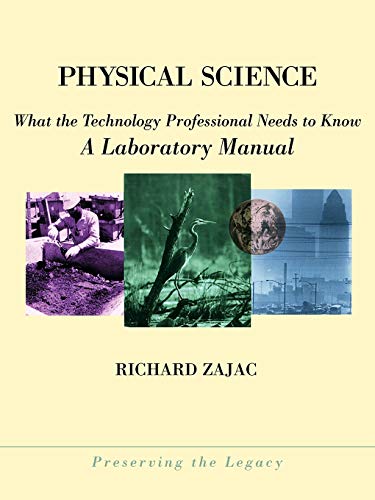
Sinopsis
This laboratory manual is designed to be used with the text, Physical Science: What the Technology Professional Needs to Know. Developed for the aspiring technology professional with little or no background in the study of physics or chemistry, it provides the experience necessary for students to develop skills in experimentation and data interpretation.
Like all of the books in the critically acclaimed Preserving the Legacy series, this manual is easy to understand and use, with clear instructions and a discovery approach. The book contains 26 experiments that have been carefully selected to illustrate major physics and chemistry concepts. They require simple, inexpensive equipment and are designed to be completed within three hours.
Each experiment starts with a review of the background concepts, information, and formulas necessary to carry out the experiment. Three or four investigations are then presented, each with its own objectives, procedures, and interpretation. Next, students are asked to demonstrate their understanding by bringing together selected data and conclusions in the preparation of a "Report Sheet." In a final section, students are given the opportunity to demonstrate their understanding of the concepts by applying them to a new situation.
Topics addressed in the experiments include:
* Measurements
* Matter and energy
* Acids and bases
* Motion
* Electricity
* Optics
* Nuclear processes
* Chemical reactions
"Sinopsis" puede pertenecer a otra edición de este libro.
Acerca del autor
RICHARD ZAJAC, PhD, is Assistant Professor of Physics in the Department of Arts, Sciences, and Business at Kansas State University-Salina.
De la contraportada
This laboratory manual is designed to be used with the text, Physical Science: What the Technology Professional Needs to Know. Developed for the aspiring technology professional with little or no background in the study of physics or chemistry, it provides the experience necessary for students to develop skills in experimentation and data interpretation.
Like all of the books in the critically acclaimed Preserving the Legacy series, this manual is easy to understand and use, with clear instructions and a discovery approach. The book contains 26 experiments that have been carefully selected to illustrate major physics and chemistry concepts. They require simple, inexpensive equipment and are designed to be completed within three hours.
Each experiment starts with a review of the background concepts, information, and formulas necessary to carry out the experiment. Three or four investigations are then presented, each with its own objectives, procedures, and interpretation. Next, students are asked to demonstrate their understanding by bringing together selected data and conclusions in the preparation of a "Report Sheet." In a final section, students are given the opportunity to demonstrate their understanding of the concepts by applying them to a new situation.
Topics addressed in the experiments include:
* Measurements
* Matter and energy
* Acids and bases
* Motion
* Electricity
* Optics
* Nuclear processes
* Chemical reactions
De la solapa interior
This laboratory manual is designed to be used with the text, Physical Science: What the Technology Professional Needs to Know. Developed for the aspiring technology professional with little or no background in the study of physics or chemistry, it provides the experience necessary for students to develop skills in experimentation and data interpretation.
Like all of the books in the critically acclaimed Preserving the Legacy series, this manual is easy to understand and use, with clear instructions and a discovery approach. The book contains 26 experiments that have been carefully selected to illustrate major physics and chemistry concepts. They require simple, inexpensive equipment and are designed to be completed within three hours.
Each experiment starts with a review of the background concepts, information, and formulas necessary to carry out the experiment. Three or four investigations are then presented, each with its own objectives, procedures, and interpretation. Next, students are asked to demonstrate their understanding by bringing together selected data and conclusions in the preparation of a Report Sheet. In a final section, students are given the opportunity to demonstrate their understanding of the concepts by applying them to a new situation.
Topics addressed in the experiments include:
* Measurements
* Matter and energy
* Acids and bases
* Motion
* Electricity
* Optics
* Nuclear processes
* Chemical reactions
"Sobre este título" puede pertenecer a otra edición de este libro.
Resultados de la búsqueda para Physical Science: What the Technology Professional...

Imagen de archivo
Physical Science
Librería: PBShop.store UK, Fairford, GLOS, Reino Unido
Calificación del vendedor: 5 de 5 estrellas

PAP. Condición: New. New Book. Shipped from UK. Established seller since 2000. Nº de ref. del artículo: FW-9780471360193
Comprar nuevo
EUR 86,63
Envío por EUR 7,87
Se envía de Reino Unido a Estados Unidos de America
Se envía de Reino Unido a Estados Unidos de America
Cantidad disponible: 15 disponibles
Imagen del vendedor
Physical Science : What the Technology Professional Needs to Know
Librería: GreatBookPricesUK, Woodford Green, Reino Unido
Calificación del vendedor: 5 de 5 estrellas
Condición: As New. Unread book in perfect condition. Nº de ref. del artículo: 32690
Comprar usado
EUR 78,44
Envío por EUR 17,46
Se envía de Reino Unido a Estados Unidos de America
Se envía de Reino Unido a Estados Unidos de America
Cantidad disponible: Más de 20 disponibles
Imagen de archivo
Physical Science: What the Technology Professional Needs to Know: A Laboratory Manual (eng)
Librería: Brook Bookstore On Demand, Napoli, NA, Italia
Calificación del vendedor: 5 de 5 estrellas
Condición: new. Nº de ref. del artículo: 9987c664b93f2090bcd117ad9ebe2a53
Comprar nuevo
EUR 86,95
Envío por EUR 11,00
Se envía de Italia a Estados Unidos de America
Se envía de Italia a Estados Unidos de America
Cantidad disponible: Más de 20 disponibles
Imagen del vendedor
Physical Science : What the Technology Professional Needs to Know
Librería: GreatBookPrices, Columbia, MD, Estados Unidos de America
Calificación del vendedor: 5 de 5 estrellas
Condición: New. Nº de ref. del artículo: 32690-n
Comprar nuevo
EUR 95,79
Envío por EUR 2,30
Se envía dentro de Estados Unidos de America
Se envía dentro de Estados Unidos de America
Cantidad disponible: Más de 20 disponibles
Imagen de archivo
Physical Science : What the Technology Professional Needs to Know
Librería: GreatBookPricesUK, Woodford Green, Reino Unido
Calificación del vendedor: 5 de 5 estrellas
Condición: New. Nº de ref. del artículo: 32690-n
Comprar nuevo
EUR 86,61
Envío por EUR 17,46
Se envía de Reino Unido a Estados Unidos de America
Se envía de Reino Unido a Estados Unidos de America
Cantidad disponible: Más de 20 disponibles
Imagen de archivo
Physical Science
Librería: Majestic Books, Hounslow, Reino Unido
Calificación del vendedor: 4 de 5 estrellas

Condición: New. pp. xi + 426 Illus. Nº de ref. del artículo: 7477508
Comprar nuevo
EUR 113,61
Envío por EUR 7,57
Se envía de Reino Unido a Estados Unidos de America
Se envía de Reino Unido a Estados Unidos de America
Cantidad disponible: 3 disponibles
Imagen de archivo
Physical Science: A Laboratory Manual
Librería: Ria Christie Collections, Uxbridge, Reino Unido
Calificación del vendedor: 5 de 5 estrellas
Condición: New. In English. Nº de ref. del artículo: ria9780471360193_new
Comprar nuevo
EUR 103,82
Envío por EUR 17,39
Se envía de Reino Unido a Estados Unidos de America
Se envía de Reino Unido a Estados Unidos de America
Cantidad disponible: Más de 20 disponibles
Imagen de archivo
Integrated Chemistry and Physics
Publicado por
John Wiley and Sons Ltd, 2001
ISBN 10: 0471360198
ISBN 13: 9780471360193
Nuevo
Tapa blanda
Original o primera edición
Librería: Kennys Bookshop and Art Galleries Ltd., Galway, GY, Irlanda
Calificación del vendedor: 5 de 5 estrellas
Condición: New. This is the official lab manual to accompany Sawnson's Integrated Chemistry and Physics, the first book to combine chemistry and physics in a unified course of study for environmental technology. Series: Preserving the Legacy. Num Pages: 440 pages, Illustrations. BIC Classification: JNU; PDN; PH. Category: (P) Professional & Vocational; (XV) Technical / Manuals. Dimension: 279 x 215 x 23. Weight in Grams: 1034. . 2001. 1st Edition. Paperback. . . . . Nº de ref. del artículo: V9780471360193
Comprar nuevo
EUR 117,74
Envío por EUR 9,50
Se envía de Irlanda a Estados Unidos de America
Se envía de Irlanda a Estados Unidos de America
Cantidad disponible: Más de 20 disponibles
Imagen de archivo
Physical Science: What the Technology Professional Needs to Know: A Laboratory Manual
Publicado por
John Wiley & Sons Inc, 2001
ISBN 10: 0471360198
ISBN 13: 9780471360193
Nuevo
Paperback / softback
Librería: THE SAINT BOOKSTORE, Southport, Reino Unido
Calificación del vendedor: 5 de 5 estrellas
Paperback / softback. Condición: New. New copy - Usually dispatched within 4 working days. Nº de ref. del artículo: B9780471360193
Comprar nuevo
EUR 102,96
Envío por EUR 24,89
Se envía de Reino Unido a Estados Unidos de America
Se envía de Reino Unido a Estados Unidos de America
Cantidad disponible: Más de 20 disponibles
Imagen de archivo
Physical Science: What the Technology Professional Needs to Know: A Laboratory Manual
Publicado por
John Wiley & Sons Inc, 2001
ISBN 10: 0471360198
ISBN 13: 9780471360193
Nuevo
Paperback
Librería: Revaluation Books, Exeter, Reino Unido
Calificación del vendedor: 5 de 5 estrellas
Paperback. Condición: Brand New. lab manual edition. 250 pages. 10.50x8.25x0.75 inches. In Stock. Nº de ref. del artículo: __0471360198
Comprar nuevo
EUR 121,30
Envío por EUR 17,46
Se envía de Reino Unido a Estados Unidos de America
Se envía de Reino Unido a Estados Unidos de America
Cantidad disponible: 2 disponibles