
Artículos relacionados a Clustering: 10 (IEEE Press Series on Computational...
Sinopsis
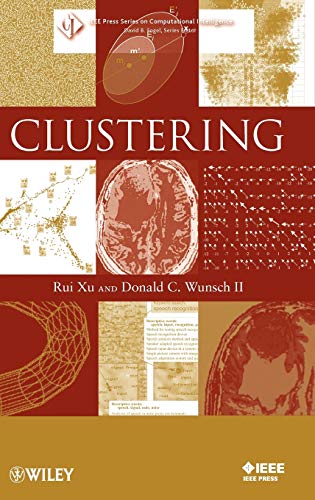
This is the first book to take a truly comprehensive look at clustering. It begins with an introduction to cluster analysis and goes on to explore: proximity measures; hierarchical clustering; partition clustering; neural network-based clustering; kernel-based clustering; sequential data clustering; large-scale data clustering; data visualization and high-dimensional data clustering; and cluster validation. The authors assume no previous background in clustering and their generous inclusion of examples and references help make the subject matter comprehensible for readers of varying levels and backgrounds.
"Sinopsis" puede pertenecer a otra edición de este libro.
Acerca del autor
Rui Xu, PhD, is a Research Associate in the Department of Electrical and Computer Engineering at Missouri University of Science and Technology. His research interests include computational intelligence, machine learning, data mining, neural networks, pattern classification, clustering, and bioinformatics. Dr. Xu is a member of the IEEE, the IEEE Computational Intelligence Society (CIS), and Sigma Xi.
Donald C. Wunsch II, PhD, is the M.K. Finley Missouri Distinguished Professor at Missouri University of Science and Technology. His key contributions are in adaptive resonance and reinforcement learning hardware and applications, neurofuzzy regression, improved Traveling Salesman Problem heuristics, clustering, and bioinformatics. He is an IEEE Fellow, the 2005 International Neural Networks Society (INNS) President, and Senior Fellow of the INNS.
De la contraportada
The only thorough, comprehensive book available on clustering
From two of the best-known experts in the field comes the first book to take a truly comprehensive look at clustering. The book begins with a complete introduction to cluster analysis in which readers will become familiarized with classification and clustering; definition of clusters; clustering applications; and the literature of clustering algorithms. The authors then present a detailed outline of the book's content and go on to explore:
-
Proximity measures
-
Hierarchical clustering
-
Partition clustering
-
Neural network-based clustering
-
Kernel-based clustering
-
Sequential data clustering
-
Large-scale data clustering
-
Data visualization and high-dimensional data clustering
-
Cluster validation
The authors assume no previous background in clustering and their generous inclusion of examples and references help make the subject matter comprehensible for readers of varying levels and backgrounds. The book is intended as a professional reference for computer scientists and applied mathematicians working with data-intensive applications, and for computational intelligence researchers who use clustering for feature selection or data reduction. Its selection of homework exercises also makes it appropriate as a textbook for graduate students in mathematics, science, and engineering.
"Sobre este título" puede pertenecer a otra edición de este libro.
Resultados de la búsqueda para Clustering: 10 (IEEE Press Series on Computational...

Imagen de archivo
Clustering
Publicado por
Wiley-IEEE Press, 2008
ISBN 10: 0470276800
ISBN 13: 9780470276808
Antiguo o usado
Tapa dura
Librería: Grey Matter Books, Hadley, MA, Estados Unidos de America
Calificación del vendedor: 4 de 5 estrellas

Hardcover. Condición: Very Good. Text is unmarked; pages are bright. Previous owner's signature in pen on the first free end page. Binding is sturdy. Covers show some wear around the corners and at the head and base of the spine. No dust jacket, as issued. Nº de ref. del artículo: 070351
Comprar usado
EUR 36,17
Envío por EUR 4,83
Se envía dentro de Estados Unidos de America
Se envía dentro de Estados Unidos de America
Cantidad disponible: 1 disponibles
Imagen de archivo
Clustering
Publicado por
Wiley, NJ, 2009
ISBN 10: 0470276800
ISBN 13: 9780470276808
Antiguo o usado
Tapa dura
Original o primera edición
Librería: Feldman's Books, Menlo Park, CA, Estados Unidos de America
Calificación del vendedor: 4 de 5 estrellas
Hardcover. Condición: Very Fine. First Edition. No markings. Nº de ref. del artículo: 00043897
Comprar usado
EUR 54,25
Envío por EUR 3,95
Se envía dentro de Estados Unidos de America
Se envía dentro de Estados Unidos de America
Cantidad disponible: 1 disponibles
Imagen de archivo
Clustering (IEEE Press Series on Computational Intelligence)
Publicado por
Wiley-IEEE Press (edition ), 2008
ISBN 10: 0470276800
ISBN 13: 9780470276808
Antiguo o usado
Tapa dura
Librería: BooksRun, Philadelphia, PA, Estados Unidos de America
Calificación del vendedor: 5 de 5 estrellas

Hardcover. Condición: Very Good. It's a well-cared-for item that has seen limited use. The item may show minor signs of wear. All the text is legible, with all pages included. It may have slight markings and/or highlighting. Nº de ref. del artículo: 0470276800-8-1
Comprar usado
EUR 109,91
Gastos de envío gratis
Se envía dentro de Estados Unidos de America
Se envía dentro de Estados Unidos de America
Cantidad disponible: 1 disponibles
Imagen de archivo
Clustering (eng)
Librería: Brook Bookstore On Demand, Napoli, NA, Italia
Calificación del vendedor: 5 de 5 estrellas
Condición: new. Nº de ref. del artículo: c2cd8e8a5b1c5b67615bacc73675a074
Comprar nuevo
EUR 141,48
Envío por EUR 6,80
Se envía de Italia a Estados Unidos de America
Se envía de Italia a Estados Unidos de America
Cantidad disponible: Más de 20 disponibles
Imagen de archivo
Clustering
Librería: PBShop.store UK, Fairford, GLOS, Reino Unido
Calificación del vendedor: 5 de 5 estrellas
HRD. Condición: New. New Book. Shipped from UK. Established seller since 2000. Nº de ref. del artículo: FW-9780470276808
Comprar nuevo
EUR 147,97
Envío por EUR 6,83
Se envía de Reino Unido a Estados Unidos de America
Se envía de Reino Unido a Estados Unidos de America
Cantidad disponible: 15 disponibles
Imagen del vendedor
Clustering
Publicado por
Wiley-IEEE Press, 2008
ISBN 10: 0470276800
ISBN 13: 9780470276808
Antiguo o usado
Tapa dura
Librería: GreatBookPrices, Columbia, MD, Estados Unidos de America
Calificación del vendedor: 5 de 5 estrellas
Condición: As New. Unread book in perfect condition. Nº de ref. del artículo: 5322733
Comprar usado
EUR 154,26
Envío por EUR 2,32
Se envía dentro de Estados Unidos de America
Se envía dentro de Estados Unidos de America
Cantidad disponible: Más de 20 disponibles
Imagen del vendedor
Clustering
Librería: GreatBookPrices, Columbia, MD, Estados Unidos de America
Calificación del vendedor: 5 de 5 estrellas
Condición: New. Nº de ref. del artículo: 5322733-n
Comprar nuevo
EUR 154,70
Envío por EUR 2,32
Se envía dentro de Estados Unidos de America
Se envía dentro de Estados Unidos de America
Cantidad disponible: Más de 20 disponibles
Imagen de archivo
Clustering
Librería: GreatBookPricesUK, Woodford Green, Reino Unido
Calificación del vendedor: 5 de 5 estrellas
Condición: New. Nº de ref. del artículo: 5322733-n
Comprar nuevo
EUR 147,96
Envío por EUR 17,44
Se envía de Reino Unido a Estados Unidos de America
Se envía de Reino Unido a Estados Unidos de America
Cantidad disponible: Más de 20 disponibles
Imagen del vendedor
Clustering
Publicado por
Wiley-IEEE Press, 2008
ISBN 10: 0470276800
ISBN 13: 9780470276808
Antiguo o usado
Tapa dura
Librería: GreatBookPricesUK, Woodford Green, Reino Unido
Calificación del vendedor: 5 de 5 estrellas
Condición: As New. Unread book in perfect condition. Nº de ref. del artículo: 5322733
Comprar usado
EUR 154,37
Envío por EUR 17,44
Se envía de Reino Unido a Estados Unidos de America
Se envía de Reino Unido a Estados Unidos de America
Cantidad disponible: Más de 20 disponibles
Imagen de archivo
Clustering: 10 (IEEE Press Series on Computational Intelligence)
Publicado por
John Wiley & Sons 2008-10-01, 2008
ISBN 10: 0470276800
ISBN 13: 9780470276808
Nuevo
Tapa dura
Librería: Chiron Media, Wallingford, Reino Unido
Calificación del vendedor: 5 de 5 estrellas
Hardcover. Condición: New. Brand new book, sourced directly from publisher. Dispatch time is 6-7 days from our warehouse. Book will be sent in robust, secure packaging to ensure it reaches you securely. Nº de ref. del artículo: 6666-WLY-9780470276808
Comprar nuevo
EUR 171,37
Envío por EUR 7,55
Se envía de Reino Unido a Estados Unidos de America
Se envía de Reino Unido a Estados Unidos de America
Cantidad disponible: Más de 20 disponibles