
Artículos relacionados a Bioequivalence Studies in Drug Development: Methods...
Bioequivalence Studies in Drug Development: Methods and Applications: 47 (Statistics in Practice) - Tapa dura
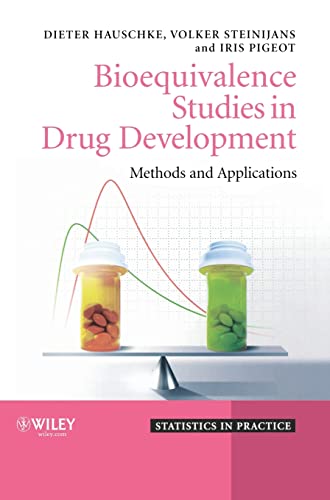
Sinopsis
Studies in bioequivalence are the commonly accepted method to demonstrate therapeutic equivalence between two medicinal products. Savings in time and cost are substantial when using bioequivalence as an established surrogate marker of therapeutic equivalence. For this reason the design, performance and evaluation of bioequivalence studies have received major attention from academia, the pharmaceutical industry and health authorities.
Bioequivalence Studies in Drug Development focuses on the planning, conducting, analysing and reporting of bioequivalence studies, covering all aspects required by regulatory authorities. This text presents the required statistical methods, and with an outstanding practical emphasis, demonstrates their applications through numerous examples using real data from drug development.
- Includes all the necessary pharmacokinetic background information.
- Presents parametric and nonparametric statistical techniques.
- Describes adequate methods for power and sample size determination.
- Includes appropriate presentation of results from bioequivalence studies.
- Provides a practical overview of the design and analysis of bioequivalence studies.
- Presents the recent developments in methodology, including population and individual bioequivalence.
- Reviews the regulatory guidelines for such studies, and the existing global discrepancies.
- Discusses the designs and analyses of drug-drug and food-drug interaction studies.
Bioequivalence Studies in Drug Development is written in an accessible style that makes it ideal for pharmaceutical scientists, clinical pharmacologists, and medical practitioners, as well as biometricians working in the pharmaceutical industry. It will also be of great value for professionals from regulatory bodies assessing bioequivalence studies.
"Sinopsis" puede pertenecer a otra edición de este libro.
Acerca del autor
Dieter Hauschke, ALTANA Pharma, Konstanz, Germany. Well-respected statistician working in the pharmaceutical industry, specializing in bioequivalence studies, with over 60 publications in leading journals.
Volker Steinijans, ALTANA Pharma, Konstanz, Germany. Head of the Department of Biometry and Clinical Data Management at ALTANA.
Iris Pigeot, Institute for Statistics, University of Bremen, Germany. Has over 50 published papers, and also written a number of books in German.
De la contraportada
Studies in bioequivalence are the commonly accepted method to demonstrate therapeutic equivalence between two medicinal products. Savings in time and cost are substantial when using bioequivalence as an established surrogate marker of therapeutic equivalence. For this reason the design, performance and evaluation of bioequivalence studies have received major attention from academia, the pharmaceutical industry and health authorities.
Bioequivalence Studies in Drug Development focuses on the planning, conducting, analysing and reporting of bioequivalence studies, covering all aspects required by regulatory authorities. This text presents the required statistical methods, and with an outstanding practical emphasis, demonstrates their applications through numerous examples using real data from drug development.
- Includes all the necessary pharmacokinetic background information.
- Presents parametric and nonparametric statistical techniques.
- Describes adequate methods for power and sample size determination.
- Includes appropriate presentation of results from bioequivalence studies.
- Provides a practical overview of the design and analysis of bioequivalence studies.
- Presents the recent developments in methodology, including population and individual bioequivalence.
- Reviews the regulatory guidelines for such studies, and the existing global discrepancies.
- Discusses the designs and analyses of drug-drug and food-drug interaction studies.
Bioequivalence Studies in Drug Development is written in an accessible style that makes it ideal for pharmaceutical scientists, clinical pharmacologists, and medical practitioners, as well as biometricians working in the pharmaceutical industry. It will also be of great value for professionals from regulatory bodies assessing bioequivalence studies.
"Sobre este título" puede pertenecer a otra edición de este libro.
Resultados de la búsqueda para Bioequivalence Studies in Drug Development: Methods...

Imagen del vendedor
Bioequivalence Studies in Drug Development: Methods and Applications (Statistics in Practice)
Librería: Gate City Books, GREENSBORO, NC, Estados Unidos de America
Calificación del vendedor: 5 de 5 estrellas

Condición: good. USED book in GOOD condition. Great binding, pages and cover show normal signs of wear from use. Nº de ref. del artículo: GCM.3QKJ
Comprar usado
EUR 35,93
Gastos de envío gratis
Se envía dentro de Estados Unidos de America
Se envía dentro de Estados Unidos de America
Cantidad disponible: 1 disponibles
Imagen de archivo
Bioequivalence Studies in Drug Development: Methods and Applications (Statistics in Practice)
Librería: GoldBooks, Denver, CO, Estados Unidos de America
Calificación del vendedor: 5 de 5 estrellas
Hardcover. Condición: new. New Copy. Customer Service Guaranteed. Nº de ref. del artículo: 39C33_46_0470094753
Comprar nuevo
EUR 86,04
Envío por EUR 4,91
Se envía dentro de Estados Unidos de America
Se envía dentro de Estados Unidos de America
Cantidad disponible: 1 disponibles
Imagen del vendedor
Bioequivalence Studies in Drug Development : Methods and Applications
Librería: GreatBookPrices, Columbia, MD, Estados Unidos de America
Calificación del vendedor: 5 de 5 estrellas
Condición: New. Nº de ref. del artículo: 2267451-n
Comprar nuevo
EUR 92,00
Envío por EUR 2,36
Se envía dentro de Estados Unidos de America
Se envía dentro de Estados Unidos de America
Cantidad disponible: Más de 20 disponibles
Imagen de archivo
Bioequivalence Studies in Drug Development: Methods and Applications (Statistics in Practice)
Librería: DeckleEdge LLC, Albuquerque, NM, Estados Unidos de America
Calificación del vendedor: 5 de 5 estrellas
hardcover. Condición: new. Nº de ref. del artículo: Shelfdream0470094753
Comprar nuevo
EUR 94,44
Gastos de envío gratis
Se envía dentro de Estados Unidos de America
Se envía dentro de Estados Unidos de America
Cantidad disponible: 1 disponibles
Imagen de archivo
Bioequivalence Studies in Drug Development: Methods and Applications (Statistics in Practice)
Publicado por
Wiley, 2007
ISBN 10: 0470094753
ISBN 13: 9780470094754
Antiguo o usado
Tapa dura
Original o primera edición
Librería: killarneybooks, Inagh, CLARE, Irlanda
Calificación del vendedor: 5 de 5 estrellas
Hardcover. Condición: Very Good. 1st Edition. Hardcover, xiv + 311 pages, NOT ex-library. Printed in Great Britain. Minor wear, great shape. Book is clean and bright with unmarked text, free of inscriptions and stamps, firmly bound. Issued without a dust jacket. -- This book provides a comprehensive guide to the planning, execution, and statistical evaluation of bioequivalence trials. It begins by establishing the foundational principles, defining bioavailability and therapeutic equivalence, and outlining the regulatory contexts in which these studies are performed for new active substances, approved products, and modified release forms. The text then details the characterization of concentration-time profiles using essential pharmacokinetic metrics for both single and multiple-dose regimens. It builds a robust statistical framework, exploring additive and multiplicative models, normal and lognormal distributions, and the core concepts of hypothesis testing, including consumer and producer risk. A significant focus is placed on the practical assessment of average bioequivalence using the standard RT/TR crossover design, with detailed coverage of analytical procedures such as analysis of variance, the two one-sided t-tests, and nonparametric alternatives. These analytical techniques are logically linked to the crucial planning stages of determining adequate statistical power and sample size, followed by guidance on the proper presentation of results for regulatory submissions. The scope expands to address more complex scenarios, including the use of Williams designs for studies involving more than two formulations, the challenges of multiplicity in dose linearity trials, and the critical analysis of pharmacokinetic interactions like drug-drug and food-drug effects. A distinguishing feature of the work is its in-depth examination of advanced concepts that go beyond simple average comparisons, thoroughly investigating population and individual bioequivalence. This section contrasts aggregate and disaggregate criteria, details the application of replicate designs, and explains moment-based and probability-based statistical procedures. The book's breadth is further demonstrated by extending the principles of equivalence assessment to clinical endpoints, covering methodologies for both parallel group and crossover designs when direct pharmacokinetic surrogates are insufficient. Nº de ref. del artículo: 012052
Comprar usado
EUR 64,30
Envío por EUR 33,70
Se envía de Irlanda a Estados Unidos de America
Se envía de Irlanda a Estados Unidos de America
Cantidad disponible: 1 disponibles
Imagen de archivo
Bioequivalence Studies in Drug Development
Librería: PBShop.store UK, Fairford, GLOS, Reino Unido
Calificación del vendedor: 5 de 5 estrellas
HRD. Condición: New. New Book. Shipped from UK. Established seller since 2000. Nº de ref. del artículo: FW-9780470094754
Comprar nuevo
EUR 99,80
Envío por EUR 5,93
Se envía de Reino Unido a Estados Unidos de America
Se envía de Reino Unido a Estados Unidos de America
Cantidad disponible: 15 disponibles
Imagen de archivo
Bioequivalence Studies in Drug Development: Methods and Applications (eng)
Librería: Brook Bookstore On Demand, Napoli, NA, Italia
Calificación del vendedor: 5 de 5 estrellas
Condición: new. Nº de ref. del artículo: 70ce9794996a8b34b1427a49888530d9
Comprar nuevo
EUR 99,07
Envío por EUR 8,00
Se envía de Italia a Estados Unidos de America
Se envía de Italia a Estados Unidos de America
Cantidad disponible: Más de 20 disponibles
Imagen del vendedor
Bioequivalence Studies in Drug Development : Methods and Applications
Librería: GreatBookPrices, Columbia, MD, Estados Unidos de America
Calificación del vendedor: 5 de 5 estrellas
Condición: As New. Unread book in perfect condition. Nº de ref. del artículo: 2267451
Comprar usado
EUR 110,32
Envío por EUR 2,36
Se envía dentro de Estados Unidos de America
Se envía dentro de Estados Unidos de America
Cantidad disponible: Más de 20 disponibles
Imagen del vendedor
Bioequivalence Studies in Drug Development : Methods and Applications
Librería: GreatBookPricesUK, Woodford Green, Reino Unido
Calificación del vendedor: 5 de 5 estrellas
Condición: New. Nº de ref. del artículo: 2267451-n
Comprar nuevo
EUR 99,78
Envío por EUR 17,72
Se envía de Reino Unido a Estados Unidos de America
Se envía de Reino Unido a Estados Unidos de America
Cantidad disponible: Más de 20 disponibles
Imagen del vendedor
Bioequivalence Studies in Drug Development : Methods and Applications
Librería: GreatBookPricesUK, Woodford Green, Reino Unido
Calificación del vendedor: 5 de 5 estrellas
Condición: As New. Unread book in perfect condition. Nº de ref. del artículo: 2267451
Comprar usado
EUR 110,76
Envío por EUR 17,72
Se envía de Reino Unido a Estados Unidos de America
Se envía de Reino Unido a Estados Unidos de America
Cantidad disponible: Más de 20 disponibles