
Artículos relacionados a Our Stolen Future: Are We Threatening Our Fertility,...
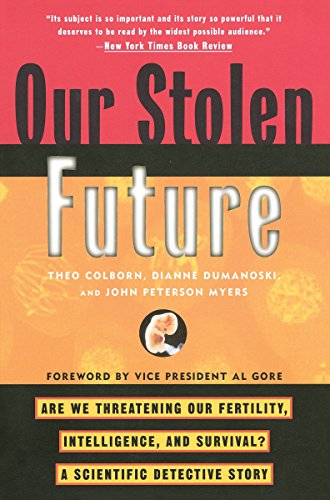
Our Stolen Future: Are We Threatening Our Fertility, Intelligence, and Survival?--A Scientific Detective Story - Tapa blanda
Sinopsis
"A critically important book that forces us to ask new questions about the synthetic chemicals that we have spread across this earth."—former vice president Al Gore, author of An Inconvenient Truth
Our Stolen Future examines the ways that certain synthetic chemicals interfere with hormonal messages involved in the control of growth and development, especially in the fetus.
The developing fetus uses these natural hormonal messages, which come from both from its own hormone system and from its mother, to guide development. They influence virtually all of the growing individual's characteristics, from determining its sex to controlling the numbers of toes and fingers to shaping intricate details of brain structure.
Scientific research over the last 50 years has revealed that this hormonal control of development is vulnerable to disruption by synthetic chemicals. Through a variety of mechanisms, hormone-disrupting chemicals (also known as endocrine disrupting chemicals or endocrine disruptors) interfere with the natural messages and alter the course of development, with potential effects on virtually all aspects of bodily function.
Our Stolen Future explores the scientific discovery of endocrine disruption. The investigation begins with wildlife, as it was in animals that the first hints of widespread endocrine disruption appeared. The book then examines a series of experiments examining endocrine disruption of animals in the laboratory which show conclusively that fetal exposure to endocrine disrupting chemicals can wreak life-long damage. These experiments also reveal some of the biological processes by which these chemicals have their effects, and that endocrine disruption effects can be caused by exposure to infinitesimally small amounts of contaminant. Moving from animals to people, Our Stolen Future summarizes a series of well-studied examples where people have been affected by endocrine disrupting chemicals, most notably the synthetic hormone dietheylstilbestrol (DES), to which several million women were exposed through misguided medical attempts to manage difficult pregnancies in the 1950s, '60s and '70s.
Our Stolen Future then asks a broader, more difficult and more controversial set of questions. Given what is known from wildlife and laboratory studies, and from examples of well-studied human exposure, and given that exposure to endocrine disrupting chemicals in the real world is widespread at levels comparable to those sufficient to cause animal harm, what effects should health scientists be looking for in people in general? Effects to be expected include declines in fertility and other impacts on the reproductive system of both men and women, impairments in disease resistance, and erosions in intelligence.
"Sinopsis" puede pertenecer a otra edición de este libro.
Acerca del autor
Dr. Theo Colborn was Professor at the University of Florida, Gainesville and President of TEDX (The Endocrine Disruption Exchange). She was the author of numerous scientific publications about compounds that alter the development of human, wildlife, and laboratory animal offspring before they are born. Dr. Colborn was awarded the Blue Planet Prize, the Rachel Carson Prize, the Society of Toxicology and Environmental Chemistry's Rachel Carson Award and Time Magazine's Environmental Heroes Award. She died in 2014.
Dianne Dumanoski is an award-winning journalist who writes on environmental issues and is the coauthor of Our Stolen Future. She lives in Massachusetts.
Reporter, editor and publisher of OurStolenFuture.org, Dr. John Peterson Myers is founder, CEO and Chief Scientist at Environmental Health Sciences, publisher of EnvironmentalHealthNews.org and DailyClimate.org. From 1990-2002, he was director of the W. Alton Jones Foundation, a private foundation supporting efforts to protect the global environment and to prevent nuclear war. He received his Ph.D. in zoology from the University of California, Berkeley, and lives near Charlottesville, Virginia.
"Sobre este título" puede pertenecer a otra edición de este libro.
Resultados de la búsqueda para Our Stolen Future: Are We Threatening Our Fertility,...

Imagen de archivo
Our Stolen Future: Are We Threatening Our Fertility, Intelligence,And Survival?-a Scientific Detective Story
Publicado por
Penguin Putnam Inc, 1997
ISBN 10: 0452274141
ISBN 13: 9780452274143
Antiguo o usado
Paperback
Librería: World of Books (was SecondSale), Montgomery, IL, Estados Unidos de America
Calificación del vendedor: 5 de 5 estrellas

Paperback. Condición: Fair. "A critically important book that forces us to ask new questions about the synthetic chemicals that we have spread across this earth."--former vice president Al Gore, author of An Inconvenient Truth Our Stolen Future examines the ways that certain synthetic chemicals interfere with hormonal messages involved in the control of growth and development, especially in the fetus. The developing fetus uses these natural hormonal messages, which come from both from its own hormone system and from its mother, to guide development. They influence virtually all of the growing individual's characteristics, from determining its sex to controlling the numbers of toes and fingers to shaping intricate details of brain structure. Scientific research over the last 50 years has revealed that this hormonal control of development is vulnerable to disruption by synthetic chemicals. Through a variety of mechanisms, hormone-disrupting chemicals (also known as endocrine disrupting chemicals or endocrine disruptors) interfere with the natural messages and alter the course of development, with potential effects on virtually all aspects of bodily function. Our Stolen Future explores the scientific discovery of endocrine disruption. The investigation begins with wildlife, as it was in animals that the first hints of widespread endocrine disruption appeared. The book then examines a series of experiments examining endocrine disruption of animals in the laboratory which show conclusively that fetal exposure to endocrine disrupting chemicals can wreak life-long damage. These experiments also reveal some of the biological processes by which these chemicals have their effects, and that endocrine disruption effects can be caused by exposure to infinitesimally small amounts of contaminant. Moving from animals to people, Our Stolen Future summarizes a series of well-studied examples where people have been affected by endocrine disrupting chemicals, most notably the synthetic hormone dietheylstilbestrol (DES), to which several million women were exposed through misguided medical attempts to manage difficult pregnancies in the 1950s, '60s and '70s. Our Stolen Future then asks a broader, more difficult and more controversial set of questions. Given what is known from wildlife and laboratory studies, and from examples of well-studied human exposure, and given that exposure to endocrine disrupting chemicals in the real world is widespread at levels comparable to those sufficient to cause animal harm, what effects should health scientists be looking for in people in general? Effects to be expected include declines in fertility and other impacts on the reproductive system of both men and women, impairments in disease resistance, and erosions in intelligence. Nº de ref. del artículo: 00100342935
Comprar usado
EUR 4,05
Gastos de envío gratis
Se envía dentro de Estados Unidos de America
Se envía dentro de Estados Unidos de America
Cantidad disponible: 13 disponibles
Imagen de archivo
Our Stolen Future: Are We Threatening Our Fertility, Intelligence,And Survival?-a Scientific Detective Story
Publicado por
Penguin Putnam Inc, 1997
ISBN 10: 0452274141
ISBN 13: 9780452274143
Antiguo o usado
Paperback
Librería: World of Books (was SecondSale), Montgomery, IL, Estados Unidos de America
Calificación del vendedor: 5 de 5 estrellas
Paperback. Condición: Very Good. "A critically important book that forces us to ask new questions about the synthetic chemicals that we have spread across this earth."--former vice president Al Gore, author of An Inconvenient Truth Our Stolen Future examines the ways that certain synthetic chemicals interfere with hormonal messages involved in the control of growth and development, especially in the fetus. The developing fetus uses these natural hormonal messages, which come from both from its own hormone system and from its mother, to guide development. They influence virtually all of the growing individual's characteristics, from determining its sex to controlling the numbers of toes and fingers to shaping intricate details of brain structure. Scientific research over the last 50 years has revealed that this hormonal control of development is vulnerable to disruption by synthetic chemicals. Through a variety of mechanisms, hormone-disrupting chemicals (also known as endocrine disrupting chemicals or endocrine disruptors) interfere with the natural messages and alter the course of development, with potential effects on virtually all aspects of bodily function. Our Stolen Future explores the scientific discovery of endocrine disruption. The investigation begins with wildlife, as it was in animals that the first hints of widespread endocrine disruption appeared. The book then examines a series of experiments examining endocrine disruption of animals in the laboratory which show conclusively that fetal exposure to endocrine disrupting chemicals can wreak life-long damage. These experiments also reveal some of the biological processes by which these chemicals have their effects, and that endocrine disruption effects can be caused by exposure to infinitesimally small amounts of contaminant. Moving from animals to people, Our Stolen Future summarizes a series of well-studied examples where people have been affected by endocrine disrupting chemicals, most notably the synthetic hormone dietheylstilbestrol (DES), to which several million women were exposed through misguided medical attempts to manage difficult pregnancies in the 1950s, '60s and '70s. Our Stolen Future then asks a broader, more difficult and more controversial set of questions. Given what is known from wildlife and laboratory studies, and from examples of well-studied human exposure, and given that exposure to endocrine disrupting chemicals in the real world is widespread at levels comparable to those sufficient to cause animal harm, what effects should health scientists be looking for in people in general? Effects to be expected include declines in fertility and other impacts on the reproductive system of both men and women, impairments in disease resistance, and erosions in intelligence. Nº de ref. del artículo: 00110791840
Comprar usado
EUR 4,05
Gastos de envío gratis
Se envía dentro de Estados Unidos de America
Se envía dentro de Estados Unidos de America
Cantidad disponible: 2 disponibles
Imagen de archivo
Our Stolen Future: Are We Threatening Our Fertility, Intelligence,And Survival?-a Scientific Detective Story
Publicado por
Penguin Putnam Inc, 1997
ISBN 10: 0452274141
ISBN 13: 9780452274143
Antiguo o usado
Paperback
Librería: World of Books (was SecondSale), Montgomery, IL, Estados Unidos de America
Calificación del vendedor: 5 de 5 estrellas
Paperback. Condición: Good. "A critically important book that forces us to ask new questions about the synthetic chemicals that we have spread across this earth."--former vice president Al Gore, author of An Inconvenient Truth Our Stolen Future examines the ways that certain synthetic chemicals interfere with hormonal messages involved in the control of growth and development, especially in the fetus. The developing fetus uses these natural hormonal messages, which come from both from its own hormone system and from its mother, to guide development. They influence virtually all of the growing individual's characteristics, from determining its sex to controlling the numbers of toes and fingers to shaping intricate details of brain structure. Scientific research over the last 50 years has revealed that this hormonal control of development is vulnerable to disruption by synthetic chemicals. Through a variety of mechanisms, hormone-disrupting chemicals (also known as endocrine disrupting chemicals or endocrine disruptors) interfere with the natural messages and alter the course of development, with potential effects on virtually all aspects of bodily function. Our Stolen Future explores the scientific discovery of endocrine disruption. The investigation begins with wildlife, as it was in animals that the first hints of widespread endocrine disruption appeared. The book then examines a series of experiments examining endocrine disruption of animals in the laboratory which show conclusively that fetal exposure to endocrine disrupting chemicals can wreak life-long damage. These experiments also reveal some of the biological processes by which these chemicals have their effects, and that endocrine disruption effects can be caused by exposure to infinitesimally small amounts of contaminant. Moving from animals to people, Our Stolen Future summarizes a series of well-studied examples where people have been affected by endocrine disrupting chemicals, most notably the synthetic hormone dietheylstilbestrol (DES), to which several million women were exposed through misguided medical attempts to manage difficult pregnancies in the 1950s, '60s and '70s. Our Stolen Future then asks a broader, more difficult and more controversial set of questions. Given what is known from wildlife and laboratory studies, and from examples of well-studied human exposure, and given that exposure to endocrine disrupting chemicals in the real world is widespread at levels comparable to those sufficient to cause animal harm, what effects should health scientists be looking for in people in general? Effects to be expected include declines in fertility and other impacts on the reproductive system of both men and women, impairments in disease resistance, and erosions in intelligence. Nº de ref. del artículo: 00107611387
Comprar usado
EUR 4,05
Gastos de envío gratis
Se envía dentro de Estados Unidos de America
Se envía dentro de Estados Unidos de America
Cantidad disponible: 9 disponibles
Imagen del vendedor
Our Stolen Future: Are We Threatening Our Fertility, Intelligence, and Survival?--A Scientific Detective Story
Publicado por
Penguin Publishing Group, 1997
ISBN 10: 0452274141
ISBN 13: 9780452274143
Antiguo o usado
Tapa blanda
Librería: Zoom Books East, Glendale Heights, IL, Estados Unidos de America
Calificación del vendedor: 5 de 5 estrellas
Condición: good. Book is in good condition and may include underlining highlighting and minimal wear. The book can also include "From the library of" labels. May not contain miscellaneous items toys, dvds, etc. . We offer 100% money back guarantee and 24 7 customer service. Nº de ref. del artículo: ZEV.0452274141.G
Comprar usado
EUR 4,06
Gastos de envío gratis
Se envía dentro de Estados Unidos de America
Se envía dentro de Estados Unidos de America
Cantidad disponible: 1 disponibles
Imagen del vendedor
Our Stolen Future: Are We Threatening Our Fertility, Intelligence, and Survival?--A Scientific Detective Story
Publicado por
Penguin Publishing Group, 1997
ISBN 10: 0452274141
ISBN 13: 9780452274143
Antiguo o usado
Tapa blanda
Librería: Zoom Books Company, Lynden, WA, Estados Unidos de America
Calificación del vendedor: 5 de 5 estrellas
Condición: very_good. Book is in very good condition and may include minimal underlining highlighting. The book can also include "From the library of" labels. May not contain miscellaneous items toys, dvds, etc. . We offer 100% money back guarantee and 24 7 customer service. Nº de ref. del artículo: ZBV.0452274141.VG
Comprar usado
EUR 4,06
Gastos de envío gratis
Se envía dentro de Estados Unidos de America
Se envía dentro de Estados Unidos de America
Cantidad disponible: 2 disponibles
Imagen del vendedor
Our Stolen Future: Are We Threatening Our Fertility, Intelligence, and Survival?--A Scientific Detective Story
Publicado por
Penguin Publishing Group, 1997
ISBN 10: 0452274141
ISBN 13: 9780452274143
Antiguo o usado
Tapa blanda
Librería: 3Brothers Bookstore, Egg harbor township, NJ, Estados Unidos de America
Calificación del vendedor: 5 de 5 estrellas
Condición: acceptable. Books may contain multiple pages with notes and highlighting. Supplements such as Access Codes, Cd's, etc. are not guaranteed with used book purchases. Nº de ref. del artículo: EVV.0452274141.A
Comprar usado
EUR 4,11
Gastos de envío gratis
Se envía dentro de Estados Unidos de America
Se envía dentro de Estados Unidos de America
Cantidad disponible: 1 disponibles
Imagen de archivo
Our Stolen Future: Are We Threatening Our Fertility, Intelligence, and Survival?--A Scientific Detective Story
Publicado por
Penguin Publishing Group (edition First Edition), 1997
ISBN 10: 0452274141
ISBN 13: 9780452274143
Antiguo o usado
Paperback
Original o primera edición
Librería: BooksRun, Philadelphia, PA, Estados Unidos de America
Calificación del vendedor: 5 de 5 estrellas
Paperback. Condición: Very Good. First Edition. It's a well-cared-for item that has seen limited use. The item may show minor signs of wear. All the text is legible, with all pages included. It may have slight markings and/or highlighting. Nº de ref. del artículo: 0452274141-11-1
Comprar usado
EUR 4,81
Gastos de envío gratis
Se envía dentro de Estados Unidos de America
Se envía dentro de Estados Unidos de America
Cantidad disponible: 2 disponibles
Imagen del vendedor
Our Stolen Future: Are We Threatening Our Fertility, Intelligence, and Survival?--A Scientific Detective Story
Publicado por
Penguin Publishing Group, 1997
ISBN 10: 0452274141
ISBN 13: 9780452274143
Antiguo o usado
Tapa blanda
Librería: ZBK Books, Carlstadt, NJ, Estados Unidos de America
Calificación del vendedor: 5 de 5 estrellas
Condición: good. Fast & Free Shipping â" Good condition. It may show normal signs of use, such as light writing, highlighting, or library markings, but all pages are intact and the book is fully readable. A solid, complete copy that's ready to enjoy. Nº de ref. del artículo: ZWV.0452274141.G
Comprar usado
EUR 5,35
Gastos de envío gratis
Se envía dentro de Estados Unidos de America
Se envía dentro de Estados Unidos de America
Cantidad disponible: 1 disponibles
Imagen del vendedor
Our Stolen Future: Are We Threatening Our Fertility, Intelligence, and Survival?--A Scientific Detective Story
Publicado por
Penguin Publishing Group, 1997
ISBN 10: 0452274141
ISBN 13: 9780452274143
Antiguo o usado
Tapa blanda
Librería: Greenworld Books, Arlington, TX, Estados Unidos de America
Calificación del vendedor: 5 de 5 estrellas
Condición: very_good. Fast Free Shipping â" Very Good condition book with a firm cover and clean pages. Shows normal use and some light wear or limited notes markings. A solid, nice copy to enjoy. Nº de ref. del artículo: GWV.0452274141.VG
Comprar usado
EUR 5,61
Gastos de envío gratis
Se envía dentro de Estados Unidos de America
Se envía dentro de Estados Unidos de America
Cantidad disponible: 1 disponibles
Imagen del vendedor
Our Stolen Future: Are We Threatening Our Fertility, Intelligence, and Survival?--A Scientific Detective Story
Publicado por
Penguin Publishing Group, 1997
ISBN 10: 0452274141
ISBN 13: 9780452274143
Antiguo o usado
Tapa blanda
Librería: Austin Goodwill 1101, Austin, TX, Estados Unidos de America
Calificación del vendedor: 5 de 5 estrellas
Condición: good. Book shows general signs of use and handling. May have light wear on the cover or edges and minimal writing or highlighting. Binding remains tight, and pages are clean and readable. Nº de ref. del artículo: CTXV.0452274141.G
Comprar usado
EUR 2,87
Envío por EUR 2,94
Se envía dentro de Estados Unidos de America
Se envía dentro de Estados Unidos de America
Cantidad disponible: 1 disponibles