
Artículos relacionados a Sustainable Applications of Multifunctional Metal and...
Sustainable Applications of Multifunctional Metal and Metal Oxide Nanoparticles (Micro and Nano Technologies) - Tapa blanda
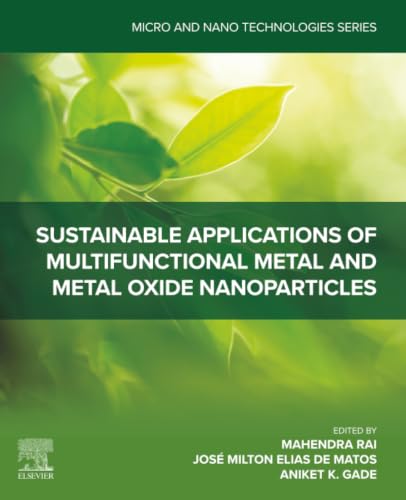
Sinopsis
Sustainable Applications of Multifunctional Metal and Metal Oxide Nanoparticles provides a comprehensive overview of the synthesis, characterization, and diverse applications of metal and metal oxide nanomaterials. The book first introduces fundamental concepts related to metal and metal oxide nanomaterials, including their synthesis through green methods and the unique physicochemical properties that emerge at the nanoscale. Following chapters review their applications in sustainable technologies, focusing on healthcare and the food industry, including topics such as antimicrobial resistance, biodegradable drug delivery systems, biosensing, and food packaging. The book also discusses agricultural and environmental applications, highlighting improvements in crop production, pest control, and water purification. Advanced materials, such as hybrid nanomaterials combining metal and metal oxides are discussed in the context of sustainability and their integration into IoT and smart technologies. Finally, the book explores the environmental and societal impacts of these nanomaterials, including their roles in energy, sustainable construction, and the circular bioeconomy, while addressing important toxicity considerations. This book is a valuable resource for researchers, scientists, and industry professionals who are interested in the field of nanotechnology and its applications.
"Sinopsis" puede pertenecer a otra edición de este libro.
Acerca de los autores
Mahendra Rai is an internationally recognized scholar with extensive contributions to microbial biotechnology and nanobiotechnology research, particularly in the green synthesis of metal nanoparticles using fungi and their application as nano‑antimicrobials. His work is highly interdisciplinary, bridging microbiology, biotechnology, and nanoscience, and he is an active member of several scientific societies. He has received multiple national and international distinctions, including the Father T.A. Mathias Award from the All-India Association for Christian Higher Education and the Medini Award from the Government of India. Professor Rai has also held numerous visiting scientist and visiting professor positions across Europe, South America, and Asia, contributing to long‑standing research collaborations in countries such as Brazil, Argentina, Hungary, Switzerland, Italy, Germany, and the United States. His sustained academic impact is reflected in his inclusion among the global top 2% of scientists in nanoscience and nanotechnology, and recognition as one of India’s leading researchers in biology and biochemistry, including a Biology and Biochemistry India Leader Award from Research.com.
Prof. José Milton Elias de Matos is a Professor in the Department of Chemistry and the Materials Postgraduate Programs at the Federal University of Piauí, Brazil. His research group primarily focuses on the green synthesis of polymers derived from vegetable oils, the creation of heterojunctions with nanoparticles, particularly metal nanoparticles, and their use as nanoantimicrobials to combat pathogenic microbes and remediate water contaminated by textile dyes and pharmaceutical residues. His research is highly interdisciplinary, combining natural polymers and metal oxides with nanotechnology.
Dr. Aniket K. Gade is an Associate Professor in the Department of Biological Sciences and Biotechnology at the Institute of Chemical Technology, India. He is currently a Visiting Scientist under the OLONES-BIS Fellowship at the Department of Microbiology, Nicolaus Copernicus University, Poland. Dr. Gade completed his postdoctoral research in the Biology Department at Utah State University, USA, under the guidance of Prof. Anne Anderson. In 2011, he visited the Department of Biological Chemistry at the University of Campinas, Brazil. His research primarily focuses on bioinformatics, bionanotechnology, and molecular biology.
"Sobre este título" puede pertenecer a otra edición de este libro.
Resultados de la búsqueda para Sustainable Applications of Multifunctional Metal and...

Imagen de archivo
SUSTAINABLE APPLICATIONS OF MULTIFU
Impresión bajo demandaLibrería: Brook Bookstore On Demand, Napoli, NA, Italia
Calificación del vendedor: 5 de 5 estrellas

Condición: new. Questo è un articolo print on demand. Nº de ref. del artículo: 0CZT3BYT0J
Comprar nuevo
EUR 188,06
Envío por EUR 11,00
Se envía de Italia a Estados Unidos de America
Se envía de Italia a Estados Unidos de America
Cantidad disponible: Más de 20 disponibles
Imagen de archivo
Sustainable Applications of Multifunctional Metal and Metal Oxide Nanoparticles
Librería: Majestic Books, Hounslow, Reino Unido
Calificación del vendedor: 4 de 5 estrellas

Condición: New. Nº de ref. del artículo: 408610688
Comprar nuevo
EUR 206,16
Envío por EUR 7,56
Se envía de Reino Unido a Estados Unidos de America
Se envía de Reino Unido a Estados Unidos de America
Cantidad disponible: 3 disponibles
Imagen de archivo
Sustainable Applications of Multifunctional Metal and Metal Oxide Nanoparticles
Librería: PBShop.store UK, Fairford, GLOS, Reino Unido
Calificación del vendedor: 5 de 5 estrellas
PAP. Condición: New. New Book. Shipped from UK. Established seller since 2000. Nº de ref. del artículo: IB-9780443441233
Comprar nuevo
EUR 218,27
Envío por EUR 4,84
Se envía de Reino Unido a Estados Unidos de America
Se envía de Reino Unido a Estados Unidos de America
Cantidad disponible: 4 disponibles
Imagen de archivo
Sustainable Applications of Multifunctional Metal and Metal Oxide Nanoparticles
Librería: Books Puddle, New York, NY, Estados Unidos de America
Calificación del vendedor: 4 de 5 estrellas
Condición: New. Nº de ref. del artículo: 26405624927
Comprar nuevo
EUR 221,15
Envío por EUR 3,44
Se envía dentro de Estados Unidos de America
Se envía dentro de Estados Unidos de America
Cantidad disponible: 3 disponibles
Imagen de archivo
Sustainable Applications of Multifunctional Metal and Metal Oxide Nanoparticles (Micro and Nano Technologies)
Librería: Revaluation Books, Exeter, Reino Unido
Calificación del vendedor: 5 de 5 estrellas
Paperback. Condición: Brand New. 500 pages. 7.52x1.31x9.25 inches. In Stock. Nº de ref. del artículo: __0443441235
Comprar nuevo
EUR 210,96
Envío por EUR 17,46
Se envía de Reino Unido a Estados Unidos de America
Se envía de Reino Unido a Estados Unidos de America
Cantidad disponible: 2 disponibles
Imagen de archivo
Sustainable Applications of Multifunctional Metal and Metal Oxide Nanoparticles (Paperback)
Publicado por
Elsevier - Health Sciences Division, Philadelphia, 2026
ISBN 10: 0443441235
ISBN 13: 9780443441233
Nuevo
Paperback
Librería: Grand Eagle Retail, Bensenville, IL, Estados Unidos de America
Calificación del vendedor: 5 de 5 estrellas
Paperback. Condición: new. Paperback. Sustainable Applications of Multifunctional Metal and Metal Oxide Nanoparticles provides a comprehensive overview of the synthesis, characterization, and diverse applications of metal and metal oxide nanomaterials. The book first introduces fundamental concepts related to metal and metal oxide nanomaterials, including their synthesis through green methods and the unique physicochemical properties that emerge at the nanoscale. Following chapters review their applications in sustainable technologies, focusing on healthcare and the food industry, including topics such as antimicrobial resistance, biodegradable drug delivery systems, biosensing, and food packaging. The book also discusses agricultural and environmental applications, highlighting improvements in crop production, pest control, and water purification.Advanced materials, such as hybrid nanomaterials combining metal and metal oxides are discussed in the context of sustainability and their integration into IoT and smart technologies. Finally, the book explores the environmental and societal impacts of these nanomaterials, including their roles in energy, sustainable construction, and the circular bioeconomy, while addressing important toxicity considerations. This book is a valuable resource for researchers, scientists, and industry professionals who are interested in the field of nanotechnology and its applications. Shipping may be from multiple locations in the US or from the UK, depending on stock availability. Nº de ref. del artículo: 9780443441233
Comprar nuevo
EUR 240,18
Gastos de envío gratis
Se envía dentro de Estados Unidos de America
Se envía dentro de Estados Unidos de America
Cantidad disponible: 1 disponibles
Imagen de archivo
Sustainable Applications of Multifunctional Metal and Metal Oxide Nanoparticles
Librería: Biblios, Frankfurt am main, HESSE, Alemania
Calificación del vendedor: 4 de 5 estrellas
Condición: New. Nº de ref. del artículo: 18405624917
Comprar nuevo
EUR 233,17
Envío por EUR 9,95
Se envía de Alemania a Estados Unidos de America
Se envía de Alemania a Estados Unidos de America
Cantidad disponible: 3 disponibles
Imagen del vendedor
Sustainable Applications of Multifunctional Metal and Metal Oxide Nanoparticles
Publicado por
Elsevier - Health Sciences Division, US, 2026
ISBN 10: 0443441235
ISBN 13: 9780443441233
Nuevo
Paperback
Librería: Rarewaves.com USA, London, LONDO, Reino Unido
Calificación del vendedor: 5 de 5 estrellas
Paperback. Condición: New. Sustainable Applications of Multifunctional Metal and Metal Oxide Nanoparticles provides a comprehensive overview of the synthesis, characterization, and diverse applications of metal and metal oxide nanomaterials. The book first introduces fundamental concepts related to metal and metal oxide nanomaterials, including their synthesis through green methods and the unique physicochemical properties that emerge at the nanoscale. Following chapters review their applications in sustainable technologies, focusing on healthcare and the food industry, including topics such as antimicrobial resistance, biodegradable drug delivery systems, biosensing, and food packaging. The book also discusses agricultural and environmental applications, highlighting improvements in crop production, pest control, and water purification.Advanced materials, such as hybrid nanomaterials combining metal and metal oxides are discussed in the context of sustainability and their integration into IoT and smart technologies. Finally, the book explores the environmental and societal impacts of these nanomaterials, including their roles in energy, sustainable construction, and the circular bioeconomy, while addressing important toxicity considerations. This book is a valuable resource for researchers, scientists, and industry professionals who are interested in the field of nanotechnology and its applications. Nº de ref. del artículo: LU-9780443441233
Comprar nuevo
EUR 270,03
Gastos de envío gratis
Se envía de Reino Unido a Estados Unidos de America
Se envía de Reino Unido a Estados Unidos de America
Cantidad disponible: 1 disponibles
Imagen del vendedor
Sustainable Applications of Multifunctional Metal and Metal Oxide Nanoparticles
Librería: moluna, Greven, Alemania
Calificación del vendedor: 5 de 5 estrellas
Condición: New. Presents a detailed introduction to the synthesis and characterization of metal and metal oxide nanomaterials, with a focus on green synthesis methodsHighlights sustainable applications of metal and metal oxide nanomaterials across various . Nº de ref. del artículo: 3186215324
Comprar nuevo
EUR 221,22
Envío por EUR 48,99
Se envía de Alemania a Estados Unidos de America
Se envía de Alemania a Estados Unidos de America
Cantidad disponible: 1 disponibles
Imagen del vendedor
Sustainable Applications of Multifunctional Metal and Metal Oxide Nanoparticles
Publicado por
Elsevier Science Aug 2026, 2026
ISBN 10: 0443441235
ISBN 13: 9780443441233
Nuevo
Taschenbuch
Librería: AHA-BUCH GmbH, Einbeck, Alemania
Calificación del vendedor: 5 de 5 estrellas
Taschenbuch. Condición: Neu. Neuware - Sustainable Applications of Multifunctional Metal and Metal Oxide Nanoparticles provides a comprehensive overview of the synthesis, characterization, and diverse applications of metal and metal oxide nanomaterials. The book first introduces fundamental concepts related to metal and metal oxide nanomaterials, including their synthesis through green methods and the unique physicochemical properties that emerge at the nanoscale. Following chapters review their applications in sustainable technologies, focusing on healthcare and the food industry, including topics such as antimicrobial resistance, biodegradable drug delivery systems, biosensing, and food packaging. The book also discusses agricultural and environmental applications, highlighting improvements in crop production, pest control, and water purification.Advanced materials, such as hybrid nanomaterials combining metal and metal oxides are discussed in the context of sustainability and their integration into IoT and smart technologies. Finally, the book explores the environmental and societal impacts of these nanomaterials, including their roles in energy, sustainable construction, and the circular bioeconomy, while addressing important toxicity considerations. This book is a valuable resource for researchers, scientists, and industry professionals who are interested in the field of nanotechnology and its applications. Nº de ref. del artículo: 9780443441233
Comprar nuevo
EUR 239,22
Envío por EUR 39,17
Se envía de Alemania a Estados Unidos de America
Se envía de Alemania a Estados Unidos de America
Cantidad disponible: 1 disponibles