
Artículos relacionados a Acute Head Injury: Practical Management In Rehabilitation...
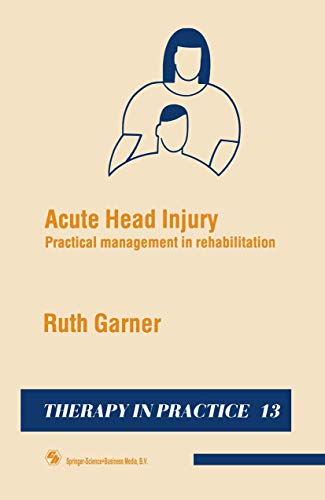
Acute Head Injury: Practical Management In Rehabilitation (Therapy In Practice Series): 13 - Tapa blanda
Sinopsis
It is both a pleasure and a privilege to be invited to contribute a foreword to this book, which deserves - and needs - to be read by virtually everyone who is concerned with the treatment and subse quent welfare of the victims of severe injuries of the brain. Some friends, relatives and workmates might be helped by reading some parts of it, but, if the book has the effect it deserves to have on therapists, nurses, doctors, and others working in both hospitals and the community, these laymen will be suitably informed and assisted by one or more members of the necessarily large therapeutic team. The improvements in methods of resuscitation that have taken place during the last 40 years or so have abolished the previously fatalistic readiness to accept that a week or two in coma after a head injury was virtually a sentence to death from pneumonia. After it had become possible to save lives it gradually became clear that survival of the patient was not necessarily followed by recovery of the brain and that the price of success, in saving lives, was a popula tion of cerebral cripples that was increasing at the rate of 1000 or more a year throughout the country. Although this figure has remained about the same for more than 20 years, there has been a great improvement in the amount of interest, the standard of care and the quality of results that are being achieved.
"Sinopsis" puede pertenecer a otra edición de este libro.
Reseña del editor
It is both a pleasure and a privilege to be invited to contribute a foreword to this book, which deserves - and needs - to be read by virtually everyone who is concerned with the treatment and subse quent welfare of the victims of severe injuries of the brain. Some friends, relatives and workmates might be helped by reading some parts of it, but, if the book has the effect it deserves to have on therapists, nurses, doctors, and others working in both hospitals and the community, these laymen will be suitably informed and assisted by one or more members of the necessarily large therapeutic team. The improvements in methods of resuscitation that have taken place during the last 40 years or so have abolished the previously fatalistic readiness to accept that a week or two in coma after a head injury was virtually a sentence to death from pneumonia. After it had become possible to save lives it gradually became clear that survival of the patient was not necessarily followed by recovery of the brain and that the price of success, in saving lives, was a popula tion of cerebral cripples that was increasing at the rate of 1000 or more a year throughout the country. Although this figure has remained about the same for more than 20 years, there has been a great improvement in the amount of interest, the standard of care and the quality of results that are being achieved.
Reseña del editor
Part of a series aimed at therapists concerned with rehabilitation in a very broad sense, this book is based upon the author's experiences as part of a team caring for victims of severe injuries of the brain paying particular attention to the disturbances of behaviour. The methods of pioneers in this field were based on recognizing that it is as necessary to stimulate an injured brain in order to help it to recover as it is to stimulate a normal brain to enable it to develop - a process that is referred to as "exercising the mental muscles". In this guide the author explains that therapists need to start treating patients while they are still receiving intensive care, and nurses in these units, as well as those in ordinary wards, need to know how closely their work should be intergrated with that of others. Although the book will be of particular interest to occupational and physical therapists, psychologists and a social workers it will also be of use to doctors as clear evidence of the range and duration of methods of treatment required and of the fact that they have a part to play long after the patients leave hospital.
"Sobre este título" puede pertenecer a otra edición de este libro.
Resultados de la búsqueda para Acute Head Injury: Practical Management In Rehabilitation...

Imagen de archivo
Acute Head Injury: Practical Management In Rehabilitation (Therapy In Practice Series)
Librería: Anybook.com, Lincoln, Reino Unido
Calificación del vendedor: 5 de 5 estrellas

Condición: Fair. This is an ex-library book and may have the usual library/used-book markings inside.This book has soft covers. In fair condition, suitable as a study copy. Please note the Image in this listing is a stock photo and may not match the covers of the actual item,300grams, ISBN:9780412324208. Nº de ref. del artículo: 8008447
Comprar usado
EUR 3,01
Envío por EUR 15,87
Se envía de Reino Unido a Estados Unidos de America
Se envía de Reino Unido a Estados Unidos de America
Cantidad disponible: 1 disponibles
Imagen de archivo
Acute Head Injury: Practical Management In Rehabilitation (Therapy In Practice Series)
Librería: Anybook.com, Lincoln, Reino Unido
Calificación del vendedor: 5 de 5 estrellas
Condición: Good. This is an ex-library book and may have the usual library/used-book markings inside.This book has soft covers. In good all round condition. Please note the Image in this listing is a stock photo and may not match the covers of the actual item,250grams, ISBN:9780412324208. Nº de ref. del artículo: 8008446
Comprar usado
EUR 3,01
Envío por EUR 15,87
Se envía de Reino Unido a Estados Unidos de America
Se envía de Reino Unido a Estados Unidos de America
Cantidad disponible: 1 disponibles
Imagen de archivo
Acute Head Injury
Publicado por
Chapman & Hall, London, 1990
ISBN 10: 0412324202
ISBN 13: 9780412324208
Antiguo o usado
paperback
Original o primera edición
Librería: PsychoBabel & Skoob Books, Didcot, Reino Unido
Calificación del vendedor: 5 de 5 estrellas
paperback. Condición: Good. First Edition. Ex-library: plastic cover; label on spine; glue mark and label on half title; ink stamps on title. Contents otherwise clean and sound throughout; minor wear/fading to cover. Ex Library. Nº de ref. del artículo: 196891
Comprar usado
EUR 9,58
Envío por EUR 14,59
Se envía de Reino Unido a Estados Unidos de America
Se envía de Reino Unido a Estados Unidos de America
Cantidad disponible: 1 disponibles
Imagen de archivo
Acute Head Injury (Paperback)
Publicado por
Oxford University Press, Oxford, 1990
ISBN 10: 0412324202
ISBN 13: 9780412324208
Nuevo
Paperback
Librería: Grand Eagle Retail, Bensenville, IL, Estados Unidos de America
Calificación del vendedor: 5 de 5 estrellas
Paperback. Condición: new. Paperback. Part of a series aimed at therapists concerned with rehabilitation in a very broad sense, this book is based upon the author's experiences as part of a team caring for victims of severe injuries of the brain paying particular attention to the disturbances of behaviour. The methods of pioneers in this field were based on recognizing that it is as necessary to stimulate an injured brain in order to help it to recover as it is to stimulate a normal brain to enable it to develop - a process that is referred to as "exercising the mental muscles". In this guide the author explains that therapists need to start treating patients while they are still receiving intensive care, and nurses in these units, as well as those in ordinary wards, need to know how closely their work should be intergrated with that of others. Although the book will be of particular interest to occupational and physical therapists, psychologists and a social workers it will also be of use to doctors as clear evidence of the range and duration of methods of treatment required and of the fact that they have a part to play long after the patients leave hospital. It is both a pleasure and a privilege to be invited to contribute a foreword to this book, which deserves - and needs - to be read by virtually everyone who is concerned with the treatment and subse quent welfare of the victims of severe injuries of the brain. This item is printed on demand. Shipping may be from multiple locations in the US or from the UK, depending on stock availability. Nº de ref. del artículo: 9780412324208
Comprar nuevo
EUR 68,53
Gastos de envío gratis
Se envía dentro de Estados Unidos de America
Se envía dentro de Estados Unidos de America
Cantidad disponible: 1 disponibles
Imagen de archivo
Acute Head Injury: Practical management in rehabilitation (Therapy in Practice Series)
Librería: Ria Christie Collections, Uxbridge, Reino Unido
Calificación del vendedor: 5 de 5 estrellas
Condición: New. In English. Nº de ref. del artículo: ria9780412324208_new
Comprar nuevo
EUR 59,30
Envío por EUR 10,93
Se envía de Reino Unido a Estados Unidos de America
Se envía de Reino Unido a Estados Unidos de America
Cantidad disponible: Más de 20 disponibles
Imagen de archivo
Acute Head Injury : Practical management in rehabilitation
Librería: Chiron Media, Wallingford, Reino Unido
Calificación del vendedor: 5 de 5 estrellas
PF. Condición: New. Nº de ref. del artículo: 6666-IUK-9780412324208
Comprar nuevo
EUR 56,95
Envío por EUR 18,07
Se envía de Reino Unido a Estados Unidos de America
Se envía de Reino Unido a Estados Unidos de America
Cantidad disponible: 10 disponibles
Imagen del vendedor
Acute Head Injury
Publicado por
Springer US, Humana Jan 1990, 1990
ISBN 10: 0412324202
ISBN 13: 9780412324208
Nuevo
Taschenbuch
Librería: BuchWeltWeit Ludwig Meier e.K., Bergisch Gladbach, Alemania
Calificación del vendedor: 5 de 5 estrellas
Taschenbuch. Condición: Neu. This item is printed on demand - it takes 3-4 days longer - Neuware -It is both a pleasure and a privilege to be invited to contribute a foreword to this book, which deserves - and needs - to be read by virtually everyone who is concerned with the treatment and subse quent welfare of the victims of severe injuries of the brain. Some friends, relatives and workmates might be helped by reading some parts of it, but, if the book has the effect it deserves to have on therapists, nurses, doctors, and others working in both hospitals and the community, these laymen will be suitably informed and assisted by one or more members of the necessarily large therapeutic team. The improvements in methods of resuscitation that have taken place during the last 40 years or so have abolished the previously fatalistic readiness to accept that a week or two in coma after a head injury was virtually a sentence to death from pneumonia. After it had become possible to save lives it gradually became clear that survival of the patient was not necessarily followed by recovery of the brain and that the price of success, in saving lives, was a popula tion of cerebral cripples that was increasing at the rate of 1000 or more a year throughout the country. Although this figure has remained about the same for more than 20 years, there has been a great improvement in the amount of interest, the standard of care and the quality of results that are being achieved. 152 pp. Englisch. Nº de ref. del artículo: 9780412324208
Comprar nuevo
EUR 53,49
Envío por EUR 23,00
Se envía de Alemania a Estados Unidos de America
Se envía de Alemania a Estados Unidos de America
Cantidad disponible: 2 disponibles
Imagen de archivo
Acute Head Injury
Librería: Books Puddle, New York, NY, Estados Unidos de America
Calificación del vendedor: 4 de 5 estrellas

Condición: New. pp. 152. Nº de ref. del artículo: 2699465390
Comprar nuevo
EUR 83,39
Envío por EUR 3,48
Se envía dentro de Estados Unidos de America
Se envía dentro de Estados Unidos de America
Cantidad disponible: 4 disponibles
Imagen de archivo
Acute Head Injury: Practical Management in Rehabilitation
Librería: Revaluation Books, Exeter, Reino Unido
Calificación del vendedor: 5 de 5 estrellas
Paperback. Condición: Brand New. 151 pages. 8.35x5.35x0.39 inches. In Stock. Nº de ref. del artículo: x-0412324202
Comprar nuevo
EUR 76,42
Envío por EUR 11,67
Se envía de Reino Unido a Estados Unidos de America
Se envía de Reino Unido a Estados Unidos de America
Cantidad disponible: 2 disponibles
Imagen de archivo
Acute Head Injury
Impresión bajo demandaLibrería: Majestic Books, Hounslow, Reino Unido
Calificación del vendedor: 4 de 5 estrellas
Condición: New. Print on Demand pp. 152 Illus. Nº de ref. del artículo: 93980529
Comprar nuevo
EUR 83,17
Envío por EUR 7,58
Se envía de Reino Unido a Estados Unidos de America
Se envía de Reino Unido a Estados Unidos de America
Cantidad disponible: 4 disponibles