
Artículos relacionados a Applications of Computer Aided Time Series Modeling:...
Applications of Computer Aided Time Series Modeling: 119 (Lecture Notes in Statistics, 119) - Tapa blanda
Sinopsis
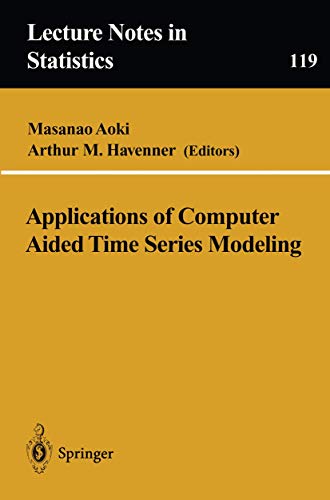
This book consists of three parts: Part One is composed of two introductory chapters. The first chapter provides an instrumental varible interpretation of the state space time series algorithm originally proposed by Aoki (1983), and gives an introductory account for incorporating exogenous signals in state space models. The second chapter, by Havenner, gives practical guidance in apply ing this algorithm by one of the most experienced practitioners of the method. Havenner begins by summarizing six reasons state space methods are advanta geous, and then walks the reader through construction and evaluation of a state space model for four monthly macroeconomic series: industrial production in dex, consumer price index, six month commercial paper rate, and money stock (Ml). To single out one of the several important insights in modeling that he shares with the reader, he discusses in Section 2ii the effects of sampling er rors and model misspecification on successful modeling efforts. He argues that model misspecification is an important amplifier of the effects of sampling error that may cause symplectic matrices to have complex unit roots, a theoretical impossibility. Correct model specifications increase efficiency of estimators and often eliminate this finite sample problem. This is an important insight into the positive realness of covariance matrices; positivity has been emphasized by system engineers to the exclusion of other methods of reducing sampling error and alleviating what is simply a finite sample problem. The second and third parts collect papers that describe specific applications.
"Sinopsis" puede pertenecer a otra edición de este libro.
Reseña del editor
This book consists of three parts: Part One is composed of two introductory chapters. The first chapter provides an instrumental varible interpretation of the state space time series algorithm originally proposed by Aoki (1983), and gives an introductory account for incorporating exogenous signals in state space models. The second chapter, by Havenner, gives practical guidance in apply ing this algorithm by one of the most experienced practitioners of the method. Havenner begins by summarizing six reasons state space methods are advanta geous, and then walks the reader through construction and evaluation of a state space model for four monthly macroeconomic series: industrial production in dex, consumer price index, six month commercial paper rate, and money stock (Ml). To single out one of the several important insights in modeling that he shares with the reader, he discusses in Section 2ii the effects of sampling er rors and model misspecification on successful modeling efforts. He argues that model misspecification is an important amplifier of the effects of sampling error that may cause symplectic matrices to have complex unit roots, a theoretical impossibility. Correct model specifications increase efficiency of estimators and often eliminate this finite sample problem. This is an important insight into the positive realness of covariance matrices; positivity has been emphasized by system engineers to the exclusion of other methods of reducing sampling error and alleviating what is simply a finite sample problem. The second and third parts collect papers that describe specific applications.
Reseña del editor
This text provides an introduction to state space modelling, discusses applications of state space modelling and discusses applications of neural networks.
"Sobre este título" puede pertenecer a otra edición de este libro.
Resultados de la búsqueda para Applications of Computer Aided Time Series Modeling:...

Imagen de archivo
Applications of Computer Aided Time Series Modeling (Lecture Notes in Statistics)
Librería: La bataille des livres, Pradinas, Francia
Calificación del vendedor: 5 de 5 estrellas

Condición: Très bon. Applications of Computer Aided Time Series Modeling (Lecture Notes in Statistics) | Aoki, Havenner | Springer, 1997. In-8° broché, 335p. Couverture propre. Dos solide. Intérieur frais. Exemplaire de bibliothèque : petit code barre en pied de 1re de couv., cotation au dos, rares et discrets petits tampons à l'intérieur de l'ouvrage. Très bon état général pour cet exemplaire. [Sh50+] Pour les expéditions internationales, nous consulter au préalable pour l ajustement des frais de port qui seront peut-être revus à la baisse/ For international shipments, please contact us in advance to adjust shipping costs. |. Nº de ref. del artículo: 89-TVGU-G8DA
Comprar usado
EUR 30,00
Envío por EUR 65,00
Se envía de Francia a Estados Unidos de America
Se envía de Francia a Estados Unidos de America
Cantidad disponible: 1 disponibles
Imagen del vendedor
Applications of Computer Aided Time Series Modeling
Publicado por
New York, NY : Springer, 1997
ISBN 10: 0387947515
ISBN 13: 9780387947518
Antiguo o usado
Tapa blanda
Librería: CSG Onlinebuch GMBH, Darmstadt, Alemania
Calificación del vendedor: 5 de 5 estrellas
Condición: Gut. Gebraucht - Gut * good, clean condition, no markings in text * -This book consists of three parts: Part One is composed of two introductory chapters. The first chapter provides an instrumental varible interpretation of the state space time series algorithm originally proposed by Aoki (1983), and gives an introductory account for incorporating exogenous signals in state space models. The second chapter, by Havenner, gives practical guidance in apply ing this algorithm by one of the most experienced practitioners of the method. Havenner begins by summarizing six reasons state space methods are advanta geous, and then walks the reader through construction and evaluation of a state space model for four monthly macroeconomic series: industrial production in dex, consumer price index, six month commercial paper rate, and money stock (Ml). To single out one of the several important insights in modeling that he shares with the reader, he discusses in Section 2ii the effects of sampling er rors and model misspecification on successful modeling efforts. He argues that model misspecification is an important amplifier of the effects of sampling error that may cause symplectic matrices to have complex unit roots, a theoretical impossibility. Correct model specifications increase efficiency of estimators and often eliminate this finite sample problem. This is an important insight into the positive realness of covariance matrices; positivity has been emphasized by system engineers to the exclusion of other methods of reducing sampling error and alleviating what is simply a finite sample problem. The second and third parts collect papers that describe specific applications. Nº de ref. del artículo: INF1000051897
Comprar usado
EUR 4,94
Envío por EUR 95,00
Se envía de Alemania a Estados Unidos de America
Se envía de Alemania a Estados Unidos de America
Cantidad disponible: 1 disponibles
Imagen de archivo
Applications of Computer Aided Time Series Modeling
Librería: GreatBookPrices, Columbia, MD, Estados Unidos de America
Calificación del vendedor: 5 de 5 estrellas
Condición: As New. Unread book in perfect condition. Nº de ref. del artículo: 18677486
Comprar usado
EUR 126,41
Envío por EUR 2,35
Se envía dentro de Estados Unidos de America
Se envía dentro de Estados Unidos de America
Cantidad disponible: 15 disponibles
Imagen del vendedor
Applications of Computer Aided Time Series Modeling
Publicado por
Springer, Springer Nov 1996, 1996
ISBN 10: 0387947515
ISBN 13: 9780387947518
Nuevo
Taschenbuch
Librería: BuchWeltWeit Ludwig Meier e.K., Bergisch Gladbach, Alemania
Calificación del vendedor: 5 de 5 estrellas
Taschenbuch. Condición: Neu. This item is printed on demand - it takes 3-4 days longer - Neuware -This book consists of three parts: Part One is composed of two introductory chapters. The first chapter provides an instrumental varible interpretation of the state space time series algorithm originally proposed by Aoki (1983), and gives an introductory account for incorporating exogenous signals in state space models. The second chapter, by Havenner, gives practical guidance in apply ing this algorithm by one of the most experienced practitioners of the method. Havenner begins by summarizing six reasons state space methods are advanta geous, and then walks the reader through construction and evaluation of a state space model for four monthly macroeconomic series: industrial production in dex, consumer price index, six month commercial paper rate, and money stock (Ml). To single out one of the several important insights in modeling that he shares with the reader, he discusses in Section 2ii the effects of sampling er rors and model misspecification on successful modeling efforts. He argues that model misspecification is an important amplifier of the effects of sampling error that may cause symplectic matrices to have complex unit roots, a theoretical impossibility. Correct model specifications increase efficiency of estimators and often eliminate this finite sample problem. This is an important insight into the positive realness of covariance matrices; positivity has been emphasized by system engineers to the exclusion of other methods of reducing sampling error and alleviating what is simply a finite sample problem. The second and third parts collect papers that describe specific applications. 352 pp. Englisch. Nº de ref. del artículo: 9780387947518
Comprar nuevo
EUR 106,99
Envío por EUR 23,00
Se envía de Alemania a Estados Unidos de America
Se envía de Alemania a Estados Unidos de America
Cantidad disponible: 2 disponibles
Imagen de archivo
Applications of Computer Aided Time Series Modeling
Librería: GreatBookPrices, Columbia, MD, Estados Unidos de America
Calificación del vendedor: 5 de 5 estrellas
Condición: New. Nº de ref. del artículo: 18677486-n
Comprar nuevo
EUR 134,33
Envío por EUR 2,35
Se envía dentro de Estados Unidos de America
Se envía dentro de Estados Unidos de America
Cantidad disponible: 15 disponibles
Imagen del vendedor
Applications of Computer Aided Time Series Modeling
Impresión bajo demandaLibrería: moluna, Greven, Alemania
Calificación del vendedor: 5 de 5 estrellas
Condición: New. Dieser Artikel ist ein Print on Demand Artikel und wird nach Ihrer Bestellung fuer Sie gedruckt. This book consists of three parts: Part One is composed of two introductory chapters. The first chapter provides an instrumental varible interpretation of the state space time series algorithm originally proposed by Aoki (1983), and gives an introductory ac. Nº de ref. del artículo: 5912175
Comprar nuevo
EUR 92,27
Envío por EUR 48,99
Se envía de Alemania a Estados Unidos de America
Se envía de Alemania a Estados Unidos de America
Cantidad disponible: Más de 20 disponibles
Imagen de archivo
Applications of Computer Aided Time Series Modeling (Lecture Notes in Statistics, 119)
Librería: Ria Christie Collections, Uxbridge, Reino Unido
Calificación del vendedor: 5 de 5 estrellas
Condición: New. In English. Nº de ref. del artículo: ria9780387947518_new
Comprar nuevo
EUR 129,58
Envío por EUR 13,31
Se envía de Reino Unido a Estados Unidos de America
Se envía de Reino Unido a Estados Unidos de America
Cantidad disponible: Más de 20 disponibles
Imagen del vendedor
Applications of Computer Aided Time Series Modeling
Impresión bajo demandaLibrería: AHA-BUCH GmbH, Einbeck, Alemania
Calificación del vendedor: 5 de 5 estrellas
Taschenbuch. Condición: Neu. nach der Bestellung gedruckt Neuware - Printed after ordering - This book consists of three parts: Part One is composed of two introductory chapters. The first chapter provides an instrumental varible interpretation of the state space time series algorithm originally proposed by Aoki (1983), and gives an introductory account for incorporating exogenous signals in state space models. The second chapter, by Havenner, gives practical guidance in apply ing this algorithm by one of the most experienced practitioners of the method. Havenner begins by summarizing six reasons state space methods are advanta geous, and then walks the reader through construction and evaluation of a state space model for four monthly macroeconomic series: industrial production in dex, consumer price index, six month commercial paper rate, and money stock (Ml). To single out one of the several important insights in modeling that he shares with the reader, he discusses in Section 2ii the effects of sampling er rors and model misspecification on successful modeling efforts. He argues that model misspecification is an important amplifier of the effects of sampling error that may cause symplectic matrices to have complex unit roots, a theoretical impossibility. Correct model specifications increase efficiency of estimators and often eliminate this finite sample problem. This is an important insight into the positive realness of covariance matrices; positivity has been emphasized by system engineers to the exclusion of other methods of reducing sampling error and alleviating what is simply a finite sample problem. The second and third parts collect papers that describe specific applications. Nº de ref. del artículo: 9780387947518
Comprar nuevo
EUR 114,00
Envío por EUR 35,00
Se envía de Alemania a Estados Unidos de America
Se envía de Alemania a Estados Unidos de America
Cantidad disponible: 1 disponibles
Imagen de archivo
Applications of Computer Aided Time Series Modeling
Librería: Books Puddle, Woodside, NY, Estados Unidos de America
Calificación del vendedor: 4 de 5 estrellas

Condición: New. pp. 352. Nº de ref. del artículo: 262579883
Comprar nuevo
EUR 157,52
Envío por EUR 3,55
Se envía dentro de Estados Unidos de America
Se envía dentro de Estados Unidos de America
Cantidad disponible: 4 disponibles
Imagen del vendedor
Applications of Computer Aided Time Series Modeling
Publicado por
Springer, Springer Nov 1996, 1996
ISBN 10: 0387947515
ISBN 13: 9780387947518
Nuevo
Taschenbuch
Librería: buchversandmimpf2000, Emtmannsberg, BAYE, Alemania
Calificación del vendedor: 5 de 5 estrellas
Taschenbuch. Condición: Neu. This item is printed on demand - Print on Demand Titel. Neuware -This book consists of three parts: Part One is composed of two introductory chapters. The first chapter provides an instrumental varible interpretation of the state space time series algorithm originally proposed by Aoki (1983), and gives an introductory account for incorporating exogenous signals in state space models. The second chapter, by Havenner, gives practical guidance in apply ing this algorithm by one of the most experienced practitioners of the method. Havenner begins by summarizing six reasons state space methods are advanta geous, and then walks the reader through construction and evaluation of a state space model for four monthly macroeconomic series: industrial production in dex, consumer price index, six month commercial paper rate, and money stock (Ml). To single out one of the several important insights in modeling that he shares with the reader, he discusses in Section 2ii the effects of sampling er rors and model misspecification on successful modeling efforts. He argues that model misspecification is an important amplifier of the effects of sampling error that may cause symplectic matrices to have complex unit roots, a theoretical impossibility. Correct model specifications increase efficiency of estimators and often eliminate this finite sample problem. This is an important insight into the positive realness of covariance matrices; positivity has been emphasized by system engineers to the exclusion of other methods of reducing sampling error and alleviating what is simply a finite sample problem. The second and third parts collect papers that describe specific applications.Springer-Verlag KG, Sachsenplatz 4-6, 1201 Wien 352 pp. Englisch. Nº de ref. del artículo: 9780387947518
Comprar nuevo
EUR 106,99
Envío por EUR 60,00
Se envía de Alemania a Estados Unidos de America
Se envía de Alemania a Estados Unidos de America
Cantidad disponible: 1 disponibles