
Artículos relacionados a The Simple Science of Flight, revised and expanded...
The Simple Science of Flight, revised and expanded edition: From Insects to Jumbo Jets - Tapa blanda
Sinopsis
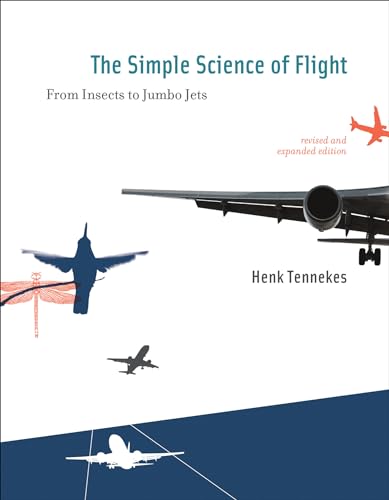
An investigation into how machines and living creatures fly, and of the similarities between butterflies and Boeings, paper airplanes and plovers.
From the smallest gnat to the largest aircraft, all things that fly obey the same aerodynamic principles. In The Simple Science of Flight, Henk Tennekes investigates just how machines and creatures fly: what size wings they need, how much energy is required for their journeys, how they cross deserts and oceans, how they take off, climb, and soar. Fascinated by the similarities between nature and technology, Tennekes offers an introduction to flight that teaches by association. Swans and Boeings differ in numerous ways, but they follow the same aerodynamic principles. Biological evolution and its technical counterpart exhibit exciting parallels. What makes some airplanes successful and others misfits? Why does the Boeing 747 endure but the Concorde now seem a fluke? Tennekes explains the science of flight through comparisons, examples, equations, and anecdotes. The new edition of this popular book has been thoroughly revised and much expanded. Highlights of the new material include a description of the incredible performance of bar-tailed godwits (7,000 miles nonstop from Alaska to New Zealand), an analysis of the convergence of modern jetliners (from both Boeing and Airbus), a discussion of the metabolization of energy featuring Lance Armstrong, a novel treatment of the aerodynamics of drag and trailing vortices, and an emphasis throughout on evolution, in nature and in engineering. Tennekes draws on new evidence on bird migration, new wind-tunnel studies, and data on new airliners. And his analysis of the relative efficiency of planes, trains, and automobiles is newly relevant. (On a cost-per-seat scale, a 747 is more efficient than a passenger car.)
"Sinopsis" puede pertenecer a otra edición de este libro.
Acerca del autor
Henk Tennekes is Director of Research Emeritus at the Royal Netherlands Meteorological Institute, Emeritus Professor of Meteorology at the Free University (VU) in Amsterdam, and Emeritus Professor of Aerospace Engineering at Pennsylvania State University. He is the coauthor of A First Course in Turbulence (MIT Press, 1972).
"Sobre este título" puede pertenecer a otra edición de este libro.
Resultados de la búsqueda para The Simple Science of Flight, revised and expanded...

Imagen de archivo
The Simple Science of Flight, revised and expanded edition: From Insects to Jumbo Jets (The MIT Press)
Publicado por
The MIT Press, 2009
ISBN 10: 0262513137
ISBN 13: 9780262513135
Antiguo o usado
Paperback
Librería: HPB-Red, Dallas, TX, Estados Unidos de America
Calificación del vendedor: 5 de 5 estrellas

Paperback. Condición: Good. Connecting readers with great books since 1972! Used textbooks may not include companion materials such as access codes, etc. May have some wear or writing/highlighting. We ship orders daily and Customer Service is our top priority! Nº de ref. del artículo: S_473684013
Comprar usado
EUR 5,52
Envío por EUR 3,35
Se envía dentro de Estados Unidos de America
Se envía dentro de Estados Unidos de America
Cantidad disponible: 1 disponibles
Imagen de archivo
The Simple Science of Flight: From Insects to Jumbo Jets (MIT Press)
Publicado por
The MIT Press, 2009
ISBN 10: 0262513137
ISBN 13: 9780262513135
Antiguo o usado
Paperback
Librería: Half Price Books Inc., Dallas, TX, Estados Unidos de America
Calificación del vendedor: 5 de 5 estrellas
Paperback. Condición: Very Good. Connecting readers with great books since 1972! Used books may not include companion materials, and may have some shelf wear or limited writing. We ship orders daily and Customer Service is our top priority! Nº de ref. del artículo: S_473517108
Comprar usado
EUR 6,20
Envío por EUR 3,35
Se envía dentro de Estados Unidos de America
Se envía dentro de Estados Unidos de America
Cantidad disponible: 1 disponibles
Imagen del vendedor
The Simple Science of Flight, revised and expanded edition: From Insects to Jumbo Jets (Mit Press)
Publicado por
The MIT Press, 2009
ISBN 10: 0262513137
ISBN 13: 9780262513135
Antiguo o usado
Tapa blanda
Librería: Goodbookscafe, Macon, GA, Estados Unidos de America
Calificación del vendedor: 5 de 5 estrellas
Condición: good. Used may have minimal highlights, annotations, creases, curled corners, writing on some pages, discoloration, dust from shelves, may need batteries. Nº de ref. del artículo: MGV.0262513137.G
Comprar usado
EUR 9,19
Envío por EUR 3,56
Se envía dentro de Estados Unidos de America
Se envía dentro de Estados Unidos de America
Cantidad disponible: 1 disponibles
Imagen de archivo
Simple Science of Flight : From Insects to Jumbo Jets
Librería: Vashon Island Books, Vashon, WA, Estados Unidos de America
Calificación del vendedor: 5 de 5 estrellas
Paperback. Condición: Very Good. Later Printing. 4to - over 9¾" - 12" Tall. Nº de ref. del artículo: 0851455
Comprar usado
EUR 9,15
Envío por EUR 4,91
Se envía dentro de Estados Unidos de America
Se envía dentro de Estados Unidos de America
Cantidad disponible: 1 disponibles
Imagen de archivo
The Simple Science of Flight, revised and expanded edition: From Insects to Jumbo Jets (The MIT Press)
Publicado por
The MIT Press, 2009
ISBN 10: 0262513137
ISBN 13: 9780262513135
Antiguo o usado
paperback
Librería: Books From California, Simi Valley, CA, Estados Unidos de America
Calificación del vendedor: 4 de 5 estrellas

paperback. Condición: Very Good. Nº de ref. del artículo: mon0004010648
Comprar usado
EUR 11,92
Envío por EUR 4,45
Se envía dentro de Estados Unidos de America
Se envía dentro de Estados Unidos de America
Cantidad disponible: 5 disponibles
Imagen de archivo
The Simple Science of Flight, revised and expanded edition: From Insects to Jumbo Jets (The MIT Press)
Publicado por
The MIT Press, 2009
ISBN 10: 0262513137
ISBN 13: 9780262513135
Antiguo o usado
paperback
Librería: Books From California, Simi Valley, CA, Estados Unidos de America
Calificación del vendedor: 4 de 5 estrellas
paperback. Condición: Fine. Nº de ref. del artículo: mon0003668183
Comprar usado
EUR 17,81
Envío por EUR 4,45
Se envía dentro de Estados Unidos de America
Se envía dentro de Estados Unidos de America
Cantidad disponible: 1 disponibles
Imagen del vendedor
Simple Science of Flight : From Insects to Jumbo Jets
Librería: GreatBookPrices, Columbia, MD, Estados Unidos de America
Calificación del vendedor: 5 de 5 estrellas
Condición: New. Nº de ref. del artículo: 6241043-n
Comprar nuevo
EUR 21,83
Envío por EUR 2,36
Se envía dentro de Estados Unidos de America
Se envía dentro de Estados Unidos de America
Cantidad disponible: 1 disponibles
Imagen del vendedor
The Simple Science of Flight
Librería: Rarewaves USA, HEBRON, KY, Estados Unidos de America
Calificación del vendedor: 5 de 5 estrellas
Paperback. Condición: New. revised and expanded edition. An investigation into how machines and living creatures fly, and of the similarities between butterflies and Boeings, paper airplanes and plovers.From the smallest gnat to the largest aircraft, all things that fly obey the same aerodynamic principles. In The Simple Science of Flight, Henk Tennekes investigates just how machines and creatures fly: what size wings they need, how much energy is required for their journeys, how they cross deserts and oceans, how they take off, climb, and soar. Fascinated by the similarities between nature and technology, Tennekes offers an introduction to flight that teaches by association. Swans and Boeings differ in numerous ways, but they follow the same aerodynamic principles. Biological evolution and its technical counterpart exhibit exciting parallels. What makes some airplanes successful and others misfits? Why does the Boeing 747 endure but the Concorde now seem a fluke? Tennekes explains the science of flight through comparisons, examples, equations, and anecdotes. The new edition of this popular book has been thoroughly revised and much expanded. Highlights of the new material include a description of the incredible performance of bar-tailed godwits (7,000 miles nonstop from Alaska to New Zealand), an analysis of the convergence of modern jetliners (from both Boeing and Airbus), a discussion of the metabolization of energy featuring Lance Armstrong, a novel treatment of the aerodynamics of drag and trailing vortices, and an emphasis throughout on evolution, in nature and in engineering. Tennekes draws on new evidence on bird migration, new wind-tunnel studies, and data on new airliners. And his analysis of the relative efficiency of planes, trains, and automobiles is newly relevant. (On a cost-per-seat scale, a 747 is more efficient than a passenger car.). Nº de ref. del artículo: LU-9780262513135
Comprar nuevo
EUR 24,24
Gastos de envío gratis
Se envía dentro de Estados Unidos de America
Se envía dentro de Estados Unidos de America
Cantidad disponible: Más de 20 disponibles
Imagen de archivo
The Simple Science of Flight (Paperback)
Publicado por
MIT Press Ltd, Cambridge, Mass., 2009
ISBN 10: 0262513137
ISBN 13: 9780262513135
Nuevo
Paperback
Librería: Grand Eagle Retail, Bensenville, IL, Estados Unidos de America
Calificación del vendedor: 5 de 5 estrellas
Paperback. Condición: new. Paperback. An investigation into how machines and living creatures fly, and of the similarities between butterflies and Boeings, paper airplanes and plovers.From the smallest gnat to the largest aircraft, all things that fly obey the same aerodynamic principles. In The Simple Science of Flight, Henk Tennekes investigates just how machines and creatures fly: what size wings they need, how much energy is required for their journeys, how they cross deserts and oceans, how they take off, climb, and soar. Fascinated by the similarities between nature and technology, Tennekes offers an introduction to flight that teaches by association. Swans and Boeings differ in numerous ways, but they follow the same aerodynamic principles. Biological evolution and its technical counterpart exhibit exciting parallels. What makes some airplanes successful and others misfits? Why does the Boeing 747 endure but the Concorde now seem a fluke? Tennekes explains the science of flight through comparisons, examples, equations, and anecdotes. The new edition of this popular book has been thoroughly revised and much expanded. Highlights of the new material include a description of the incredible performance of bar-tailed godwits (7,000 miles nonstop from Alaska to New Zealand), an analysis of the convergence of modern jetliners (from both Boeing and Airbus), a discussion of the metabolization of energy featuring Lance Armstrong, a novel treatment of the aerodynamics of drag and trailing vortices, and an emphasis throughout on evolution, in nature and in engineering. Tennekes draws on new evidence on bird migration, new wind-tunnel studies, and data on new airliners. And his analysis of the relative efficiency of planes, trains, and automobiles is newly relevant. (On a cost-per-seat scale, a 747 is more efficient than a passenger car.) An investigation into how machines and living creatures fly, and of the similarities between butterflies and Boeings, paper airplanes and plovers. Shipping may be from multiple locations in the US or from the UK, depending on stock availability. Nº de ref. del artículo: 9780262513135
Comprar nuevo
EUR 24,25
Gastos de envío gratis
Se envía dentro de Estados Unidos de America
Se envía dentro de Estados Unidos de America
Cantidad disponible: 1 disponibles
Imagen de archivo
Simple Science of Flight: From Insects to Jumbo Jets (The MIT Press) (The Simple Science of Flight)
Librería: Chiron Media, Wallingford, Reino Unido
Calificación del vendedor: 5 de 5 estrellas
paperback. Condición: New. Brand new book, sourced directly from publisher. Dispatch time is 6-7 days from our warehouse. Book will be sent in robust, secure packaging to ensure it reaches you securely. Nº de ref. del artículo: 6666-MAC-9780262513135
Comprar nuevo
EUR 20,75
Envío por EUR 5,91
Se envía de Reino Unido a Estados Unidos de America
Se envía de Reino Unido a Estados Unidos de America
Cantidad disponible: 10 disponibles