
Artículos relacionados a Do the Right Thing: Studies in Limited Rationality...
Sinopsis
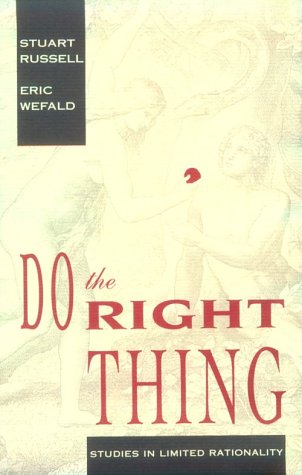
Like Mooki, the hero of Spike Lee's film "Do the Right Thing," artificially intelligent systems have a hard time knowing what to do in all circumstances. Classical theories of perfect rationality prescribe the "right thing" for any occasion, but no finite agent can compute their prescriptions fast enough. In Do the Right Thing, the authors argue that a new theoretical foundation for artificial intelligence can be constructed in which rationality is a property of "programs" within a finite architecture, and their behavior over time in the task environment, rather than a property of individual decisions.
Do the Right Thing suggests that the rich structure that seems to be exhibited by humans, and ought to be exhibited by AI systems, is a necessary result of the pressure for optimal behavior operating within a system of strictly limited resources. It provides an outline for the design of new intelligent systems and describes theoretical and practical tools for bringing about intelligent behavior in finite machines. The tools are applied to game planning and realtime problem solving, with surprising results.
"Sinopsis" puede pertenecer a otra edición de este libro.
Reseña del editor
Like Mooki, the hero of Spike Lee's film "Do the Right Thing" artificially, intelligent systems have a hard time knowing what to do in all circumstances. Classical theories of perfect rationality prescribe the "right thing" for any occasion, but no finite agent can compute their prescriptions fast enough. In "Do the Right Thing", the authors argue that a new theoretical foundation for artificial intelligence can be constructed in which rationality is a property of "programs" within a finite architecture, and their behaviour over time in the task environment, rather than a property of individual decisions. "Do The Right Thing" suggests that the rich structure that seems to be exhibited by humans, and ought to be exhibited by AI systems, is a necessary result of the pressure for optimal behaviour operating within a system of strictly limited resources. It provides an outline for the design of new intelligent systems and describes theoretical and practical tools for bringing about intelligent behaviour in finite machines. The tools are applied to game planning and real-time problem solving, with surprising results.
"Sobre este título" puede pertenecer a otra edición de este libro.
Resultados de la búsqueda para Do the Right Thing: Studies in Limited Rationality...

Imagen de archivo
Do the right thing : studies in limited rationality.
Librería: Kloof Booksellers & Scientia Verlag, Amsterdam, Holanda
Calificación del vendedor: 4 de 5 estrellas

Condición: as new. Cambridge, MA : M.I.T. Press, 1991. Hardcover. Dustjacket. xx,200 pp. - Like Mooki, the hero of Spike Lee's film "Do the Right Thing," artificially intelligent systems have a hard time knowing what to do in all circumstances. Classical theories of perfect rationality prescribe the "right thing" for any occasion, but no finite agent can compute their prescriptions fast enough. In Do the Right Thing, the authors argue that a new theoretical foundation for artificial intelligence can be constructed in which rationality is a property of "programs" within a finite architecture, and their behavior over time in the task environment, rather than a property of individual decisions. Do the Right Thing suggests that the rich structure that seems to be exhibited by humans, and ought to be exhibited by AI systems, is a necessary result of the pressure for optimal behavior operating within a system of strictly limited resources. It provides an outline for the design of new intelligent systems and describes theoretical and practical tools for bringing about intelligent behavior in finite machines. The tools are applied to game planning and real-time problem solving, with surprising results. Condition : as new copy. ISBN 9780262181440. Keywords : PHILOSOPHY, *2018-20 philosophy. Nº de ref. del artículo: 268128
Comprar usado
EUR 16,95
Envío por EUR 30,00
Se envía de Holanda a Estados Unidos de America
Se envía de Holanda a Estados Unidos de America
Cantidad disponible: 1 disponibles
Imagen del vendedor
Do the Right Thing: Studies in Limited Rationality (Artificial Intelligence)
Librería: -OnTimeBooks-, Phoenix, AZ, Estados Unidos de America
Calificación del vendedor: 5 de 5 estrellas

Condición: good. A copy that has been read, remains in good condition. All pages are intact, and the cover is intact. The spine and cover show signs of wear. Pages can include notes and highlighting and show signs of wear, and the copy can include "From the library of" labels or previous owner inscriptions. 100% GUARANTEE! Shipped with delivery confirmation, if you're not satisfied with purchase please return item! Ships via media mail. Nº de ref. del artículo: OTV.0262181444.G
Comprar usado
EUR 90,02
Gastos de envío gratis
Se envía dentro de Estados Unidos de America
Se envía dentro de Estados Unidos de America
Cantidad disponible: 1 disponibles
Imagen de archivo
Do the Right Thing: Studies in Limited Rationality (Artificial Intelligence)
Librería: SHIMEDIA, Brooklyn, NY, Estados Unidos de America
Calificación del vendedor: 4 de 5 estrellas
Condición: New. Satisfaction Guaranteed or your money back. Nº de ref. del artículo: 0262181444
Comprar nuevo
EUR 90,49
Gastos de envío gratis
Se envía dentro de Estados Unidos de America
Se envía dentro de Estados Unidos de America
Cantidad disponible: 1 disponibles