
Artículos relacionados a Social Security Policy in a Changing Environment (National...
Social Security Policy in a Changing Environment (National Bureau of Economic Research Conference Report) - Tapa dura
Libro 75 de 139: National Bureau of Economic Research Conference Report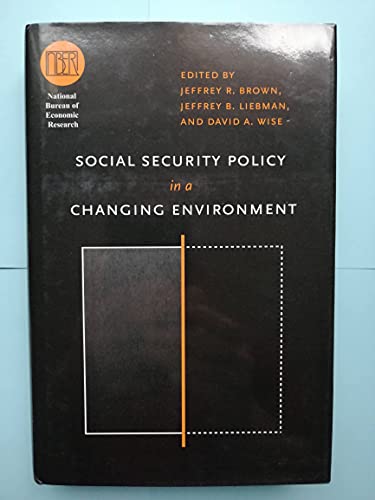
Sinopsis
This volume analyzes the changing economic and demographic environment in which social insurance programs benefiting elderly households will operate. It also explores how these ongoing trends will affect future beneficiaries, under both the current Social Security program and potential reform options. An esteemed group of economists probes the challenge posed to Social Security by an aging population. The researchers examine trends in private sector retirement saving and health care costs, as well as the uncertain nature of future demographic, economic, and social trends - including marriage and divorce rates and female participation in the labor force. Recognizing the ambiguity of the environment in which the Social Security system must operate and evolve, this landmark book explores factors that policy makers must consider in designing policies that are resilient enough to survive in an economically and demographically uncertain society.
"Sinopsis" puede pertenecer a otra edición de este libro.
Acerca del autor
Jeffrey R. Brown is the William G. Karnes Professor in the Department of Finance and director of the Center for Business and Public Policy in the College of Business at the University of Illinois at Urbana-Champaign. He also serves as associate director of the NBER Retirement Research Center. Jeffrey B. Liebman is Malcolm Wiener Professor of Public Policy at the Kennedy School of Government, Harvard University, and a research associate of the NBER. David A. Wise is the John F. Stambaugh Professor of Political Economy at the Kennedy School of Government, Harvard University, and director of the programs on aging and health care at the NBER.
Fragmento. © Reproducción autorizada. Todos los derechos reservados.
Social Security Policy in a Changing Environment
The University of Chicago Press
Copyright © 2009 National Bureau of Economic ResearchAll right reserved.
ISBN: 978-0-226-07648-5
Contents
Acknowledgments...............................................................................................................................................xiIntroduction Jeffrey R. Brown, Jeffrey Liebman, and David A. Wise............................................................................................11. Removing the Disincentives in Social Security for Long Careers.............................................................................................212. Notional Defined Contribution Pension Systems in a Stochastic Context: Design and Stability................................................................433. Reforming Social Security with Progressive Personal Accounts...............................................................................................734. Who Chooses Defined Contribution Plans?....................................................................................................................1315. The Importance of Default Options for Retirement Saving Outcomes: Evidence from the United States..........................................................1676. Reducing the Risk of Investment-Based Social Security Reform...............................................................................................2017. Pricing Personal Account Benefit Guarantees: A Simplified Approach.........................................................................................2298. Reducing Social Security PRA Risk at the Individual Level: Life-Cycle Funds and No-Loss Strategies.........................................................2559. Changing Progressivity as a Means of Risk Protection in Investment-Based Social Security...................................................................29910. The Decline of Defined Benefit Retirement Plans and Asset Flows...........................................................................................33311. Demographic Change, Relative Factor Prices, International Capital Flows, and Their Differential Effects on the Welfare of Generations.....................38512. Is the U.S. Population Behaving Healthier?................................................................................................................423Contributors..................................................................................................................................................447Author Index..................................................................................................................................................451Subject Index.................................................................................................................................................455
Chapter One
Removing the Disincentives in Social Security for Long Careers Gopi Shah Goda, John B. Shoven, and Sita Nataraj Slavov
1.1 Introduction
When Social Security was instituted in 1935, the period life expectancy at age twenty for males was sixty-six and for females sixty-nine. Today, twenty-year-old males have a period life expectancy of seventy-six and females eighty. This increase in life expectancy has been accompanied by a corresponding improvement in health at all ages. Cutler, Liebman, and Smyth (2007) find that, in terms of mortality, men at age sixty-eight in 2000 have roughly the same mortality risk as men at age sixty-two in 1960. Thus, at a same age, men in the year 2000 are roughly six years younger. In terms of self-assessed health status, they find that the difference is even larger, approximately ten years. Their bottom line is, "Our best guess is that people aged 62 in the 1960s are in equivalent health to people aged 70 or more today" (p. 14). In related work, Shoven (2004) suggests that the age of elderly people is more appropriately measured by remaining life expectancy than by years since birth.
These improvements in life expectancy and health status enable individuals to prolong their careers and delay retirement. However, the length of retirement has actually grown by more than the increase in life expectancy at retirement. Figure 1.1 shows labor force participation rates by age in 1965 and 2003. Both early retirees and median retirees are retiring earlier in 2003 than they were in 1965. Figure 1.2 displays labor force participation rates by remaining life expectancy rather than age and shows that the average length of retirement for men has increased almost 50 percent since 1965. In 1965, the average length of retirement for the median male retiree was thirteen years. By 2003, it was nineteen years. Roughly half of the additional years were due to improvements in life expectancy, and half were due to earlier retirement.
Individuals may choose to use increases in their life expectancy for additional leisure or additional consumption, and it is possible that the shift toward longer retirements is optimal. However, there are a number of features of Social Security that distort incentives toward increased retirement length by imposing high implicit tax rates on longer careers and working at older ages. For example, Social Security benefits are computed based on the average of an individual's highest thirty-five years of earnings. An individual with fewer than thirty-five years of earnings has a relatively strong incentive to work for an additional year as the additional earnings clearly raise the average upon which the benefit is based. On the other hand, an individual who has already worked for thirty-five years has a diminished incentive to work an additional year-the earnings from that year will, at best, replace one of the previous highest thirty-five in the benefit computation. Thus, the benefit formula encourages careers of thirty-five years or less. Several other features of the benefit computation-which we will discuss in detail in the following-contribute to the disincentives for long careers.
In this chapter, we examine the disincentives for long careers created by Social Security. Our main finding is that the structure of these programs imposes high implicit tax rates on workers late in their careers. As a result of this distortion, we believe retirements are suboptimally long. The consequences of this distortion are significant: a lot of the stress on public and private pension systems is caused by the increased length of retirement. We also outline ways to reduce or eliminate the implicit taxes on long careers and working at older ages. The potential benefits of a larger work force for Social Security and Medicare (and gross domestic product [GDP]) are large.
1.2 Work Incentives in U.S. Social Security
In this section, we investigate the impact of Old Age and Survivors Insurance (OASI) on the career-length incentives of both stylized and actual workers. In each year of their working life, we compute the workers' present value of Social Security taxes minus benefits under the assumption that they stop working after the current year (i.e., they accumulate no further earnings). The implicit Social Security tax rate is defined as the increase in the net tax burden from working an additional year as a percentage of the current year's earnings. In other words, this is the additional net tax the worker incurs by prolonging his or her career by one year. This variable captures the worker's incentive to continue working for an additional year as opposed to retiring. Throughout our analysis, OASI benefits are computed under 2005 law. That is, we sum each worker's highest thirty-five years of wage-indexed earnings that fall below the earnings cap and divide this amount by 420 months to get the worker's average indexed monthly earnings (AIME). We then compute the worker's primary insurance amount (PIA): the PIA is equal to 90 percent of the first $x of AIME, plus 32 percent of the amount between $x and $y, plus 15 percent of the remainder of AIME, where x and y are the constructed bend points for the appropriate retirement year. The worker receives the PIA-indexed for inflation-every month from retirement until death. A minimum of ten years of work is required to qualify for any benefits. In computing taxes and benefits, we assume an aggregate wage growth rate of 3.5 percent, an inflation rate of 2.5 percent, and a discount rate of 4.5 percent. The OASI tax rate is assumed to be 10.6 percent applied to capped earnings using the historical earnings caps. Benefit streams are discounted for mortality using the Social Security Administration's intermediate scenario mortality rates.
Our analysis is similar to that of Feldstein and Samwick (1992). Feldstein and Samwick compute marginal net tax rates for stylized workers who vary by gender, income, and marital status. They show that the additional tax paid on an additional dollar of income varies significantly across workers and over a worker's lifetime-in particular, marginal tax rates are significantly higher for single workers and for younger workers. Their finding that marginal tax rates decline with age comes from the fact that as a worker approaches retirement, the present value of the additional benefit received increases. However, they only compute marginal tax rates for workers between ages twenty-five and sixty, and each year of earnings over this thirty-five-year period is assumed to count in the benefit computation. This assumption overlooks a major disincentive for long careers: after a worker has accumulated thirty-five years of earnings, additional years are likely to have little, if any, impact on benefits. As we will show in the following, taking account of this fact implies that older workers face significantly higher implicit tax rates than younger workers.
1.2.1 A Stylized Computation
To illustrate our argument, we compute implicit tax rates for a set of four male stylized workers under current law. Three of our stylized workers receive simulated earnings profiles equal to either the average, 10th percentile, or 90th percentile earnings for their age group. In order to simulate wage histories, we use Outgoing Rotation Groups from the 2001 and 2002 Current Population Survey to compute the wage for each of the three earnings levels within each age group. We then divide this by the aggregate average wage across all age groups. This ratio is multiplied by the historical average wage in each year of the worker's life to arrive at a wage for the worker. For example, consider an average male thirty-year-old worker in 1950. The national average annual wage in 1950 was $2,763. According to our computations, a thirty-year-old male earns 1.13 times the national average; therefore, his simulated wage would be $2,763 X 1.13 = $3,122. A fourth stylized worker earns the historical earnings cap in each year.
We assume that all stylized workers start work at age twenty and retire at the normal retirement age. The implicit Social Security tax rate for a given career length is calculated as described previously. The results of this exercise are shown in figure 1.3. Note that for less than ten years of work, the worker is not yet vested in the system and, therefore, faces an implicit tax rate of the full 10.6 percent. (These years are not shown in figure 1.3.)
Two points should be clear from the graph. First, all workers experience a sharp increase in their implicit tax rate at thirty-five years of work. The reason for this increase is that Social Security benefits are calculated based on the highest thirty-five years of indexed annual earnings. This means that the thirty-third, thirty-fourth, and thirty-fifth year of work noticeably improve retirement benefits because the earnings of that year replace a zero in the calculation of average indexed monthly earnings (AIME). On the other hand, the thirty-sixth year of work may or may not enter the calculation, and if it does, it will replace a lower year of earnings and not a zero in the calculation. The marginal incentive to work for the thirty-sixth year and beyond is much lower than for the first thirty-five years. Part-time work after a career of thirty-five years or more will, in particular, usually have no impact on subsequent benefits, and, therefore, the 10.6 percent OASI payroll tax is simply a tax and has no component of deferred benefits. For people who enter the workforce immediately after high school and who do not leave the labor force for an extended period, thirty-five years of earnings will be accumulated by the age of fifty-three.
Second, the median and low earners each experience a sharp increase in their implicit tax rate earlier in their careers-for the middle-income earner, after twelve years of work, and for the low-income earner, after twenty-two years of work. This increase results from the fact that the PIA formula is sharply progressive, combined with the fact that the AIME calculation does not distinguish between workers with lower earnings and those with higher earnings but shorter covered careers. At the beginning of their careers, workers tend to have a low AIME because they have significantly fewer than thirty-five years of positive earnings. The benefit computation replaces the missing years of earnings with zeros, and these workers appear to be in a lower income group than their true lifetime earnings would imply. The progressivity of the PIA formula translates this low AIME into a disproportionately high monthly benefit. As workers accumulate positive earnings years, the benefit computation begins to treat them as if they have higher lifetime incomes. A sharp increase in the implicit tax rate occurs when a worker accumulates enough positive earnings years to cross a PIA bend point. Thus, the current formula favors workers with short careers by treating them as if they were low earners. In some cases, for instance, where the short career was necessitated by poor health, that may be appropriate. In most cases, however, the current treatment seems inappropriate and blunts the incentive to work long careers. This effect is most pronounced for low-income workers, who face the sharpest increase in their implicit tax rate.
These distortions lead us to evaluate the following three reforms:
1. Use forty years, rather than thirty-five, in the AIME computation.
If forty years were used instead of thirty-five, this would remove some of the discouragement currently built into the system for staying in the workforce. An extra five years of work would count toward the calculation of retirement benefits.
2. Disentangle career length and progressivity.
Average indexed monthly earnings could be calculated only for the months with covered earnings (eliminating the zeros from the computation and dividing by the number of months of nonzero earnings rather than 420). The PIA would be calculated using this modified AIME formula. However, a single person would only get the full PIA at the Normal Retirement Age (NRA) if they worked a full career (currently thirty-five years, proposed to be forty years under the first reform). If they worked fewer years, their benefits would be reduced proportionately. For example, consider how we currently treat someone with a ten-year high-income career. Their benefits are determined as if they were a relative low earner with the twenty-five years of zeros in the earnings calculation. The alternative would be to give them 10/35ths of the PIA of a high earner. This would result in a reduction of benefits for short career workers. This reform is illustrated in figure 1.4.
3. Establish a "paid-up" category of workers who have more than forty years of contributions.
Under the first proposed reform, the number of years in the benefit calculation is forty. A complementary policy is to only collect forty years of payroll taxes from workers. After forty years of covered employment, the worker would be declared "paid-up" for Social Security. This should be relatively easy to administer-conceivably an indicator would be added to the individual's Social Security number reflecting the fact that paid-up status had been achieved. A related idea was mentioned in Burtless and Quinn (2002), namely allowing workers who reach the NRA to opt out of additional Social Security contributions.
There is a theoretical justification for these policies. The intuition of optimal tax theory would be to place heavier taxes on more inelastic supply (and demand) and lighter taxes or no taxes on highly elastic behavior. Our hypothesis is that the forty-first and forty-second years of work, for instance, are far more sensitive to incentives than the twenty-first and twenty-second years of work. The practical significance of these three reforms is to make employment of veteran workers more attractive for both the employee and the employer.
Taken together, these three proposals result in a benefit cut. In order to compensate for this and keep the reforms benefit-neutral in aggregate, we increase retirement benefits proportionately in order to keep aggregate benefits constant before and after the reforms. Assuming no behavioral changes, the adjustment needed is a 19.4 percent increase in benefits. The proposals also result in redistribution from those with shorter careers to those with longer ones. Figure 1.5 illustrates this by depicting our stylized average earner's PIA, as a function of career length, under both the current and the proposed law. Under the proposed law, a worker's PIA would rise more sharply as he or she accumulated years of work-that is, benefits are more responsive to a decision to delay retirement. Workers with fewer than thirty-one years of covered earnings would receive a smaller PIA than under the current system; however, as their career length extends beyond thirty-one years, their PIA rises above the current level. A similar result holds for the low and high earners.
On the revenue side, introducing the "paid-up" category of workers who have worked forty years constitutes a reduction in the amount of tax revenues the system receives. We estimate that at most 4.35 percent of OASI revenue comes from income that was earned after an individual worked forty years. Thus, instituting the "paid-up" reform would require a payroll tax increase of 0.5 percent, changing the current OASI tax from 10.6 percent to 11.1 percent. All future calculations of the impact of the three proposed reforms account for the tax and benefit adjustments to ensure benefit- and revenue-neutrality.
We repeat our implicit tax rate computations for the four stylized workers under the proposed reforms. The results are shown in figure 1.6 and labeled "Proposed Law." Current Law results are also shown for comparison purposes. Note that implicit tax rates remain roughly constant over each worker's life, resulting in less distortion of career length choices. Moreover, implicit tax rates for all income groups are closer to zero. The decreasing trend arises from the present value of future benefits increasing as a worker gets closer to the NRA. At forty years of work, all workers enter the "paid-up" category and no longer participate in the system.
(Continues...)
Excerpted from Social Security Policy in a Changing Environment Copyright © 2009 by National Bureau of Economic Research. Excerpted by permission.
All rights reserved. No part of this excerpt may be reproduced or reprinted without permission in writing from the publisher.
Excerpts are provided by Dial-A-Book Inc. solely for the personal use of visitors to this web site.
"Sobre este título" puede pertenecer a otra edición de este libro.
Resultados de la búsqueda para Social Security Policy in a Changing Environment (National...

Imagen de archivo
Social Security Policy in a Changing Environment (National Bureau of Economic Research Conference Report)
Publicado por
University of Chicago Press, 2009
ISBN 10: 0226076482
ISBN 13: 9780226076485
Antiguo o usado
Tapa dura
Librería: Wonder Book, Frederick, MD, Estados Unidos de America
Calificación del vendedor: 5 de 5 estrellas

Condición: Good. Good condition. Good dust jacket. A copy that has been read but remains intact. May contain markings such as bookplates, stamps, limited notes and highlighting, or a few light stains. Nº de ref. del artículo: P02R-01620
Comprar usado
EUR 13,29
Gastos de envío gratis
Se envía dentro de Estados Unidos de America
Se envía dentro de Estados Unidos de America
Cantidad disponible: 1 disponibles
Imagen de archivo
Social Security Policy in a Changing Environment (National Bureau of Economic Research Conference Report)
Publicado por
University of Chicago Press, 2009
ISBN 10: 0226076482
ISBN 13: 9780226076485
Antiguo o usado
Tapa dura
Original o primera edición
Librería: Katsumi-san Co., Cambridge, MA, Estados Unidos de America
Calificación del vendedor: 5 de 5 estrellas
Hardcover. Condición: Near Fine. Dust Jacket Included. 1st Edition. xi, [1], 459 p. [O3:6 ; otob: 32(mid) ; otob: 7 ; br 27 (2 c.)]. Nº de ref. del artículo: 402192
Comprar usado
EUR 13,36
Envío por EUR 1,70
Se envía dentro de Estados Unidos de America
Se envía dentro de Estados Unidos de America
Cantidad disponible: 1 disponibles
Imagen del vendedor
Social Security Policy in a Changing Environment
Publicado por
University of Chicago Press, 2009
ISBN 10: 0226076482
ISBN 13: 9780226076485
Antiguo o usado
Tapa dura
Original o primera edición
Librería: Boards & Wraps, Baltimore, MD, Estados Unidos de America
Calificación del vendedor: 4 de 5 estrellas

Hardcover. Condición: Very Good+. Estado de la sobrecubierta: Very Good+. First Edition; First Printing. Black cloth boards with silver gilt lettering. Black jacket with orange and white lettering. A tight and clean copy. Photos upon request. International shipping billed at cost.; National Bureau Of Economic Research Conference Report; Large 8vo 9" - 10" tall; 472 pages. Nº de ref. del artículo: 90783
Comprar usado
EUR 31,39
Gastos de envío gratis
Se envía dentro de Estados Unidos de America
Se envía dentro de Estados Unidos de America
Cantidad disponible: 1 disponibles
Imagen de archivo
Social Security Policy in a Changing Environment
Publicado por
University of Chicago Press, 2009
ISBN 10: 0226076482
ISBN 13: 9780226076485
Antiguo o usado
Tapa dura
Original o primera edición
Librería: Gene Sperry Books, Quincy, MA, Estados Unidos de America
Calificación del vendedor: 3 de 5 estrellas

Hardcover. Condición: As New. Estado de la sobrecubierta: As New. 1st Edition. Brown, Jeffrey R., Jeffrey B. Liebman & David A. Wise (Editors)., The University of Chicago Press, c2009, 1st Edition, 1st printing, cloth (hard cover), fine with fine dj (as new), 459 pp with indices, tall 8vo, ISBN: 9780226076485, 'Explores how changing demographic and economic trends will affect future beneficiaries', 'National Bureau of Economic Research'. Nº de ref. del artículo: 80918
Comprar usado
EUR 53,80
Envío por EUR 4,78
Se envía dentro de Estados Unidos de America
Se envía dentro de Estados Unidos de America
Cantidad disponible: 1 disponibles
Imagen de archivo
Social Security Policy In
Publicado por
University of Chicago Press, 2009
ISBN 10: 0226076482
ISBN 13: 9780226076485
Nuevo
Tapa dura
Librería: Basi6 International, Irving, TX, Estados Unidos de America
Calificación del vendedor: 5 de 5 estrellas
Condición: Brand New. New. US edition. Expediting shipping for all USA and Europe orders excluding PO Box. Excellent Customer Service. Nº de ref. del artículo: ABEOCT25-65071
Comprar nuevo
EUR 82,22
Gastos de envío gratis
Se envía dentro de Estados Unidos de America
Se envía dentro de Estados Unidos de America
Cantidad disponible: 1 disponibles