
Artículos relacionados a Financial and Macroeconomic Connectedness: A Network...
Financial and Macroeconomic Connectedness: A Network Approach to Measurement and Monitoring - Tapa dura
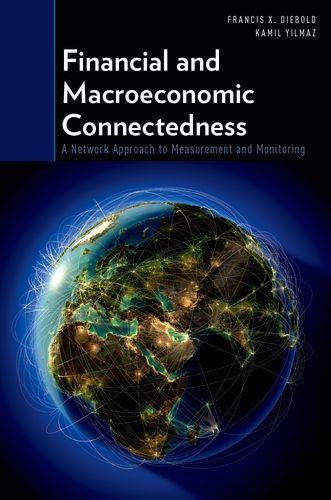
Sinopsis
Connections among different assets, asset classes, portfolios, and the stocks of individual institutions are critical in examining financial markets. Interest in financial markets implies interest in underlying macroeconomic fundamentals. In Financial and Macroeconomic Connectedness, Frank Diebold and Kamil Yilmaz propose a simple framework for defining, measuring, and monitoring connectedness, which is central to finance and macroeconomics. These measures of connectedness are theoretically rigorous yet empirically relevant.
The approach to connectedness proposed by the authors is intimately related to the familiar econometric notion of variance decomposition. The full set of variance decompositions from vector auto-regressions produces the core of the 'connectedness table.' The connectedness table makes clear how one can begin with the most disaggregated pair-wise directional connectedness measures and aggregate them in various ways to obtain total connectedness measures. The authors also show that variance decompositions define weighted, directed networks, so that these proposed connectedness measures are intimately related to key measures of connectedness used in the network literature.
After describing their methods in the first part of the book, the authors proceed to characterize daily return and volatility connectedness across major asset (stock, bond, foreign exchange and commodity) markets as well as the financial institutions within the U.S. and across countries since late 1990s. These specific measures of volatility connectedness show that stock markets played a critical role in spreading the volatility shocks from the U.S. to other countries. Furthermore, while the return connectedness across stock markets increased gradually over time the volatility connectedness measures were subject to significant jumps during major crisis events.
This book examines not only financial connectedness, but also real fundamental connectedness. In particular, the authors show that global business cycle connectedness is economically significant and time-varying, that the U.S. has disproportionately high connectedness to others, and that pairwise country connectedness is inversely related to bilateral trade surpluses.
"Sinopsis" puede pertenecer a otra edición de este libro.
Acerca del autor
Francis X. Diebold is Paul F. and Warren S. Miller Professor of Economics, and Professor of Finance and Statistics, at the University of Pennsylvania and its Wharton School. He has published widely in econometrics, forecasting, finance, and macroeconomics, and he has served on the editorial boards of leading journals including Econometrica, Review of Economics and Statistics, Journal of Business and Economic Statistics, Journal of Applied Econometrics, and International Economic Review.
Kamil Yilmaz holds PhD (1992) and MA (1990) degrees in Economics from the University of Maryland, College Park, and a BA degree in Economics from Bogaziçi University, Istanbul, Turkey (1987). He has been a faculty member at Koç University, Istanbul, Turkey, since 1994. He was a visiting professor at the University of Pennsylvania in 2003-2004 and 2010-2011 academic years. He is the recipient of the 2003 Turkish Academy of Sciences (TÜBA) Encouragement Award for Social Sciences; and a member of the American Economic Association, and the Econometric Society.
"Sobre este título" puede pertenecer a otra edición de este libro.
Resultados de la búsqueda para Financial and Macroeconomic Connectedness: A Network...

Imagen de archivo
Financial and Macroeconomic Connectedness: A Network Approach to Measurement and Monitoring (eng)
Publicado por
Oxford University Press, 2015
ISBN 10: 0199338299
ISBN 13: 9780199338290
Nuevo
Tapa dura
Librería: Brook Bookstore On Demand, Napoli, NA, Italia
Calificación del vendedor: 5 de 5 estrellas

Condición: new. Questo è un articolo print on demand. Nº de ref. del artículo: d669ce52c48781952b711d2734ca6830
Comprar nuevo
EUR 163,49
Envío por EUR 6,80
Se envía de Italia a Estados Unidos de America
Se envía de Italia a Estados Unidos de America
Cantidad disponible: Más de 20 disponibles
Imagen de archivo
Financial and Macroeconomic Connectedness: A Network Approach to Measurement and Monitoring
Publicado por
Oxford University Press Inc, 2015
ISBN 10: 0199338299
ISBN 13: 9780199338290
Nuevo
Tapa dura
Librería: THE SAINT BOOKSTORE, Southport, Reino Unido
Calificación del vendedor: 5 de 5 estrellas
Hardback. Condición: New. This item is printed on demand. New copy - Usually dispatched within 5-9 working days. Nº de ref. del artículo: C9780199338290
Comprar nuevo
EUR 166,45
Envío por EUR 19,45
Se envía de Reino Unido a Estados Unidos de America
Se envía de Reino Unido a Estados Unidos de America
Cantidad disponible: Más de 20 disponibles
Imagen de archivo
Financial and Macroeconomic Connectedness
Impresión bajo demandaLibrería: PBShop.store UK, Fairford, GLOS, Reino Unido
Calificación del vendedor: 5 de 5 estrellas
HRD. Condición: New. New Book. Delivered from our UK warehouse in 4 to 14 business days. THIS BOOK IS PRINTED ON DEMAND. Established seller since 2000. Nº de ref. del artículo: L1-9780199338290
Comprar nuevo
EUR 211,41
Envío por EUR 5,99
Se envía de Reino Unido a Estados Unidos de America
Se envía de Reino Unido a Estados Unidos de America
Cantidad disponible: Más de 20 disponibles
Imagen del vendedor
Financial and Macroeconomic Connectedness : A Network Approach to Measurement and Monitoring
Publicado por
Oxford University Press, 2015
ISBN 10: 0199338299
ISBN 13: 9780199338290
Nuevo
Tapa dura
Librería: GreatBookPrices, Columbia, MD, Estados Unidos de America
Calificación del vendedor: 5 de 5 estrellas
Condición: New. Nº de ref. del artículo: 21755879-n
Comprar nuevo
EUR 215,35
Envío por EUR 2,36
Se envía dentro de Estados Unidos de America
Se envía dentro de Estados Unidos de America
Cantidad disponible: Más de 20 disponibles
Imagen de archivo
Financial and Macroeconomic Connectedness
Impresión bajo demandaLibrería: PBShop.store US, Wood Dale, IL, Estados Unidos de America
Calificación del vendedor: 5 de 5 estrellas
HRD. Condición: New. New Book. Shipped from UK. THIS BOOK IS PRINTED ON DEMAND. Established seller since 2000. Nº de ref. del artículo: L1-9780199338290
Comprar nuevo
EUR 217,79
Gastos de envío gratis
Se envía dentro de Estados Unidos de America
Se envía dentro de Estados Unidos de America
Cantidad disponible: Más de 20 disponibles
Imagen de archivo
Financial and Macroeconomic Connectedness : A Network Approach to Measurement and Monitoring
Publicado por
Oxford University Press, 2015
ISBN 10: 0199338299
ISBN 13: 9780199338290
Nuevo
Tapa dura
Librería: GreatBookPricesUK, Woodford Green, Reino Unido
Calificación del vendedor: 5 de 5 estrellas
Condición: New. Nº de ref. del artículo: 21755879-n
Comprar nuevo
EUR 211,40
Envío por EUR 17,91
Se envía de Reino Unido a Estados Unidos de America
Se envía de Reino Unido a Estados Unidos de America
Cantidad disponible: Más de 20 disponibles
Imagen del vendedor
Financial and Macroeconomic Connectedness : A Network Approach to Measurement and Monitoring
Publicado por
Oxford University Press, 2015
ISBN 10: 0199338299
ISBN 13: 9780199338290
Antiguo o usado
Tapa dura
Librería: GreatBookPrices, Columbia, MD, Estados Unidos de America
Calificación del vendedor: 5 de 5 estrellas
Condición: As New. Unread book in perfect condition. Nº de ref. del artículo: 21755879
Comprar usado
EUR 231,44
Envío por EUR 2,36
Se envía dentro de Estados Unidos de America
Se envía dentro de Estados Unidos de America
Cantidad disponible: Más de 20 disponibles
Imagen de archivo
Financial and Macroeconomic Connectedness: A Network Approach to Measurement and Monitoring
Publicado por
Oxford University Press, 2015
ISBN 10: 0199338299
ISBN 13: 9780199338290
Nuevo
Tapa dura
Librería: Ria Christie Collections, Uxbridge, Reino Unido
Calificación del vendedor: 5 de 5 estrellas
Condición: New. In English. Nº de ref. del artículo: ria9780199338290_new
Comprar nuevo
EUR 228,73
Envío por EUR 13,48
Se envía de Reino Unido a Estados Unidos de America
Se envía de Reino Unido a Estados Unidos de America
Cantidad disponible: Más de 20 disponibles
Imagen del vendedor
Financial and Macroeconomic Connectedness : A Network Approach to Measurement and Monitoring
Publicado por
Oxford University Press, 2015
ISBN 10: 0199338299
ISBN 13: 9780199338290
Antiguo o usado
Tapa dura
Librería: GreatBookPricesUK, Woodford Green, Reino Unido
Calificación del vendedor: 5 de 5 estrellas
Condición: As New. Unread book in perfect condition. Nº de ref. del artículo: 21755879
Comprar usado
EUR 231,90
Envío por EUR 17,91
Se envía de Reino Unido a Estados Unidos de America
Se envía de Reino Unido a Estados Unidos de America
Cantidad disponible: Más de 20 disponibles
Imagen de archivo
Financial and Macroeconomic Connectedness (Hardcover)
Publicado por
Oxford University Press Inc, New York, 2015
ISBN 10: 0199338299
ISBN 13: 9780199338290
Nuevo
Tapa dura
Librería: CitiRetail, Stevenage, Reino Unido
Calificación del vendedor: 5 de 5 estrellas
Hardcover. Condición: new. Hardcover. Connections among different assets, asset classes, portfolios, and the stocks of individual institutions are critical in examining financial markets. Interest in financial markets implies interest in underlying macroeconomic fundamentals. In Financial and Macroeconomic Connectedness, Frank Diebold and Kamil Yilmaz propose a simple framework for defining, measuring, and monitoring connectedness, which is central to finance and macroeconomics. These measuresof connectedness are theoretically rigorous yet empirically relevant.The approach to connectedness proposed by the authors is intimately related to the familiar econometric notion ofvariance decomposition. The full set of variance decompositions from vector auto-regressions produces the core of the 'connectedness table.' The connectedness table makes clear how one can begin with the most disaggregated pair-wise directional connectedness measures and aggregate them in various ways to obtain total connectedness measures. The authors also show that variance decompositions define weighted, directed networks, so that these proposed connectedness measures are intimately relatedto key measures of connectedness used in the network literature.After describing their methods in the first part of the book, the authors proceed to characterize daily return andvolatility connectedness across major asset (stock, bond, foreign exchange and commodity) markets as well as the financial institutions within the U.S. and across countries since late 1990s. These specific measures of volatility connectedness show that stock markets played a critical role in spreading the volatility shocks from the U.S. to other countries. Furthermore, while the return connectedness across stock markets increased gradually over time the volatility connectedness measures weresubject to significant jumps during major crisis events.This book examines not only financial connectedness, but also real fundamental connectedness. In particular, the authorsshow that global business cycle connectedness is economically significant and time-varying, that the U.S. has disproportionately high connectedness to others, and that pairwise country connectedness is inversely related to bilateral trade surpluses. In Financial and Macroeconomic Connectedness, Francis Diebold and Kamil Yilmaz propose several connectedness measures for financial and macroeconomic networks based on forecast error variance decompositions from approximating vector autoregressions. This item is printed on demand. Shipping may be from our UK warehouse or from our Australian or US warehouses, depending on stock availability. Nº de ref. del artículo: 9780199338290
Comprar nuevo
EUR 221,36
Envío por EUR 44,18
Se envía de Reino Unido a Estados Unidos de America
Se envía de Reino Unido a Estados Unidos de America
Cantidad disponible: 1 disponibles