
Artículos relacionados a Principles of Nuclear Magnetic Resonance Microscopy
Sinopsis
Nuclear magnetic resonance imaging is best known for its spectacular use in medical tomography. However, the method has potential applications in biology, materials science and chemical physics, some of which have begun to be realized as laboratory NMR spectrometers have been adapted to enable small-scale imaging. NMR microscopy has available a variety of contrast including molecular specificity and sensitivity to molecular dynamics. In NMR imaging the signal is acquired in k-space, a dimension which bears a Fourier relationship with the positions of nuclear spins. A dynamic analogue of k-space imaging is the Pulsed Gradient Spin Echo (PGSE) experiment in which the signal is acquired in q-space, conjugate to the distances moved by the spins over a well-defined time interval. Q-space microsocpy provides images of the nuclear self-correlation function with a resolution some two orders of magnitude better than is possible in imaging the nuclear density. As well as revealing the spectrum of molecular motion, PGSE NMR can be used to study morphology in porous systems through the influence of motional boundaries. This book explores principles and common themes underlying these two variants of NMR Microscopy, providing many examples of their use. The methods discussed here are of importance in fundamental biological and physical research, as well as having applications in a wide variety of industries, including those concerned with petrochemicals, polymers, biotechnology, food processing and natural product processing.
"Sinopsis" puede pertenecer a otra edición de este libro.
Reseña del editor
Nuclear magnetic resonance imaging is best known for its spectacular use in medical tomography. However, the method has potential applications in biology, materials science and chemical physics, some of which have begun to be realized as laboratory NMR spectrometers have been adapted to enable small-scale imaging. NMR microscopy has available a variety of contrast including molecular specificity and sensitivity to molecular dynamics. In NMR imaging the signal is acquired in k-space, a dimension which bears a Fourier relationship with the positions of nuclear spins. A dynamic analogue of k-space imaging is the Pulsed Gradient Spin Echo (PGSE) experiment in which the signal is acquired in q-space, conjugate to the distances moved by the spins over a well-defined time interval. Q-space microsocpy provides images of the nuclear self-correlation function with a resolution some two orders of magnitude better than is possible in imaging the nuclear density. As well as revealing the spectrum of molecular motion, PGSE NMR can be used to study morphology in porous systems through the influence of motional boundaries. This book explores principles and common themes underlying these two variants of NMR Microscopy, providing many examples of their use. The methods discussed here are of importance in fundamental biological and physical research, as well as having applications in a wide variety of industries, including those concerned with petrochemicals, polymers, biotechnology, food processing and natural product processing.
"Sobre este título" puede pertenecer a otra edición de este libro.
Resultados de la búsqueda para Principles of Nuclear Magnetic Resonance Microscopy

Imagen de archivo
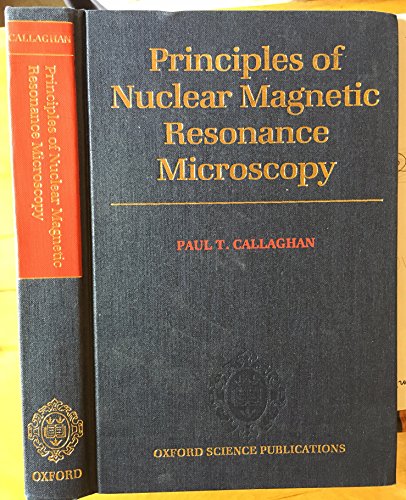
Principles of Nuclear Magnetic Resonance Microscopy
Publicado por
Oxford University Press, 1991
ISBN 10: 0198539444
ISBN 13: 9780198539445
Antiguo o usado
Tapa dura
Librería: Zubal-Books, Since 1961, Cleveland, OH, Estados Unidos de America
Calificación del vendedor: 5 de 5 estrellas

Condición: Good. 510 pp., hardcover, ex library, else text clean and binding tight. - If you are reading this, this item is actually (physically) in our stock and ready for shipment once ordered. We are not bookjackers. Buyer is responsible for any additional duties, taxes, or fees required by recipient's country. Nº de ref. del artículo: ZB1349059
Comprar usado
EUR 50,66
Envío por EUR 4,02
Se envía dentro de Estados Unidos de America
Se envía dentro de Estados Unidos de America
Cantidad disponible: 1 disponibles
Imagen del vendedor
Principles of Nuclear Magnetic Resonance Microscopy
Publicado por
Clarendon Press, Oxford, 1991
ISBN 10: 0198539444
ISBN 13: 9780198539445
Antiguo o usado
Tapa dura
Librería: Attic Books (ABAC, ILAB), London, ON, Canada
Calificación del vendedor: 5 de 5 estrellas
Hardcover. Condición: ex library-good. Oxford Science Publications. xvii, 492 p. 24 cm. 4 colour plates. Numerous b&w figures. Black cloth with gold and red impressing. Ex library with labels on lower spine and rear pastedown, ink stamps on top edge and title. Corners bumped. Nº de ref. del artículo: 142366
Comprar usado
EUR 46,05
Envío por EUR 13,41
Se envía de Canada a Estados Unidos de America
Se envía de Canada a Estados Unidos de America
Cantidad disponible: 1 disponibles