
Artículos relacionados a Free Culture: The Nature and Future of Creativity
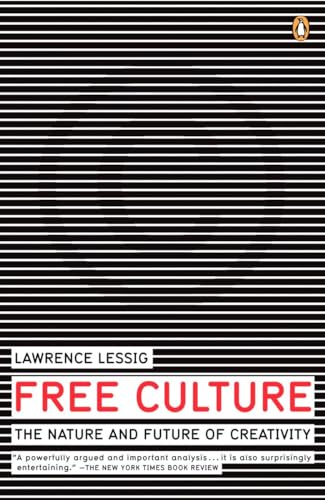
Sinopsis
Lawrence Lessig, “the most important thinker on intellectual property in the Internet era” (The New Yorker), masterfully argues that never before in human history has the power to control creative progress been so concentrated in the hands of the powerful few, the so-called Big Media. Never before have the cultural powers- that-be been able to exert such control over what we can and can’t do with the culture around us. Our society defends free markets and free speech; why then does it permit such top-down control? To lose our long tradition of free culture, Lawrence Lessig shows us, is to lose our freedom to create, our freedom to build, and, ultimately, our freedom to imagine.
"Sinopsis" puede pertenecer a otra edición de este libro.
Acerca del autor
Lawrence Lessig is a professor at Stanford Law School and the founder of the Stanford Center for Internet and Society. The author of The Future of Ideas and Code and Other Laws of Cyberspace, he is the chair of the Creative Commons project. A graduate of the University of Pennsylvania, Cambridge University, and Yale Law School, he has clerked for Judge Richard Posner of the U.S. 7th Circuit Court of Appeals and Judge Antonin Scalia of the U.S. Supreme Court.
Fragmento. © Reproducción autorizada. Todos los derechos reservados.
Jon Else is a documentary filmmaker, who has been very successful in spreading his art. He is a teacher of other filmmakers and, as a teacher myself, I envy the loyalty and admiration he has built in his students. (I met, by accident, two of his students at a dinner party. He was their god.)
Else worked on a documentary that I was involved with. At a break, he told me a story about the freedom to create with film in America today.
In 1990, Else was working on a documentary about Wagner’s Ring Cycle, and the story was to be told by the stagehands at the San Francisco Opera. Stagehands are a particularly funny and colorful aspect of opera. During a show, they hang out below the stage in the grips’ lounge and in the lighting loft. They are a perfect contrast to the art on the stage.
In the course of one of these performances, Else was shooting some stagehands playing checkers. In the corner of the room, there was a television set. Playing on the television set, as the stagehands played checkers, as the San Francisco Opera played Wagner, was The Simpsons. And as Else judged it, this touch helped capture the oddness of the scene.
Years later, when he finally got funding to complete the film, Else attempted to clear the rights for those few seconds of The Simpsons. Of course, those few seconds are copyrighted and, of course, to use copyrighted material you need the permission of the copyright owner.
Else knows Matt Groening, so he called Groening’s office to get permission. Groening said, “Sure, use the shot.” The shot was a four-and-a-half-second image on a tiny television set in the corner of the room. How could it hurt? Groening was happy to have it in the film, but he told Else to contact Gracie Films, the company that produced The Simpsons.
Gracie Films was okay with it, too, but they, like Groening, also wanted to be careful. So they told Else to contact Fox, Gracie’s parent company. So Else called Fox and told them about the film and told them about the four-and-a-half-second clip in the corner of the one shot. Matt Groening had already given permission, Else said. He was just confirming the permission with Fox.
Then, as Else told me, “two things happened. First we discovered…; that Matt Groening doesn’t own his own creation—or at least that someone [at Fox] believes he doesn’t own his own creation.” And second, Fox “wanted ten thousand dollars as a licensing fee for us to use this four and a half seconds of…; entirely unsolicited Simpsons, which was in the corner of the shot.”
Else was certain there was a mistake. He worked his way up to the someone he thought was a vice president for licensing, Rebecca Herrera. And he said to her, “There must be some mistake here…;.We’re asking for your educational rate on this.” That was the educational rate, Herrera told Else. A day or so later, Else called again to confirm what he had been told.
“I wanted to make sure I had my facts straight,” he told me he told her. “Yes, you have your facts straight,” she said. Ten thousand dollars to use the clip of The Simpsons in the corner of a short in a documentary film about Wagner’s Ring Cycle. And then, astonishingly, Herrera told Else, “And if you quote me, I’ll turn you over to our attorneys.” As an assistant to Herrera told Else later on, “They don’t give a shit. They just want the money.”
Else didn’t have the money to buy the right to replay what was playing on the television backstage at the San Francisco Opera. To repeat that reality was beyond the documentary filmmaker’s budget. And thus, at the very last minute before the film was to be released, Else digitally replaced the four and a half seconds of The Simpsons with a clip from another film he had worked on—The Day After Trinity. Only problem was that when Else shot the sequence at the San Francisco Opera in 1990, The Day After Trinity had not yet been made.
We live in a free society—built between the bulwarks of free speech and the prosperity of a free market. Yet the culture of that culture—once a free culture—is changing. We are moving from this free culture, where artists and creators and critics could build easily upon our past, to a permission culture, where the right to use what is all around us depends upon the permission of an increasingly small few.
This is a profound change in our culture. It is the product of changing law and changing technology. Unless it is reversed, it will remake who we are and how we build our culture.
"Sobre este título" puede pertenecer a otra edición de este libro.
Resultados de la búsqueda para Free Culture: The Nature and Future of Creativity

Imagen de archivo
Free Culture: The Nature and Future of Creativity
Publicado por
Penguin Books, 2005
ISBN 10: 0143034650
ISBN 13: 9780143034650
Antiguo o usado
Tapa blanda
Librería: World of Books (was SecondSale), Montgomery, IL, Estados Unidos de America
Calificación del vendedor: 5 de 5 estrellas

Condición: Very Good. Item in very good condition! Textbooks may not include supplemental items i.e. CDs, access codes etc. Nº de ref. del artículo: 00110092597
Comprar usado
EUR 4,08
Gastos de envío gratis
Se envía dentro de Estados Unidos de America
Se envía dentro de Estados Unidos de America
Cantidad disponible: 1 disponibles
Imagen de archivo
Free Culture: The Nature and Future of Creativity
Publicado por
Penguin Books, 2005
ISBN 10: 0143034650
ISBN 13: 9780143034650
Antiguo o usado
Tapa blanda
Librería: World of Books (was SecondSale), Montgomery, IL, Estados Unidos de America
Calificación del vendedor: 5 de 5 estrellas
Condición: Good. Item in good condition. Textbooks may not include supplemental items i.e. CDs, access codes etc. Nº de ref. del artículo: 00108783487
Comprar usado
EUR 4,08
Gastos de envío gratis
Se envía dentro de Estados Unidos de America
Se envía dentro de Estados Unidos de America
Cantidad disponible: 3 disponibles
Imagen de archivo
Free Culture: The Nature and Future of Creativity
Publicado por
Penguin Books, 2005
ISBN 10: 0143034650
ISBN 13: 9780143034650
Antiguo o usado
Tapa blanda
Librería: World of Books (was SecondSale), Montgomery, IL, Estados Unidos de America
Calificación del vendedor: 5 de 5 estrellas
Condición: Acceptable. Item in acceptable condition! Textbooks may not include supplemental items i.e. CDs, access codes etc. Nº de ref. del artículo: 00093423876
Comprar usado
EUR 4,08
Gastos de envío gratis
Se envía dentro de Estados Unidos de America
Se envía dentro de Estados Unidos de America
Cantidad disponible: 3 disponibles
Imagen de archivo
Free Culture: The Nature and Future of Creativity
Publicado por
Penguin Publishing Group, 2005
ISBN 10: 0143034650
ISBN 13: 9780143034650
Antiguo o usado
paperback
Librería: Gulf Coast Books, Cypress, TX, Estados Unidos de America
Calificación del vendedor: 5 de 5 estrellas
paperback. Condición: Fair. Nº de ref. del artículo: 0143034650-4-37367336
Comprar usado
EUR 4,09
Gastos de envío gratis
Se envía dentro de Estados Unidos de America
Se envía dentro de Estados Unidos de America
Cantidad disponible: 1 disponibles
Imagen de archivo
Free Culture: The Nature and Future of Creativity
Publicado por
Penguin Putnam Inc, 2005
ISBN 10: 0143034650
ISBN 13: 9780143034650
Antiguo o usado
Paperback
Librería: World of Books Inc, Montgomery, IL, Estados Unidos de America
Calificación del vendedor: 2 de 5 estrellas

Paperback. Condición: Very Good. How big media uses technology and the law to lock down culture and control creativity. Free Culture is an entertaining and important look at the past and future of the cold war between the media industry and new technologies. - Marc Andreessen, cofounder of Netscape. Free Culture goes beyond illuminating the catastrophe to our culture of increasing regulation to show examples of how we can make a different future. These new-style heroes and examples are rooted in the traditions of the founding fathers in ways that seem obvious after reading this book. Recommended reading to those trying to unravel the shrill hype around 'intellectual property.' - Brewster Kahle, founder of the Internet Archive. The web site for the book is http: //free-culture.cc/. Nº de ref. del artículo: CIN0143034650VG
Comprar usado
EUR 5,85
Gastos de envío gratis
Se envía dentro de Estados Unidos de America
Se envía dentro de Estados Unidos de America
Cantidad disponible: 1 disponibles
Imagen de archivo
Free Culture: The Nature and Future of Creativity
Publicado por
Penguin Putnam Inc, 2005
ISBN 10: 0143034650
ISBN 13: 9780143034650
Antiguo o usado
Paperback
Librería: World of Books Inc, Montgomery, IL, Estados Unidos de America
Calificación del vendedor: 2 de 5 estrellas
Paperback. Condición: Fair. How big media uses technology and the law to lock down culture and control creativity. Free Culture is an entertaining and important look at the past and future of the cold war between the media industry and new technologies. - Marc Andreessen, cofounder of Netscape. Free Culture goes beyond illuminating the catastrophe to our culture of increasing regulation to show examples of how we can make a different future. These new-style heroes and examples are rooted in the traditions of the founding fathers in ways that seem obvious after reading this book. Recommended reading to those trying to unravel the shrill hype around 'intellectual property.' - Brewster Kahle, founder of the Internet Archive. The web site for the book is http: //free-culture.cc/. Nº de ref. del artículo: CIN0143034650A
Comprar usado
EUR 5,85
Gastos de envío gratis
Se envía dentro de Estados Unidos de America
Se envía dentro de Estados Unidos de America
Cantidad disponible: 3 disponibles
Imagen de archivo
Free Culture : The Nature and Future of Creativity
Publicado por
Penguin Publishing Group, 2005
ISBN 10: 0143034650
ISBN 13: 9780143034650
Antiguo o usado
Tapa blanda
Librería: Better World Books, Mishawaka, IN, Estados Unidos de America
Calificación del vendedor: 5 de 5 estrellas
Condición: Good. culture Edition. Pages intact with minimal writing/highlighting. The binding may be loose and creased. Dust jackets/supplements are not included. Stock photo provided. Product includes identifying sticker. Better World Books: Buy Books. Do Good. Nº de ref. del artículo: GRP102623855
Comprar usado
EUR 5,97
Gastos de envío gratis
Se envía dentro de Estados Unidos de America
Se envía dentro de Estados Unidos de America
Cantidad disponible: 2 disponibles
Imagen de archivo
Free Culture : The Nature and Future of Creativity
Publicado por
Penguin Publishing Group, 2005
ISBN 10: 0143034650
ISBN 13: 9780143034650
Antiguo o usado
Tapa blanda
Librería: Better World Books, Mishawaka, IN, Estados Unidos de America
Calificación del vendedor: 5 de 5 estrellas
Condición: Good. culture Edition. Former library copy. Pages intact with minimal writing/highlighting. The binding may be loose and creased. Dust jackets/supplements are not included. Includes library markings. Stock photo provided. Product includes identifying sticker. Better World Books: Buy Books. Do Good. Nº de ref. del artículo: GRP60817955
Comprar usado
EUR 5,97
Gastos de envío gratis
Se envía dentro de Estados Unidos de America
Se envía dentro de Estados Unidos de America
Cantidad disponible: 1 disponibles
Imagen de archivo
Free Culture : The Nature and Future of Creativity
Publicado por
Penguin Publishing Group, 2005
ISBN 10: 0143034650
ISBN 13: 9780143034650
Antiguo o usado
Tapa blanda
Librería: Better World Books: West, Reno, NV, Estados Unidos de America
Calificación del vendedor: 5 de 5 estrellas
Condición: Good. culture Edition. Pages intact with minimal writing/highlighting. The binding may be loose and creased. Dust jackets/supplements are not included. Stock photo provided. Product includes identifying sticker. Better World Books: Buy Books. Do Good. Nº de ref. del artículo: GRP102623855
Comprar usado
EUR 5,97
Gastos de envío gratis
Se envía dentro de Estados Unidos de America
Se envía dentro de Estados Unidos de America
Cantidad disponible: 1 disponibles
Imagen de archivo
Free Culture: The Nature and Future of Creativity
Publicado por
Penguin Adult Hc/Tr, 2005
ISBN 10: 0143034650
ISBN 13: 9780143034650
Antiguo o usado
Paperback
Librería: ThriftBooks-Atlanta, AUSTELL, GA, Estados Unidos de America
Calificación del vendedor: 5 de 5 estrellas
Paperback. Condición: Fair. No Jacket. Readable copy. Pages may have considerable notes/highlighting. ~ ThriftBooks: Read More, Spend Less. Nº de ref. del artículo: G0143034650I5N00
Comprar usado
EUR 6,20
Gastos de envío gratis
Se envía dentro de Estados Unidos de America
Se envía dentro de Estados Unidos de America
Cantidad disponible: 1 disponibles