
Artículos relacionados a Gargantua and Pantagruel
Sinopsis
A masterly new translation of Rabelais’s robust scatalogical comedy
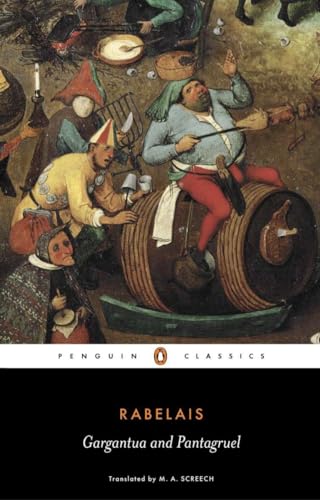
Parodying everyone from classic authors to his own contemporaries, the dazzling and exuberant stories of Rabelais expose human follies with mischievous and often obscene humor. Gargantua depicts a young giant who becomes a cultured Christian knight. Pantagruel portrays Gargantua’s bookish son who becomes a Renaissance Socrates, divinely guided by wisdom and by his idiotic, self-loving companion, Panurge.
"Sinopsis" puede pertenecer a otra edición de este libro.
Acerca del autor
François Rabelais was born at the end of the fifteenth century. A Franciscan monk turned Benedictine, he abandoned the cloister in 1530 and began to study medicine at Montpellier. Two years later he wrote his first work, Pantagruel, which revealed his genius as a storyteller, satirist, propagandist and creator of comic situations and characters. In 1534 he published Gargantua, a companion to Pantagruel, which contains some of his best work. It mocks old-fashioned theological education, and opposes the monastic ideal, contrasting it with a free society of noble Evangelicals. Following an outburst of repression in late 1534, Rabelais abandoned his post of doctor at the Hotel-Dieu at Lyons and despite Royal support his book Tiers Livre was condemned. His last work, and his boldest, Quart Livre was published in 1551 and he died two years later. For the last years of his life Rabelais was persecuted by both religious and civil authorities for his publications. His genius however was recognized in his own day and his influence was great.
Dr. M. A. Screech is a Senior Research Fellow of All Souls College, Oxford, a Fellow of the British Academy and a Fellow of University College London; he long served on the committee of the Warburg Institute as Fielden Professor of French Language and Literature in London, until his election to All Souls in 1984. He is a Renaissance scholar of international renown. His books include Montaigne and Melancholy, as well as Rabelais and (on Erasmus) Ecstasy and the Praise of Folly; all are acknowledged to be classic studies in their fields.
De la contraportada
The dazzling and exuberant moral stories of Rabelais (c. 1471-1553) expose human follies with their mischievous and often obscene humour, while intertwining the realistic with carnivalesque fantasy to make us look afresh at the world. Gargantua depicts a young giant, reduced to laughable insanity by an education at the hands of paternal ignorance, old crones and syphilitic professors, who is rescued and turned into a cultured Christian knight. And in Pantagruel and its three sequels, Rabelais parodied tall tales of chivalry and satirized the law, theology and academia to portray the bookish son of Gargantua who becomes a Renaissance Socrates, divinely guided in his wisdom, and his idiotic, self-loving companion Panurge.
"Sobre este título" puede pertenecer a otra edición de este libro.
Resultados de la búsqueda para Gargantua and Pantagruel

Imagen de archivo
Gargantua and Pantagruel (Penguin Classics)
Publicado por
Penguin Classics, 2006
ISBN 10: 0140445501
ISBN 13: 9780140445503
Antiguo o usado
Paperback
Librería: HPB-Diamond, Dallas, TX, Estados Unidos de America
Calificación del vendedor: 5 de 5 estrellas

Paperback. Condición: Very Good. Connecting readers with great books since 1972! Used books may not include companion materials, and may have some shelf wear or limited writing. We ship orders daily and Customer Service is our top priority! Nº de ref. del artículo: S_474096835
Comprar usado
EUR 7,49
Envío por EUR 3,23
Se envía dentro de Estados Unidos de America
Se envía dentro de Estados Unidos de America
Cantidad disponible: 1 disponibles
Imagen de archivo
Gargantua and Pantagruel
Publicado por
Penguin Classics, 2006
ISBN 10: 0140445501
ISBN 13: 9780140445503
Antiguo o usado
Paperback
Librería: ThriftBooks-Reno, Reno, NV, Estados Unidos de America
Calificación del vendedor: 5 de 5 estrellas
Paperback. Condición: Fair. No Jacket. Readable copy. Pages may have considerable notes/highlighting. ~ ThriftBooks: Read More, Spend Less. Nº de ref. del artículo: G0140445501I5N00
Comprar usado
EUR 10,91
Gastos de envío gratis
Se envía dentro de Estados Unidos de America
Se envía dentro de Estados Unidos de America
Cantidad disponible: 1 disponibles
Imagen de archivo
Gargantua and Pantagruel
Publicado por
Penguin Classics, 2006
ISBN 10: 0140445501
ISBN 13: 9780140445503
Antiguo o usado
Paperback
Librería: ThriftBooks-Phoenix, Phoenix, AZ, Estados Unidos de America
Calificación del vendedor: 5 de 5 estrellas
Paperback. Condición: Fair. No Jacket. Readable copy. Pages may have considerable notes/highlighting. ~ ThriftBooks: Read More, Spend Less. Nº de ref. del artículo: G0140445501I5N00
Comprar usado
EUR 10,91
Gastos de envío gratis
Se envía dentro de Estados Unidos de America
Se envía dentro de Estados Unidos de America
Cantidad disponible: 1 disponibles
Imagen de archivo
Gargantua and Pantagruel
Publicado por
Penguin Classics, 2006
ISBN 10: 0140445501
ISBN 13: 9780140445503
Antiguo o usado
Paperback
Librería: ThriftBooks-Atlanta, AUSTELL, GA, Estados Unidos de America
Calificación del vendedor: 5 de 5 estrellas
Paperback. Condición: Fair. No Jacket. Readable copy. Pages may have considerable notes/highlighting. ~ ThriftBooks: Read More, Spend Less. Nº de ref. del artículo: G0140445501I5N00
Comprar usado
EUR 10,93
Gastos de envío gratis
Se envía dentro de Estados Unidos de America
Se envía dentro de Estados Unidos de America
Cantidad disponible: 1 disponibles
Imagen de archivo
Gargantua and Pantagruel
Publicado por
Penguin Classics, 2006
ISBN 10: 0140445501
ISBN 13: 9780140445503
Antiguo o usado
Paperback
Librería: ThriftBooks-Dallas, Dallas, TX, Estados Unidos de America
Calificación del vendedor: 5 de 5 estrellas
Paperback. Condición: Fair. No Jacket. Readable copy. Pages may have considerable notes/highlighting. ~ ThriftBooks: Read More, Spend Less. Nº de ref. del artículo: G0140445501I5N00
Comprar usado
EUR 10,93
Gastos de envío gratis
Se envía dentro de Estados Unidos de America
Se envía dentro de Estados Unidos de America
Cantidad disponible: 1 disponibles
Imagen de archivo
Gargantua and Pantagruel
Publicado por
Penguin Classics, 2006
ISBN 10: 0140445501
ISBN 13: 9780140445503
Antiguo o usado
Paperback
Librería: ThriftBooks-Atlanta, AUSTELL, GA, Estados Unidos de America
Calificación del vendedor: 5 de 5 estrellas
Paperback. Condición: As New. No Jacket. Pages are clean and are not marred by notes or folds of any kind. ~ ThriftBooks: Read More, Spend Less. Nº de ref. del artículo: G0140445501I2N00
Comprar usado
EUR 10,93
Gastos de envío gratis
Se envía dentro de Estados Unidos de America
Se envía dentro de Estados Unidos de America
Cantidad disponible: 1 disponibles
Imagen de archivo
Gargantua and Pantagruel
Publicado por
Penguin Group January 2007, 2007
ISBN 10: 0140445501
ISBN 13: 9780140445503
Antiguo o usado
Paper Back
Librería: Eagle Eye Books, Decatur, GA, Estados Unidos de America
Calificación del vendedor: 4 de 5 estrellas

Paper Back. Condición: Used. Nº de ref. del artículo: 894449
Comprar usado
EUR 7,98
Envío por EUR 3,44
Se envía dentro de Estados Unidos de America
Se envía dentro de Estados Unidos de America
Cantidad disponible: 1 disponibles
Imagen de archivo
Gargantua and Pantagruel
Publicado por
Penguin Classics, 2006
ISBN 10: 0140445501
ISBN 13: 9780140445503
Antiguo o usado
paperback
Librería: The Maryland Book Bank, Baltimore, MD, Estados Unidos de America
Calificación del vendedor: 5 de 5 estrellas
paperback. Condición: Good. New Ed. Corners are bent. Used - Good. Nº de ref. del artículo: 1-o-2-1806
Comprar usado
EUR 7,58
Envío por EUR 4,04
Se envía dentro de Estados Unidos de America
Se envía dentro de Estados Unidos de America
Cantidad disponible: 1 disponibles
Imagen de archivo
Gargantua and Pantagruel
Publicado por
Penguin Classics, 2006
ISBN 10: 0140445501
ISBN 13: 9780140445503
Antiguo o usado
paperback
Librería: beneton, Millsboro, DE, Estados Unidos de America
Calificación del vendedor: 5 de 5 estrellas
paperback. Condición: Very Good. p. Nº de ref. del artículo: 260714035
Comprar usado
EUR 7,44
Envío por EUR 4,96
Se envía dentro de Estados Unidos de America
Se envía dentro de Estados Unidos de America
Cantidad disponible: 1 disponibles
Imagen de archivo
Gargantua and Pantagruel (Penguin Classics)
Publicado por
Penguin Classics, 2006
ISBN 10: 0140445501
ISBN 13: 9780140445503
Antiguo o usado
Paperback
Librería: Half Price Books Inc., Dallas, TX, Estados Unidos de America
Calificación del vendedor: 5 de 5 estrellas
Paperback. Condición: Very Good. Connecting readers with great books since 1972! Used books may not include companion materials, and may have some shelf wear or limited writing. We ship orders daily and Customer Service is our top priority! Nº de ref. del artículo: S_481788311
Comprar usado
EUR 9,31
Envío por EUR 3,23
Se envía dentro de Estados Unidos de America
Se envía dentro de Estados Unidos de America
Cantidad disponible: 1 disponibles