
Artículos relacionados a Ranking Task Exercises in Physics: Student Edition...
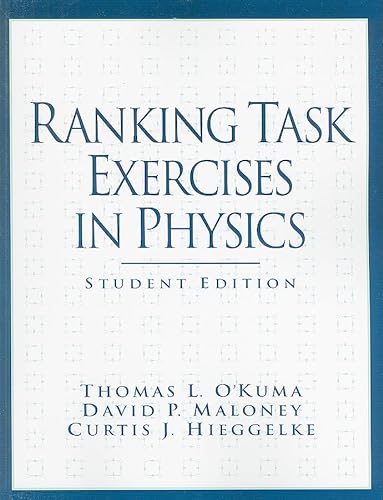
Ranking Task Exercises in Physics: Student Edition (Prentice Hall Series in Educational Innovation) - Tapa blanda
Sinopsis
A supplement for courses in Algebra-Based Physics and Calculus-Based Physics. Ranking Task Exercises in Physics are an innovative type of conceptual exercise that asks students to make comparative judgments about variations on a particular physicals situation. It includes 200 exercises covering classical physics and optics.
"Sinopsis" puede pertenecer a otra edición de este libro.
Acerca del autor
Charlotte y Peter Fiell son dos autoridades en historia, teoría y crítica del diseño y han escrito más de sesenta libros sobre la materia, muchos de los cuales se han convertido en éxitos de ventas. También han impartido conferencias y cursos como profesores invitados, han comisariado exposiciones y asesorado a fabricantes, museos, salas de subastas y grandes coleccionistas privados de todo el mundo. Los Fiell han escrito numerosos libros para TASCHEN, entre los que se incluyen 1000 Chairs, Diseño del siglo XX, El diseño industrial de la A a la Z, Scandinavian Design y Diseño del siglo XXI.
De la contraportada
This student text contains 218 Ranking Task Exercises that cover all classical physics topics. Ranking Tasks are an innovative type of conceptual exercise that asks students to make comparative judgments about a set of variations on a particular physical situation. These exercises were developed by participants in the Two-Year College (TYC) Physics Workshop Project sponsored by Joliet Junior College, Lee College, and a series of grants from the Division of Undergraduate Education of the National Science Foundation, and were edited by Thomas L. O'Kuma (Lee College), David P. Maloney (Indiana University-Purdue University, Fort Wayne), and Curtis J. Hieggelke (Joliet Junior College).
Those who have used Ranking Tasks have found that they frequently elicit students' natural ideas, rather than a memorized response, about the behavior of a given physical system. In addition, asking students to consider the same situation in a variety of ways often helps them begin to correct any misconceptions they may have. When students realize that they have given different answers to variations of the same question, they begin to think about why they responded as they did in each case. This, in turn, prompts them to consider which responses they believe in more strongly, and why.
The basic structure of a Ranking Task comprises four elements:- a description of the physical situation, including any constraints and the basis for ranking different arrangements
- a set of figures showing the different arrangements of the situation to be compared
- a place to record the ranking of each variation
- a place to explain the reason for each ranking choice
Prentice Hall is proud to publish this book as part of its Series in Educational Innovation.
"Sobre este título" puede pertenecer a otra edición de este libro.
Resultados de la búsqueda para Ranking Task Exercises in Physics: Student Edition...

Imagen de archivo
Ranking Task Exercises in Physics: Student Edition
Librería: World of Books (was SecondSale), Montgomery, IL, Estados Unidos de America
Calificación del vendedor: 5 de 5 estrellas

Condición: Good. Item in good condition. Textbooks may not include supplemental items i.e. CDs, access codes etc. Nº de ref. del artículo: 00110349778
Comprar usado
EUR 53,82
Gastos de envío gratis
Se envía dentro de Estados Unidos de America
Se envía dentro de Estados Unidos de America
Cantidad disponible: 1 disponibles
Imagen de archivo
Ranking Task Exercises in Physics: Student Edition (Prentice Hall Series in Educational Innovation)
Publicado por
Pearson (edition Student), 2003
ISBN 10: 013144851X
ISBN 13: 9780131448513
Antiguo o usado
Paperback
Librería: BooksRun, Philadelphia, PA, Estados Unidos de America
Calificación del vendedor: 5 de 5 estrellas
Paperback. Condición: Very Good. Student. It's a well-cared-for item that has seen limited use. The item may show minor signs of wear. All the text is legible, with all pages included. It may have slight markings and/or highlighting. Workbook. Nº de ref. del artículo: 013144851X-8-1-42
Comprar usado
EUR 54,85
Gastos de envío gratis
Se envía dentro de Estados Unidos de America
Se envía dentro de Estados Unidos de America
Cantidad disponible: 1 disponibles
Imagen de archivo
Ranking Task Exercises in Physics: Student Edition (Prentice Hall Series in Educational Innovation)
Publicado por
Pearson (edition Student), 2003
ISBN 10: 013144851X
ISBN 13: 9780131448513
Antiguo o usado
Paperback
Librería: BooksRun, Philadelphia, PA, Estados Unidos de America
Calificación del vendedor: 5 de 5 estrellas
Paperback. Condición: Very Good. Student. It's a well-cared-for item that has seen limited use. The item may show minor signs of wear. All the text is legible, with all pages included. It may have slight markings and/or highlighting. Workbook. Nº de ref. del artículo: 013144851X-11-1-42
Comprar usado
EUR 54,85
Gastos de envío gratis
Se envía dentro de Estados Unidos de America
Se envía dentro de Estados Unidos de America
Cantidad disponible: 1 disponibles
Imagen de archivo
Ranking Task Exercises in Physics: Student Edition
Librería: HPB-Red, Dallas, TX, Estados Unidos de America
Calificación del vendedor: 5 de 5 estrellas
Paperback. Condición: Acceptable. Connecting readers with great books since 1972. Used textbooks may not include companion materials such as access codes, etc. May have condition issues including wear and notes/highlighting. We ship orders daily and Customer Service is our top priority! Nº de ref. del artículo: S_456195008
Comprar usado
EUR 53,82
Envío por EUR 3,27
Se envía dentro de Estados Unidos de America
Se envía dentro de Estados Unidos de America
Cantidad disponible: 1 disponibles
Imagen de archivo
Ranking Task Exercises in Physics: Student Edition
Librería: BennettBooksLtd, Los Angeles, CA, Estados Unidos de America
Calificación del vendedor: 5 de 5 estrellas
paperback. Condición: New. In shrink wrap. Looks like an interesting title! Nº de ref. del artículo: Q-013144851X
Comprar nuevo
EUR 91,84
Envío por EUR 6,06
Se envía dentro de Estados Unidos de America
Se envía dentro de Estados Unidos de America
Cantidad disponible: 1 disponibles
Imagen del vendedor
Ranking Task Exercises in Physics
Librería: GreatBookPrices, Columbia, MD, Estados Unidos de America
Calificación del vendedor: 5 de 5 estrellas
Condición: New. Nº de ref. del artículo: 1950579-n
Comprar nuevo
EUR 109,72
Envío por EUR 2,30
Se envía dentro de Estados Unidos de America
Se envía dentro de Estados Unidos de America
Cantidad disponible: Más de 20 disponibles
Imagen de archivo
Ranking Task Exercises in Physics (Paperback)
Publicado por
Pearson Education (US), New Jersey, 2004
ISBN 10: 013144851X
ISBN 13: 9780131448513
Nuevo
Paperback
Original o primera edición
Librería: Grand Eagle Retail, Bensenville, IL, Estados Unidos de America
Calificación del vendedor: 5 de 5 estrellas
Paperback. Condición: new. Paperback. A supplement for courses in Algebra-Based Physics and Calculus-Based Physics. Ranking Task Exercises in Physics are an innovative type of conceptual exercise that asks students to make comparative judgments about variations on a particular physicals situation. It includes 200 exercises covering classical physics and optics. A supplement for courses in Algebra-Based Physics and Calculus-Based Physics. Ranking Task Exercises in Physics are an innovative type of conceptual exercise that asks students to make comparative judgments about variations on a particular physicals situation. It includes 200 exercises covering classical physics and optics. Shipping may be from multiple locations in the US or from the UK, depending on stock availability. Nº de ref. del artículo: 9780131448513
Comprar nuevo
EUR 112,10
Gastos de envío gratis
Se envía dentro de Estados Unidos de America
Se envía dentro de Estados Unidos de America
Cantidad disponible: 1 disponibles
Imagen de archivo
Ranking Task Exercises in Physics: Student Edition
Librería: SHIMEDIA, Brooklyn, NY, Estados Unidos de America
Calificación del vendedor: 4 de 5 estrellas

Condición: New. Satisfaction Guaranteed or your money back. Nº de ref. del artículo: 013144851X
Comprar nuevo
EUR 116,74
Gastos de envío gratis
Se envía dentro de Estados Unidos de America
Se envía dentro de Estados Unidos de America
Cantidad disponible: 1 disponibles
Imagen del vendedor
Ranking Task Exercises in Physics: Student Edition
Impresión bajo demandaLibrería: BuchWeltWeit Ludwig Meier e.K., Bergisch Gladbach, Alemania
Calificación del vendedor: 5 de 5 estrellas
Taschenbuch. Condición: Neu. This item is printed on demand - it takes 3-4 days longer - Neuware -A supplement for courses in Algebra-Based Physics and Calculus-Based Physics. 236 pp. Englisch. Nº de ref. del artículo: 9780131448513
Comprar nuevo
EUR 100,49
Envío por EUR 23,00
Se envía de Alemania a Estados Unidos de America
Se envía de Alemania a Estados Unidos de America
Cantidad disponible: 2 disponibles
Imagen del vendedor
Ranking Task Exercises in Physics
Librería: GreatBookPrices, Columbia, MD, Estados Unidos de America
Calificación del vendedor: 5 de 5 estrellas
Condición: As New. Unread book in perfect condition. Nº de ref. del artículo: 1950579
Comprar usado
EUR 124,30
Envío por EUR 2,30
Se envía dentro de Estados Unidos de America
Se envía dentro de Estados Unidos de America
Cantidad disponible: Más de 20 disponibles