
Artículos relacionados a Artificial Intelligence (Handbook of Perception and...
Sinopsis
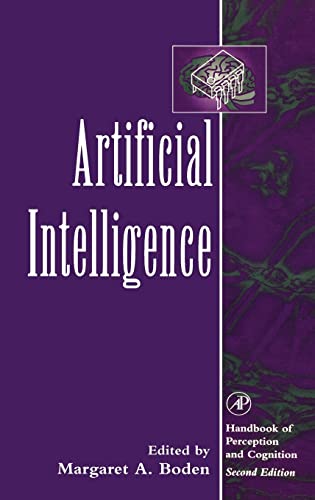
Artificial Intelligence is the study of how to build or program computers to enable them to do what minds can do. This volume discusses the ways in which computational ideas and computer modeling can aid our understanding of human and animal minds. Major theoretical approaches are outlined, as well as some promising recent developments. Fundamental philosophical questions are discussed along with topics such as: the differences between symbolic and connectionist AI, planning and problem solving, knowledge representation, learning, expert systems, vision, natural language, creativity, and human-computer interaction. This volume is suitable for any psychologist, philosopher, or computer scientist wanting to know the current state of the art in this area of cognitive science.
"Sinopsis" puede pertenecer a otra edición de este libro.
Acerca del autor
Charlotte y Peter Fiell son dos autoridades en historia, teoría y crítica del diseño y han escrito más de sesenta libros sobre la materia, muchos de los cuales se han convertido en éxitos de ventas. También han impartido conferencias y cursos como profesores invitados, han comisariado exposiciones y asesorado a fabricantes, museos, salas de subastas y grandes coleccionistas privados de todo el mundo. Los Fiell han escrito numerosos libros para TASCHEN, entre los que se incluyen 1000 Chairs, Diseño del siglo XX, El diseño industrial de la A a la Z, Scandinavian Design y Diseño del siglo XXI.
De la contraportada
Artificial intelligence (AI) is the study of how to build or program computers to enable them to do what minds can do. This volume discusses the ways in which computational ideas and computer modeling can aid our understanding of human and animal minds. Major theoretical approaches are outlined, as well as some promising recent developments. Fundamental philosophical questions are discussed along with topics such as: the differences between symbolic and connectionist AI, planning and problem solving, knowledge representation, learning, expert systems, vision, natural language, creativity, and human-computer interaction. This volume is suitable for any psychologist, philosopher, or computer scientist wanting to know the current state of the art in this area of cognitive science.
Key Features
* Up-to-date account of how computational ideas and techniques are relevant to psychology
* Includes discussions of "classical" (bymbolic) AI, of connectionism (neural nets), of evolutionary programming, and of A-Life
* Discusses a wide range of psychology from low-level vision to creativity|Artificial intelligence (AI) is the study of how to build or program computers to enable them to do what minds can do. This volume discusses the ways in which computational ideas and computer modeling can aid our understanding of human and animal minds. Major theoretical approaches are outlined, as well as some promising recent developments. Fundamental philosophical questions are discussed along with topics such as: the differences between symbolic and connectionist AI, planning and problem solving, knowledge representation, learning, expert systems, vision, natural language, creativity, and human-computer interaction. This volume is suitable for any psychologist, philosopher, or computer scientist wanting to know the current state of the art in this area of cognitive science.
Key Features
* Up-to-date account of how computational ideas and techniques are relevant to psychology
* Includes discussions of "classical" (bymbolic) AI, of connectionism (neural nets), of evolutionary programming, and of A-Life
* Discusses a wide range of psychology from low-level vision to creativity
"Sobre este título" puede pertenecer a otra edición de este libro.
Resultados de la búsqueda para Artificial Intelligence (Handbook of Perception and...

Imagen del vendedor
Artificial Intelligence (Handbook of Perception and Cognition)
Publicado por
Academic Press, 1996
ISBN 10: 0121619648
ISBN 13: 9780121619640
Antiguo o usado
Tapa dura
Librería: -OnTimeBooks-, Phoenix, AZ, Estados Unidos de America
Calificación del vendedor: 5 de 5 estrellas

Condición: good. A copy that has been read, remains in good condition. All pages are intact, and the cover is intact. The spine and cover show signs of wear. Pages can include notes and highlighting and show signs of wear, and the copy can include "From the library of" labels or previous owner inscriptions. 100% GUARANTEE! Shipped with delivery confirmation, if you're not satisfied with purchase please return item! Ships via media mail. Nº de ref. del artículo: OTV.0121619648.G
Comprar usado
EUR 9,72
Gastos de envío gratis
Se envía dentro de Estados Unidos de America
Se envía dentro de Estados Unidos de America
Cantidad disponible: 1 disponibles
Imagen de archivo
Artificial Intelligence (Handbook of Perception and Cognition)
Publicado por
Academic Press, 1996
ISBN 10: 0121619648
ISBN 13: 9780121619640
Antiguo o usado
Tapa dura
Librería: PAPER CAVALIER US, Brooklyn, NY, Estados Unidos de America
Calificación del vendedor: 5 de 5 estrellas
Condición: fair. Readable condition with clear signs of use. May contain notes, highlights, lack the dust jacket or extras like CDs, access codes or inserts. Nº de ref. del artículo: 9780121619640-5
Comprar usado
EUR 11,07
Gastos de envío gratis
Se envía dentro de Estados Unidos de America
Se envía dentro de Estados Unidos de America
Cantidad disponible: 1 disponibles
Imagen de archivo
Artificial Intelligence (Handbook Of Perception And Cognition)
Publicado por
Academic Press, 1996
ISBN 10: 0121619648
ISBN 13: 9780121619640
Antiguo o usado
Tapa dura
Librería: Mispah books, Redhill, SURRE, Reino Unido
Calificación del vendedor: 4 de 5 estrellas

Hardcover. Condición: Like New. LIKE NEW. SHIPS FROM MULTIPLE LOCATIONS. book. Nº de ref. del artículo: ERICA75801216196485
Comprar usado
EUR 202,39
Envío por EUR 29,59
Se envía de Reino Unido a Estados Unidos de America
Se envía de Reino Unido a Estados Unidos de America
Cantidad disponible: 1 disponibles