
Artículos relacionados a First, You Cry
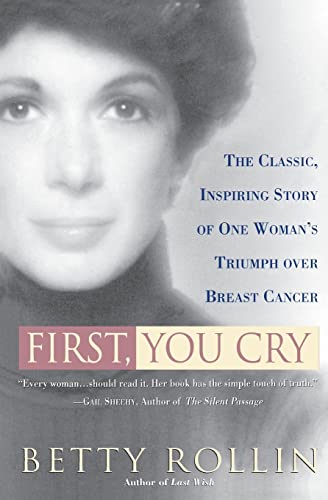
Sinopsis
"Every woman. . . should read it. Her book has the simple touch of truth." —Gail Sheehy, Author of The Silent Passage
NBC News correspondent Betty Rollin, glamorous, successful, and happily married, had it all—and then she learned that she had a malignant tumor in her breast. Written with wit, warmth, and soul searching honesty, First, You Cry is the inspiring true story about how one woman transformed the most terrifying ordeal of her life into a new beginning.
With a new introduction and epilogue, this unique memoir serves as a fascinating retrospective of the twenty-five years since Rollin's first mastectomy and, given the continuing threat of breast cancer, tells a story that will inform all women as it touches them with its honesty and even, humor.
"Sinopsis" puede pertenecer a otra edición de este libro.
Acerca del autor
Betty Rollin (1936-2023) was a writer and award-winning TV journalist. She was a contributing correspondent for NBC News and PBS, and was a writer and editor for both Look and Vogue magazines. She also wrote for many national publications, including the New York Times.
De la contraportada
NBC News correspondent Betty Rollin, glamorous, successful, and happily married, had it all -- and then she learned that she had a malignant tumor in her breast. Written with wit, warmth, and soul searching honesty, First, You Cry is the inspiring, true story about how one woman transformed the most terrifying ordeal of her life into a new beginning. Now with a new introduction and epilogue, this unique memoir serves as a fascinating retrospective of the twenty-five years since Rollin's first mastectomy and, given the continuing threat of breast cancer, tells a story that will inform all women as it touches them with its honesty and even, humor.
Fragmento. © Reproducción autorizada. Todos los derechos reservados.
First, You Cry
By Rollin, BettyQuill
Copyright © 2004 Betty RollinAll right reserved.
ISBN: 0060956305
On September 30, 1974, an NBC News correspondent reporting from the Guttman Breast Diagnostic Institute in New York told of the nationwide reaction to the mastectomy of the wife of the President of the United States, how women everywhere were rushing to their nearest mammographer, how suddenly afraid women were. The report emphasized that the fear was productive, because so many women were acting on it.
On camera, the correspondent said, The terror that women feel about breast cancer is not unreasonable. What is unreasonable is that women still turn their terror inward. They think if they avoid investigating the possibility that they have the disease, they'll avoid the disease. But as cases of such prominent women as Betty Ford become known, other women are turning their fear into the kind of action that can save their lives.
The correspondent had done her homework. She knew that early detection was important, that most lumps were benign. She knew all about the different kinds of mastectomies -- radical, simple, and so on -- and the controversies about them. She knew a lot. But as the correspondent spoke to the camera, telling the nation what she knew about breast cancer, there was one thing she did not know. She did not know that she had it herself...
Chapter One
I had a lump for a year. At least a year. It was a hard little thing -- about the size of a yellow grape -- and it resided, imperceptible except to the touch, on the far left side of my left breast, due west of the nipple. I knew it was there, my (ex-) husband knew it was there, and my (ex-) internist knew it was there, and my (ex-) mammographer knew it was there. Of the four, only one of us was worried about it. That was Arthur Herzog, the husband, who had found it on a spring evening in 1974 during a routine sexual feel.
What's that? he said. I don't know, I said. It's a lump, he said. Mmmm, I said, wanting to sleep. Will you get it looked at? he said. Sure, I said, and went to sleep.
I got it looked at. It's nothing to worry about, said my internist on Central Park West, whom I'll call Dr. Smith. Feels like a cyst. A lot of women have them. But we'll send you for some mammograms.
I went for some mammograms. This doesn't worry me a bit, said my mammographer on East Ninetieth Street, whom I'll call Dr. Ellby. He held up his pictures of my lump to the light. Come back in a year and we'll have another look.
Whew. Not that I had been worried, either. Well, maybe just a little. Anyway, I was glad to be out of there.
Mammograms -- low-radiation X-rays that show the inner structure of the breast and can, theoretically, pinpoint the location of even the smallest abnormality -- are not pleasant things to have. The experience is often likened to having a chest X-ray, but it's not like that at all. When you have a chest X-ray, you stand, shoulders forward, against a machine, and the machine performs. Mammograms require a different kind of participation. Before the picture-taking even begins, one has to tolerate the sensible and essential but unnerving business of being palpated (medically felt up) by the mammographer. Then, holding your paper gown together with one hand, and grabbing your purse, bra, and blouse with the other, you are bustled off to another room where topless and chilly, you sit on a small stool before a large machine. A technician -- a young woman, usually, who moves fast and doesn't talk much -- takes your breast in her hand and puts it, as if it were a slab of beef, on a slab of steel. Then her arm shoots up and she cranks down another slab of steel, thereby creating a sort of breast sandwich.
Your flattened breast is the filling. Say when it hurts, says the young woman, who has become part of the machine. Ouch, you say, and she stops cranking. Don't breathe, she says, as if you could. Bam, slam. Click, slam. Breathe, she says. Then, like ballet exercises, repeat on the other side. (Crank, crank. Don't breathe. Bam, slam. Click, slam. Breathe.) And that's it. But you can't go home. Not yet. You go out to the waiting room filled with women on mahogany chairs and aqua settees reading House Beautifuls and old Newsweeks or not reading at all, and there you wait -- either to be dismissed (no cancer) or called back for more pictures (maybe cancer). Not that that word is spoken either out here or in there. It is as silent as the g in sign. But, like the g in sign, it is there.
It was there in my head as I waited in Ellby's dreary waiting room on that day in June. But it was there the way rape was there. A buried terror, far, far under the ground. My remote fear of breast cancer virtually ended when Ellby said he wasn't worried, and the fear was entirely finished off a week later when, after seeing the mammograms, Smith said he wasn't worried. Ellby was the mammogram emperor of the greater New York area (Surgeons send their wives to him, a doctor friend had told me); Dr. Smith was my trusted (impeccably reputed) internist of eight years. If they weren't worried, why should I be?
Continues...Excerpted from First, You Cryby Rollin, Betty Copyright © 2004 by Betty Rollin. Excerpted by permission.
All rights reserved. No part of this excerpt may be reproduced or reprinted without permission in writing from the publisher.
Excerpts are provided by Dial-A-Book Inc. solely for the personal use of visitors to this web site.
"Sobre este título" puede pertenecer a otra edición de este libro.
Otras ediciones populares con el mismo título

Resultados de la búsqueda para First, You Cry

Imagen de archivo
First, You Cry
Librería: Gulf Coast Books, Cypress, TX, Estados Unidos de America
Calificación del vendedor: 5 de 5 estrellas

paperback. Condición: Fair. Nº de ref. del artículo: 0060956305-4-35513981
Comprar usado
EUR 4,23
Gastos de envío gratis
Se envía dentro de Estados Unidos de America
Se envía dentro de Estados Unidos de America
Cantidad disponible: 1 disponibles
Imagen de archivo
First, You Cry
Librería: Your Online Bookstore, Houston, TX, Estados Unidos de America
Calificación del vendedor: 5 de 5 estrellas
paperback. Condición: Fair. Nº de ref. del artículo: 0060956305-4-36919009
Comprar usado
EUR 4,23
Gastos de envío gratis
Se envía dentro de Estados Unidos de America
Se envía dentro de Estados Unidos de America
Cantidad disponible: 1 disponibles
Imagen de archivo
First, You Cry
Librería: Orion Tech, Kingwood, TX, Estados Unidos de America
Calificación del vendedor: 5 de 5 estrellas
paperback. Condición: Good. Nº de ref. del artículo: 0060956305-3-28442149
Comprar usado
EUR 4,23
Gastos de envío gratis
Se envía dentro de Estados Unidos de America
Se envía dentro de Estados Unidos de America
Cantidad disponible: 1 disponibles
Imagen de archivo
First, You Cry
Librería: Gulf Coast Books, Cypress, TX, Estados Unidos de America
Calificación del vendedor: 5 de 5 estrellas
Paperback. Condición: Good. Nº de ref. del artículo: 0060956305-3-24362630
Comprar usado
EUR 4,23
Gastos de envío gratis
Se envía dentro de Estados Unidos de America
Se envía dentro de Estados Unidos de America
Cantidad disponible: 1 disponibles
Imagen de archivo
First, You Cry: An Inspiring Breast Cancer Memoir of Transformation and New Beginnings
Librería: World of Books (was SecondSale), Montgomery, IL, Estados Unidos de America
Calificación del vendedor: 5 de 5 estrellas
Condición: Acceptable. Item in acceptable condition! Textbooks may not include supplemental items i.e. CDs, access codes etc. Nº de ref. del artículo: 00104201829
Comprar usado
EUR 4,24
Gastos de envío gratis
Se envía dentro de Estados Unidos de America
Se envía dentro de Estados Unidos de America
Cantidad disponible: 2 disponibles
Imagen de archivo
First, You Cry: An Inspiring Breast Cancer Memoir of Transformation and New Beginnings
Librería: World of Books (was SecondSale), Montgomery, IL, Estados Unidos de America
Calificación del vendedor: 5 de 5 estrellas
Condición: Good. Item in good condition. Textbooks may not include supplemental items i.e. CDs, access codes etc. Nº de ref. del artículo: 00104859627
Comprar usado
EUR 4,24
Gastos de envío gratis
Se envía dentro de Estados Unidos de America
Se envía dentro de Estados Unidos de America
Cantidad disponible: 1 disponibles
Imagen del vendedor
First, You Cry: An Inspiring Breast Cancer Memoir of Transformation and New Beginnings
Librería: Greenworld Books, Arlington, TX, Estados Unidos de America
Calificación del vendedor: 5 de 5 estrellas
Condición: good. Fast Free Shipping â" Good condition. It may show normal signs of use, such as light writing, highlighting, or library markings, but all pages are intact and the book is fully readable. A solid, complete copy that's ready to enjoy. Nº de ref. del artículo: GWV.0060956305.G
Comprar usado
EUR 4,39
Gastos de envío gratis
Se envía dentro de Estados Unidos de America
Se envía dentro de Estados Unidos de America
Cantidad disponible: 1 disponibles
Imagen del vendedor
First, You Cry: An Inspiring Breast Cancer Memoir of Transformation and New Beginnings
Librería: Greenworld Books, Arlington, TX, Estados Unidos de America
Calificación del vendedor: 5 de 5 estrellas
Condición: very_good. Fast Free Shipping â" Very Good condition book with a firm cover and clean pages. Shows normal use and some light wear or limited notes markings. A solid, nice copy to enjoy. Nº de ref. del artículo: GWV.0060956305.VG
Comprar usado
EUR 4,39
Gastos de envío gratis
Se envía dentro de Estados Unidos de America
Se envía dentro de Estados Unidos de America
Cantidad disponible: 1 disponibles
Imagen del vendedor
First, You Cry: An Inspiring Breast Cancer Memoir of Transformation and New Beginnings
Librería: Dream Books Co., Denver, CO, Estados Unidos de America
Calificación del vendedor: 5 de 5 estrellas
Condición: good. Gently used with minimal wear on the corners and cover. A few pages may contain light highlighting or writing, but the text remains fully legible. Dust jacket may be missing, and supplemental materials like CDs or codes may not be included. May be ex-library with library markings. Ships promptly! Nº de ref. del artículo: DBV.0060956305.G
Comprar usado
EUR 5,45
Gastos de envío gratis
Se envía dentro de Estados Unidos de America
Se envía dentro de Estados Unidos de America
Cantidad disponible: 1 disponibles
Imagen de archivo
First, You Cry: An Inspiring Breast Cancer Memoir of Transformation and New Beginnings
Publicado por
Quill (edition Reprint), 2000
ISBN 10: 0060956305
ISBN 13: 9780060956301
Antiguo o usado
Paperback
Librería: BooksRun, Philadelphia, PA, Estados Unidos de America
Calificación del vendedor: 5 de 5 estrellas
Paperback. Condición: Very Good. Reprint. It's a well-cared-for item that has seen limited use. The item may show minor signs of wear. All the text is legible, with all pages included. It may have slight markings and/or highlighting. Nº de ref. del artículo: 0060956305-11-1
Comprar usado
EUR 5,47
Gastos de envío gratis
Se envía dentro de Estados Unidos de America
Se envía dentro de Estados Unidos de America
Cantidad disponible: 1 disponibles