
Artículos relacionados a Evening in the Palace of Reason: Bach Meets Frederick...
Evening in the Palace of Reason: Bach Meets Frederick the Great in the Age of Enlightenment - Tapa blanda
Sinopsis
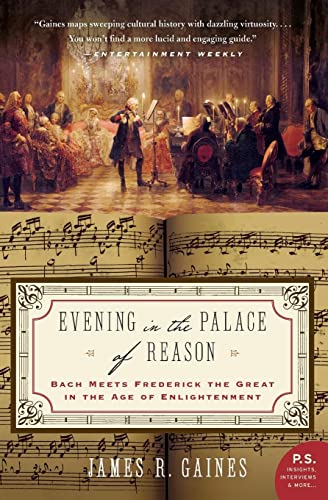
Johann Sebastian Bach created what may be the most celestial and profound body of music in history; Frederick the Great built the colossus we now know as Germany, and along with it a template for modern warfare. Their fleeting encounter in 1757 signals a unique moment in history where belief collided with the cold certainty of reason. Set at the tipping point between the ancient and modern world, Evening in the Palace of Reason captures the tumult of the eighteenth century, the legacy of the Reformation, and the birth of the Enlightenment in this extraordinary tale of two men.
"Sinopsis" puede pertenecer a otra edición de este libro.
Acerca del autor
Jim Gaines was the first Editor in Chief of People Magazine, as well as the Editor of Time Magazine. His first book, ‘Evening in The Palace of Reason’ was published in2005. He lives in Paris with his family
De la contraportada
Johann Sebastian Bach created what may be the most celestial and profound body of music in history; Frederick the Great built the colossus we now know as Germany, and along with it a template for modern warfare. Their fleeting encounter in 1757 signals a unique moment in history where belief collided with the cold certainty of reason. Set at the tipping point between the ancient and modern world, Evening in the Palace of Reason captures the tumult of the eighteenth century, the legacy of the Reformation, and the birth of the Enlightenment in this extraordinary tale of two men.
De la solapa interior
Johann Sebastian Bach created what may be the most celestial and profound body of music in history; Frederick the Great built the colossus we now know as Germany, and along with it a template for modern warfare. Their fleeting encounter in 1757 signals a unique moment in history where belief collided with the cold certainty of reason. Set at the tipping point between the ancient and modern world, Evening in the Palace of Reason captures the tumult of the eighteenth century, the legacy of the Reformation, and the birth of the Enlightenment in this extraordinary tale of two men.
--Walter Isaacson, author of BENJAMIN FRANKLINFragmento. © Reproducción autorizada. Todos los derechos reservados.
Evening in the Palace of Reason
Bach Meets Frederick the Great in the Age of EnlightenmentBy James GainesHarperCollins Publishers, Inc.
Copyright © 2005 James GainesAll right reserved.
ISBN: 0007156618
Chapter One
Theme For A Pasdedeux
Frederick the great had always loved to play the flute, which was one of the qualities in him that his father most despised. Throughout his youth, Frederick had to play in secret. Among his fondest memories were evenings at his mother's palace, where he was free to dress up in French clothes, curl and puff his hair in the French style, and play duets with his soulmate sister Wilhelmina -- he on the flute he called Principe, she on her lute Principessa. When Frederick's father once happened unexpectedly on this scene, he flew into a rage. Even more than his son's flute playing, Frederick William I hated everything French -- French clothes, French food, French mannerisms, French civilization, all of which he dismissed as "effeminate." He had of course been educated in French, like most German princes (he could not even spell Deutschland but habitually wrote Deusland), so he had to speak French, but he hated himself for it. He dressed convicts for their executions in French clothes as his own sort of fashion statement.
In this regard and others, Frederick's father was at least half mad. Flagrantly manic-depressive and violently abusive, he also suffered from porphyria, a disease common among descendants of Mary Queen of Scots (which he was, on his mother's side). Its afflictions included migraines, abscesses, boils, paranoia, and mind-engulfing stomach pains. The rages of Frederick William were frequent, infamous, and knew no rank: He hit servants, family members (no one more than Frederick), even visiting diplomats. Racked by gout, he lashed out with crutches, and if the pain was bad enough to put him in his wheelchair, he chased people down in it brandishing a cane. He was infamous for his canings -- he left canes in various rooms of the castle so they would always be close at hand -- but he also threw plates at people, pulled their hair, slapped them, knocked them down, and kicked them. A famous story has him walking down the street in Potsdam and noticing one of his subjects darting away. He ordered the man to stop and tell him why he ran. Because he was afraid, the man said."Afraid?! Afraid?! You're supposed to love me!" Out came the cane and down went the subject, the king screaming, "Love me, scum!" Such a rage could be sparked by the very word France.
Not until his father died when Frederick was twenty-eight could he play his flute free from the threat of censure or attack, so naturally it was among his most beloved and time-consuming pastimes as king. With the musicians in his court Kapelle, who were not only the best in Prussia but the best he could buy away from Saxony and Hanover and every other German territory, he played concerts virtually every evening from seven to nine o'clock, sometimes even on the battlefield. He cared as much about music as he cared about anything, except perhaps for war.
Having had both a love of the military and a cynical, self-protective ruthlessness literally beaten into him by his father, Frederick had already been dubbed "the Great" after only five years on the throne, by which time he had greatly enlarged his kingdom with a campaign of outrageously deceitful diplomacy and equally incredible military strokes that proved him a brilliant antagonist and made Prussia, for the first time, a top-rank power in Europe. A diligent amateur of the arts and literature -- avid student of the Greek and Roman classics, composer and patron of the opera, writer of poetry and political theory (mediocre poetry and wildly hypocritical political theory, but never mind) -- he had managed also to make himself known as the very model of the newly heralded "philosopher-king," so certified by none less than Voltaire, who described young Frederick as "a man who gives battle as readily as he writes an opera ... He has written more books than any of his contemporary princes has sired bastards; and he has won more victories than he has written books." Frederick's court in Potsdam fast became one of the most glamorous in Europe, no small thanks to himself, who worked tirelessly to draw around him celebrities (like Voltaire) from every corner of the arts and sciences.
One Sunday evening in the spring of his seventh year as king, as his musicians were gathering for the evening concert, a courtier brought Frederick his usual list of arrivals at the town gate. As he looked down the list of names, he gave a start.
"Gentlemen," he said, "old Bach is here." Those who heard him said there was "a kind of agitation" in his voice.
Johann Sebastian Bach was sixty-two years old in 1747, only three years from his death, and making the long trip from Leipzig, which would be his last journey, was surely more a concession than a wish. An emphatically self-directed, even stubborn man, Bach took a dim view of this particular king, the Prussian army having overrun Leipzig less than two years before, and at his advanced age he could not have relished spending two days and a night being jostled about in a coach to meet the bitter enemy of his own royal patron, the elector of Saxony. Even more problematic than the political and physical difficulties of such a journey, though, the meeting represented something of a confrontation for the aging composer -- a confrontation, one might say, with his age. In music and virtually every other sphere of life in mid-eighteenth-century Germany, Frederick represented all that was new and fashionable, while Bach's music had come to stand for everything ancient and outmoded. His musical language, teaching, and tradition had been rejected and denounced by young composers and theorists, even by his own sons, and Bach had every reason to fear that he and his music were to be forgotten entirely after his death, had indeed been all but forgotten already ...
Continues...
Excerpted from Evening in the Palace of Reasonby James Gaines Copyright © 2005 by James Gaines. Excerpted by permission.
All rights reserved. No part of this excerpt may be reproduced or reprinted without permission in writing from the publisher.
Excerpts are provided by Dial-A-Book Inc. solely for the personal use of visitors to this web site.
"Sobre este título" puede pertenecer a otra edición de este libro.
Resultados de la búsqueda para Evening in the Palace of Reason: Bach Meets Frederick...

Imagen de archivo
A Musical Offering
Publicado por
HarperCollins Publishers, 2006
ISBN 10: 0007156618
ISBN 13: 9780007156610
Antiguo o usado
Paperback
Librería: World of Books (was SecondSale), Montgomery, IL, Estados Unidos de America
Calificación del vendedor: 5 de 5 estrellas

Paperback. Condición: Fair. In one corner, a godless young warrior, Voltaire's heralded 'philosopher-king', the It Boy of the Enlightenment. In the other, a devout if bad-tempered old composer of 'outdated' music, a scorned genius in his last years. The sparks from their brief conflict illuminate a turbulent age. Behind the pomp and flash, Prussia's Frederick the Great was a tormented man, son of an abusive king who forced him to watch as his best friend (probably his lover) was beheaded. In what may have been one of history's crueler practical jokes, Frederick challenged 'old Bach' to a musical duel, asking him to improvise a six-part fugue based on an impossibly intricate theme (possibly devised for him by Bach's own son). Bach left the court fuming, but in a fever of composition, he used the coded, alchemical language of counterpoint to write 'A Musical Offering' in response. A stirring declaration of faith, it represented 'as stark a rebuke of his beliefs and world view as an absolute monarch has ever received, ' Gaines writes. It is also one of the great works of art in the history of music. Set at the tipping point between the ancient and the modern world, the triumphant story of Bach's victory expands to take in the tumult of the eighteenth century: the legacy of the Reformation, wars and conquest, the birth of the Enlightenment. Brimming with originality and wit, 'Evening in the Palace of Reason' is history of the best kind - intimate in scale and broad in its vision. Nº de ref. del artículo: 00105207932
Comprar usado
EUR 5,26
Gastos de envío gratis
Se envía dentro de Estados Unidos de America
Se envía dentro de Estados Unidos de America
Cantidad disponible: 1 disponibles
Imagen de archivo
A Musical Offering
Publicado por
HarperCollins Publishers, 2006
ISBN 10: 0007156618
ISBN 13: 9780007156610
Antiguo o usado
Paperback
Librería: World of Books (was SecondSale), Montgomery, IL, Estados Unidos de America
Calificación del vendedor: 5 de 5 estrellas
Paperback. Condición: Good. In one corner, a godless young warrior, Voltaire's heralded 'philosopher-king', the It Boy of the Enlightenment. In the other, a devout if bad-tempered old composer of 'outdated' music, a scorned genius in his last years. The sparks from their brief conflict illuminate a turbulent age. Behind the pomp and flash, Prussia's Frederick the Great was a tormented man, son of an abusive king who forced him to watch as his best friend (probably his lover) was beheaded. In what may have been one of history's crueler practical jokes, Frederick challenged 'old Bach' to a musical duel, asking him to improvise a six-part fugue based on an impossibly intricate theme (possibly devised for him by Bach's own son). Bach left the court fuming, but in a fever of composition, he used the coded, alchemical language of counterpoint to write 'A Musical Offering' in response. A stirring declaration of faith, it represented 'as stark a rebuke of his beliefs and world view as an absolute monarch has ever received, ' Gaines writes. It is also one of the great works of art in the history of music. Set at the tipping point between the ancient and the modern world, the triumphant story of Bach's victory expands to take in the tumult of the eighteenth century: the legacy of the Reformation, wars and conquest, the birth of the Enlightenment. Brimming with originality and wit, 'Evening in the Palace of Reason' is history of the best kind - intimate in scale and broad in its vision. Nº de ref. del artículo: 00099657498
Comprar usado
EUR 5,26
Gastos de envío gratis
Se envía dentro de Estados Unidos de America
Se envía dentro de Estados Unidos de America
Cantidad disponible: 14 disponibles
Imagen de archivo
Evening in the Palace of Reason: Bach Meets Frederick the Great in the Age of Enlightenment
Publicado por
Harper Perennial (edition Illustrated), 2006
ISBN 10: 0007156618
ISBN 13: 9780007156610
Antiguo o usado
Paperback
Librería: BooksRun, Philadelphia, PA, Estados Unidos de America
Calificación del vendedor: 5 de 5 estrellas
Paperback. Condición: Fair. Illustrated. The item might be beaten up but readable. May contain markings or highlighting, as well as stains, bent corners, or any other major defect, but the text is not obscured in any way. Nº de ref. del artículo: 0007156618-7-1
Comprar usado
EUR 5,27
Gastos de envío gratis
Se envía dentro de Estados Unidos de America
Se envía dentro de Estados Unidos de America
Cantidad disponible: 1 disponibles
Imagen del vendedor
Evening in the Palace of Reason: Bach Meets Frederick the Great in the Age of Enlightenment
Publicado por
Harper Perennial, 2006
ISBN 10: 0007156618
ISBN 13: 9780007156610
Antiguo o usado
Tapa blanda
Librería: ZBK Books, Carlstadt, NJ, Estados Unidos de America
Calificación del vendedor: 5 de 5 estrellas
Condición: good. Fast & Free Shipping â" Good condition. It may show normal signs of use, such as light writing, highlighting, or library markings, but all pages are intact and the book is fully readable. A solid, complete copy that's ready to enjoy. Nº de ref. del artículo: ZWV.0007156618.G
Comprar usado
EUR 5,33
Gastos de envío gratis
Se envía dentro de Estados Unidos de America
Se envía dentro de Estados Unidos de America
Cantidad disponible: 2 disponibles
Imagen de archivo
Evening in the Palace of Reason: Bach Meets Frederick the Great in the Age of Enlightenment
Publicado por
Harper Perennial (edition Illustrated), 2006
ISBN 10: 0007156618
ISBN 13: 9780007156610
Antiguo o usado
Paperback
Librería: BooksRun, Philadelphia, PA, Estados Unidos de America
Calificación del vendedor: 5 de 5 estrellas
Paperback. Condición: Very Good. Illustrated. It's a well-cared-for item that has seen limited use. The item may show minor signs of wear. All the text is legible, with all pages included. It may have slight markings and/or highlighting. Nº de ref. del artículo: 0007156618-11-18
Comprar usado
EUR 5,78
Gastos de envío gratis
Se envía dentro de Estados Unidos de America
Se envía dentro de Estados Unidos de America
Cantidad disponible: 2 disponibles
Imagen de archivo
Evening in the Palace of Reason: Bach Meets Frederick the Great in the Age of Enlightenment
Publicado por
Harper Perennial, 2006
ISBN 10: 0007156618
ISBN 13: 9780007156610
Antiguo o usado
Paperback
Librería: ThriftBooks-Atlanta, AUSTELL, GA, Estados Unidos de America
Calificación del vendedor: 5 de 5 estrellas
Paperback. Condición: Good. No Jacket. Pages can have notes/highlighting. Spine may show signs of wear. ~ ThriftBooks: Read More, Spend Less. Nº de ref. del artículo: G0007156618I3N00
Comprar usado
EUR 6,02
Gastos de envío gratis
Se envía dentro de Estados Unidos de America
Se envía dentro de Estados Unidos de America
Cantidad disponible: 1 disponibles
Imagen de archivo
Evening in the Palace of Reason: Bach Meets Frederick the Great in the Age of Enlightenment
Publicado por
Harper Perennial, 2006
ISBN 10: 0007156618
ISBN 13: 9780007156610
Antiguo o usado
Paperback
Librería: ThriftBooks-Dallas, Dallas, TX, Estados Unidos de America
Calificación del vendedor: 5 de 5 estrellas
Paperback. Condición: Good. No Jacket. Pages can have notes/highlighting. Spine may show signs of wear. ~ ThriftBooks: Read More, Spend Less. Nº de ref. del artículo: G0007156618I3N00
Comprar usado
EUR 6,02
Gastos de envío gratis
Se envía dentro de Estados Unidos de America
Se envía dentro de Estados Unidos de America
Cantidad disponible: 1 disponibles
Imagen de archivo
Evening in the Palace of Reason: Bach Meets Frederick the Great in the Age of Enlightenment (P.S.)
Publicado por
Harper Perennial, 2006
ISBN 10: 0007156618
ISBN 13: 9780007156610
Antiguo o usado
Paperback
Librería: Open Books, Chicago, IL, Estados Unidos de America
Calificación del vendedor: 5 de 5 estrellas
Paperback. Condición: Good. Light edge wear. Open Books is a nonprofit social venture that provides literacy experiences for thousands of readers each year through inspiring programs and creative capitalization of books. Nº de ref. del artículo: mon0000854343
Comprar usado
EUR 2,70
Envío por EUR 3,56
Se envía dentro de Estados Unidos de America
Se envía dentro de Estados Unidos de America
Cantidad disponible: 1 disponibles
Imagen del vendedor
Evening in the Palace of Reason: Bach Meets Frederick the Great in the Age of Enlightenment
Publicado por
Harper Perennial, 2006
ISBN 10: 0007156618
ISBN 13: 9780007156610
Antiguo o usado
Tapa blanda
Librería: Blue Vase Books, Interlochen, MI, Estados Unidos de America
Calificación del vendedor: 5 de 5 estrellas
Condición: acceptable. The item is very worn but is perfectly usable. Signs of wear can include aesthetic issues such as scratches, dents, worn and creased covers, folded page corners and minor liquid stains. All pages and the cover are intact, but the dust cover may be missing. Pages may include moderate to heavy amount of notes and highlighting, but the text is not obscured or unreadable. Page edges may have foxing age related spots and browning . May NOT include discs, access code or other supplemental materials. Nº de ref. del artículo: BVV.0007156618.A
Comprar usado
EUR 6,35
Gastos de envío gratis
Se envía dentro de Estados Unidos de America
Se envía dentro de Estados Unidos de America
Cantidad disponible: 1 disponibles
Imagen de archivo
Evening In The Palace Of Reason
Publicado por
Harper Perennial, New York, NY, 2005
ISBN 10: 0007156618
ISBN 13: 9780007156610
Antiguo o usado
Soft cover
Librería: Foxtrot Books, Yankton, SD, Estados Unidos de America
Calificación del vendedor: 5 de 5 estrellas
Soft cover. Condición: Good. Good COndition paperback 313 pages. Nº de ref. del artículo: 034416
Comprar usado
EUR 2,58
Envío por EUR 3,79
Se envía dentro de Estados Unidos de America
Se envía dentro de Estados Unidos de America
Cantidad disponible: 1 disponibles