Artículos relacionados a Concussions And Our Kids: America's Leading Expert...

Concussions And Our Kids: America's Leading Expert on How to Protect Young Athletes and Keep Sports Safe - Tapa blanda
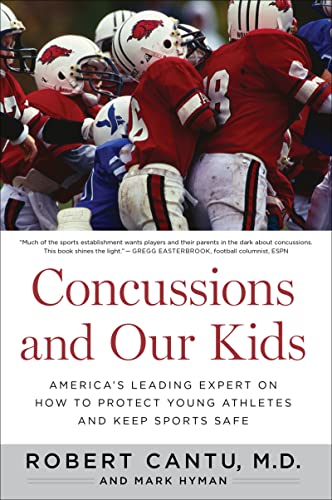
Cantu, Dr. Robert

 
9780544102231: Concussions And Our Kids: America's Leading Expert on How to Protect Young Athletes and Keep Sports Safe

Sinopsis

See the movie "Concussion." But first read the classic book from the acclaimed concussion doctor who's changing how America thinks about safety in youth sports. 

“This is an important, cutting-edge work by the premier specialist in his field. If you watch sports, or if you have a young athlete in your family, you need to read this book.” —Dan Shaughnessy, author of The Curse of the Bambino

From Washington to Quebec, from offices at the NFL to the New York Times, from the NHL players’ union to the soccer fields of Anytown, U.S.A., people are talking about concussions. At the center of this crisis—and one of the key reasons for this increased awareness—is Dr. Robert Cantu, the country’s leading expert on athletic brain trauma and a pioneer in the study of the link between concussions and progressive brain disease in athletes.

Concussions and Our Kids is the first prescriptive book of its kind to address the issue of head trauma in sports and to offer guidelines for playing sports safely. Described as “the single most important issue in sports today,” concussions are widespread and devastating. Dr. Cantu has treated thousands of patients, from pro athletes to peewee players, and his groundbreaking research is changing how sports are played. Parents, coaches, and players can learn from this combination manifesto/manual, helping to reduce concussions now and prevent more brain trauma down the road.

“A well-researched, riveting story that every coach and parent of a young athlete should read.” —Christine Brennan, USA Today sports columnist and author of Best Seat in the House

"Sinopsis" puede pertenecer a otra edición de este libro.

Acerca del autor

<div>ROBERT&#160;CANTU, M.D.,&#160;is the chief of neurosurgery and&#160;chairman of the&#160;Department of Surgery at Emerson Hospital, and codirector of Boston University&#8217;s Center for the Study of Traumatic Encephalopathy. <br>MARK&#160;HYMAN is a sports journalist&#160;and the author of <i>Until It Hurts</i>.</div>

De la contraportada

“This is an important, cutting-edge work by the premier specialist in his field. If you watch sports, or if you have a young athlete in your family, you need to read this book.” —Dan Shaughnessy, author of The Curse of the Bambino

From Washington to Quebec, from offices at the NFL to the New York Times, from the NHL players’ union to the soccer fields of Anytown, U.S.A., people are talking about concussions. At the center of this crisis—and one of the key reasons for this increased awareness—is Dr. Robert Cantu, the country’s leading expert on athletic brain trauma and a pioneer in the study of the link between concussions and progressive brain disease in athletes.

Concussions and Our Kids is the first prescriptive book of its kind to address the issue of head trauma in sports and to offer guidelines for playing sports safely. Described as “the single most important issue in sports today,” concussions are widespread and devastating. Dr. Cantu has treated thousands of patients, from pro athletes to peewee players, and his groundbreaking research is changing how sports are played. Parents, coaches, and players can learn from this combination manifesto/manual, helping to reduce concussions now and prevent more brain trauma down the road.

“A well-researched, riveting story that every coach and parent of a young athlete should read.” —Christine Brennan, USA Today sports columnist and author of Best Seat in the House

[AU PHOTO] ROBERT CANTU, M.D., is the chief of neurosurgery and chairman of the Department of Surgery at Emerson Hospital, and codirector of Boston University’s Center for the Study of Traumatic Encephalopathy. At his practice at Emerson Hospital, he treats hundreds of patients a year for concussions suffered while playing sports.

MARK HYMAN is a sports journalist whose previous books on youth sports are Until It Hurts and The Most Expensive Game in Town.


Fragmento. © Reproducción autorizada. Todos los derechos reservados.

Concussions and Our Kids

America's Leading Expert On How To Protect Young Athletes and Keep Sports Safe

By Robert Cantu, Mark Hyman

Houghton Mifflin Harcourt Publishing Company

Copyright © 2012 Robert Cantu and Mark Hyman
All rights reserved.
ISBN: 978-0-544-10223-1

Contents

Title Page,
Contents,
Copyright,
Dedication,
What Is a Concussion?,
Collision Sports,
Non-Collision Sports,
Baseline Testing,
Post-Concussion Syndrome and Second Impact Syndrome,
Chronic Traumatic Encephalopathy (CTE),
Myths,
Moms and Dads,
After Concussions,
Reforms,
Epilogue,
Postscript,
Acknowledgments,
Today's Concussion Signs and Symptoms Checklist,
Cumulative Concussion Signs and Symptoms Checklist,
Concussion Patient History Intake Form,
Guidelines for Return to Play After Concussion(s) That Season,
Index,
About the Authors,


CHAPTER 1

What Is a Concussion?


We need to do something now, this minute. Too many kids are at risk.

— Dr. Ann Mckee (Time)

We still have this culture where it's hard to convince people that a concussion is a very serious brain injury.

— Dawn Comstock, principal investigator, Center for Injury Research and Policy, The Research Institute, Nationwide Children's Hospital, Ohio State University (Time)


In the late 1950s, I was a student at Cal-Berkeley and a member of Cal's baseball team. We were playing Stanford one afternoon, and I came to bat. This was the dark ages before batters wore helmets with ear flaps. Our protection — if you can call it that — was a flimsy liner inside our felt caps.

A pitch came inside and tight, and I didn't react as quickly as I needed to. The ball caught me flush on the side of the head. The cap and the hard liner were just about worthless. The force of the blow stunned me, and I wobbled a bit as I made my way down the line to first base. This didn't seem to bother anyone as much as the blood trickling from my ear. It wasn't really coming from my ear — the force of the pitch had shattered the cap liner, which sliced into my scalp.

The coaches didn't know that, of course. They took one look at me and thought, "My God, Cantu has a skull fracture! Get him to the hospital!"

In those days, it wouldn't have occurred to anyone in either dugout that I might have had a concussion. Even at the hospital it wasn't diagnosed. It's only looking back with years of experience in this field that I can say — based on my symptoms, which included not knowing where I was for a while, lightheadedness, and a violent headache — that I certainly had a concussion.

We've come a long way since those unenlightened times. Now head trauma in sports is a topic that leads nightly newscasts and is debated at every level of amateur and professional sports. I knew that concussions had become something of a national obsession when Jerry Seinfeld built an entire monologue around the question "Why did we invent the helmet?" Normally, there isn't a lot of humor associated with head trauma of any kind, but Seinfeld's take is amusing. First, he says, we invented sports, the main feature of which is slamming our heads into each other over and over. Then, "We chose not to avoid these activities but to make little plastic hats so we could continue our head-cracking lifestyles."


A Concussion Is ...

The word derives from the Latin concutere for "to shake violently." Concussions are just that — a shaking of the brain inside the skull that changes the alertness of the injured person. That change can be relatively mild. (She is slightly dazed.) It can be profound. (She falls unconscious.) Both fall within the definition.

According to the Centers for Disease Control and Prevention, almost four million sports- and recreation-related concussions are recognized every year, with many times that number occurring but going unrecognized. For young people ages fifteen to twenty-four years, sports are the second leading cause of traumatic brain injury behind only motor vehicle crashes. According to research by the New York Times, at least fifty youth football players (high school or younger) from twenty different states have died or sustained serious head injuries on the field since 1997. One study estimates that the likelihood of an athlete in a contact sport experiencing a recognized concussion is as high as 20 percent each season. In my office, there is a very discernible cycle in the number of concussion patients. In the fall (football season) and winter (ice hockey) the numbers go up, sometimes exceeding fifteen new young athletes with a concussion per week. In the spring and summer, they slide back down.


How They Happen

Concussions happen to all types of athletes — young and old, boys and girls, and in every conceivable sport. In a typical year, I see hundreds of children and adolescents in my office. We see more than athletes, of course. Some patients have suffered concussions in traffic accidents, mishaps around the house (they walked into a door), or a slip and fall in the grocery store.

In a chapter later in this book, I offer observations about concussions in "non-collision" sports such as volleyball and tennis that parents — for good reason — do not think of as posing a great risk of concussion. However, there is risk in every sport. I would have to think a long time before naming one that has not sent a single patient to our office at Emerson Hospital in Concord, Massachusetts.

Many patients get well over two to three weeks, pretty much as expected. Other cases take unexpected turns. Mario was an eleven-year-old kid making one of those typical recoveries. After his concussion, he had a number of symptoms. We held him back from sports, gym, and physical activity. He was also under restrictions regarding his schoolwork. Just as he was about ready to resume normal activity, Mario hit his head on a bedpost and suffered another concussion. The process started all over again. I can't count the number of stories like that. Unfortunately, they happen a lot.

Concussions in sports occur when an athlete is slammed and makes sudden and forceful contact. That contact can be with the ground, court, or pool deck. It also can be with a batted ball, a thrown ball, a kicked ball, a goalpost (football), the boards (hockey), the scorer's table (basketball), and of course another player. Dylan Mello, a high school soccer and ice hockey player from Rhode Island, suffered a severe concussion in a collision with a player who smashed him with the plaster cast on his arm.

Concussions can and frequently do occur without any contact with the head. Rather, the player's body receives a jolt that causes his shoulders and head to change speed or direction violently. It's the whiplash effect. Inside the skull, the brain shifts in the cerebrospinal fluid and bangs against the inside of the skull. Even falling from five or six feet and landing upright, if it's unexpected, and therefore jarring, can send a shock through the spine and shake the head with a force that may cause a concussion. Concussions that are the most damaging to the brain tend to be the ones that involve a direct blow to the head, however. When you're struck in the head, the forces generated are about fifty times greater than being struck in another part of the body.

With such a blow, the brain pushes forward until it crashes into the skull, reverses, and bumps against the back of the skull.


Two Forces

Concussions are caused by two types of accelerations. In this book we'll refer to them not as accelerations but as forces. It's a shorthand that might make an invisible and somewhat obtuse idea easier to think about. (There is a difference between the two, as noted in Newton's law: force equals acceleration multiplied by mass.)

The first of the two forces is linear. It's akin to the straight-on force of a car smashing into a tree. At the moment of impact, the driver's head snaps violently. The collisions cause injury, of course. That damage is worse than it would otherwise be because the inside of the skull is rough, not smooth. Contact between the brain tissue and the bony surface can be irritating, sometimes bruising or even tearing brain tissue.

The second type of force is rotational. Think of a football player running from sideline to sideline and a head-hunting defensive player appearing out of nowhere to make a crunching tackle from the side. The force of the collision violently whips the ball carrier's head to one side. If it's jolting enough, the brain comes into contact with the skull. The cerebrospinal fluid in which the brain floats protects the brain and dampens the impact. However, if the force is large enough, an injury occurs. Driven into the skull by rotational forces, the brain can stretch and shear. Blood vessels and brain tissue are exposed to trauma and may tear.

The effects of rotational forces can be much worse than those from linear forces. Concern about them caused the NFL to outlaw blind-side or "defenseless player" helmet-to-helmet hits. On virtually every hit to the head, both the linear and rotational accelerations are present. Among researchers and other experts, it's believed that rotational forces are more injurious.

Changes to the brain's structure — tears and other injuries — are difficult to see. They're often invisible on head CT scans and routine magnetic resonance imaging (MRI), the imaging tests most relied on. For that reason, there are misconceptions about the damage that occurs to the brain from a concussion. Through the years, even medical professionals have questioned whether the structure of the brain was different after a concussion than before.

We know now that in some cases, the answer is yes. At the Center for the Study of Traumatic Encephalopathy at Boston University, the brains of more than one hundred deceased professional and amateur athletes have been studied. Several of these athletes died within days of a concussion. Several of their deaths were suicides. As one of the cofounders of CSTE, I'm familiar with these cases. The brains I am referring to were examined by my colleague, Dr. Ann McKee, a world-renowned neuropathologist.

The patients had widespread diffuse axonal swelling and other abnormalities that would have been missed if they had been tested when they were living. Some of the changes were limited to one region of the brain. In other cases, changes happened over several areas from the cortex and brain stem down to the spinal cord. All the injuries were microscopic. But they were and are real.


Metabolic Changes

Concussions also trigger a complicated chain of chemical and metabolic reactions, which are known as the neurometabolic cascade of concussion. This process confuses the brain, throwing off its ability to regulate, to transmit signals, and to send messages that control how we think and what we remember.

From being pushed and pulled violently, the brain goes into an overactive state, a state of hyperalertness, releasing chemicals called neurotransmitters. These are the chemicals needed for one cell to communicate with the next and the next. In this situation, the cells begin communicating in a disorderly way, blasting out impulses to all cells at the same time so that the system becomes overloaded. At this point the brain loses its ability to regulate certain chemical balances. Potassium ions, which are typically contained within brain cells, flood out. Calcium ions, which are on the outside, rush inside the cells. The brain's chemical batting order is turned upside down, and returning things to normal is a very difficult process. To pump the ions back to the right places, the brain needs energy. But the chemical imbalances resulting from the concussion hinder that process, slowing or preventing the metabolic processes. At a time when the brain needs energy to set itself straight, its ability to make energy is greatly impaired.

David Hovda, a well-regarded research scientist at UCLA, has studied these chemical imbalances in laboratory rats. Dr. Hovda's research points out that while cell chemistry in rats is disrupted for a short time after a concussion, it takes longer to return to normal. That reversal may occur over weeks, even months. Assuming that our brains function exactly as the brains of rats is quite a leap — and likely inaccurate. Still, it is worth thinking about these findings and what they reveal about concussed athletes.


Symptoms

All concussions are accompanied by symptoms. They fall into four major categories:

Somatic: Headaches, nausea, vomiting, balance and/or visual problems, dizzy spells, and issues such as sensitivity to light and noise.

Emotional: Sadness to the point of depression (even suicide), nervousness, and irritability.

Sleep disturbance: Sleeping more or less than usual and trouble falling asleep.

Cognitive: Difficulty concentrating, troubles with memory, feeling mentally slow or as if in a fog that will not lift.


The first time I see patients, I ask them to complete a symptom checklist, a three-page form on which twenty-six symptoms associated with concussions are listed (see Appendix A, page 163). The symptoms are listed in alphabetical order starting with "balance issues" all the way to "trouble falling asleep" and "visual problems." In between are a range of symptoms, some commonly associated with concussions — fatigue, feeling in a fog, headache, problems with memory and concentration, sensitivity to light and noise — and others less common, such as ringing in the ears and vomiting. We ask our patients to tell us which of the symptoms they have experienced and to rank them by severity. In addition, patients complete a similar form that records symptoms they suffered with any past concussions (see Appendix B, page 165) and, thirdly, a medical history form (see Appendix C, page 167). This is how it might work on the form noting past concussions. If a young person had previous head trauma, the instruction would be, for concussion number one, put a "1" here noting that the symptoms affected balance issues only and "2" beside it to show that the symptoms were moderate. For the second concussion, the only symptom was confusion and it was relatively mild. The patient puts a "2-1" in the appropriate box for the second concussion. For each of the previous concussions, I'm able to calculate what is called a symptom load — the total number of concussion symptoms he's had for each concussion, and a symptom score based on the severity of the symptoms. Most important, when they come in, patients go through a similar process letting me know about their symptoms that day. I have a symptom load and scale for that visit and every future visit. In addition, I ask the patient to tell me how many times he's had the symptoms without a concussion being diagnosed. For many, the number may exceed recognized concussions by more than fivefold.

Under past medical history, I also record conditions that can negatively affect concussion recovery and prevent one from being asymptomatic after full recovery from the concussion. Such conditions include attention deficit disorder (ADD), attention deficit hyperactivity disorder (ADHD), other learning disorders, depression, anxiety disorders or panic attacks, and migraine headaches.

Symptoms are clues. They reveal many things — the severity of the injury and the pace of recovery, for example. The number and combination also can pinpoint areas of the brain affected by a concussion. Those that are focal — the insult is to one area — tend to result in fewer symptoms of shorter duration. When trauma is diffuse — spread across several regions — the patient has more symptoms that persist longer. Take the case of a hockey player who falls on the ice and cracks his head. If the blow affected the medial temporal lobe (controlling thought, attention, memory, and so on) and the calcarine cortex (affecting vision) located in the medial back of the brain, there would be multiple symptoms.


When will my child be over her concussion? When will I be better? These are questions that every patient and every parent of every patient wants answered. There is no "normal" recovery for a child with a concussion — no timeline or timetable to predict when symptoms will lift. In approximately 80 percent of concussion patients, symptoms clear within seven to ten days. In 20 percent of cases, the patient feels the effects for a longer period, sometimes much longer. Symptoms can last for weeks or months or, in a few cases, years. In a chapter on post-concussion syndrome we will learn about these cases in detail. We'll review the reasons that mild concussions become more serious ones and the consequences when they do. Some kids have to leave school for a year. Others have to give up one collision sport that they really enjoy or, even worse, all competitive sports.


(Continues...)
Excerpted from Concussions and Our Kids by Robert Cantu, Mark Hyman. Copyright © 2012 Robert Cantu and Mark Hyman. Excerpted by permission of Houghton Mifflin Harcourt Publishing Company.
All rights reserved. No part of this excerpt may be reproduced or reprinted without permission in writing from the publisher.
Excerpts are provided by Dial-A-Book Inc. solely for the personal use of visitors to this web site.

"Sobre este título" puede pertenecer a otra edición de este libro.

Otras ediciones populares con el mismo título

9780547773940: Concussions and Our Kids: America's Leading Expert on How to Protect Young Athletes and Keep Sports Safe

Edición Destacada

ISBN 10:  0547773943 ISBN 13:  9780547773940
Editorial: Houghton Mifflin Harcourt, 2012
Tapa dura