
Artículos relacionados a Degrees Kelvin: A Tale of Genius, Invention, and Tragedy
Sinopsis
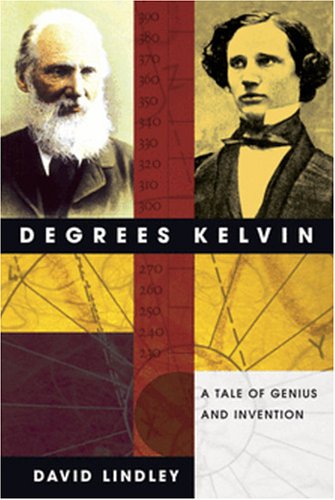
Elevated to the peerage by Queen Victoria for his many achievements, Sir William Thomson, Lord Kelvin was once Great Britain's most celebrated scientist. In this accessibly written biography, Lindley (an astrophysicist by training) describes Thomson's groundbreaking work in the areas of heat, light, electricity, and magnetism. He also discusses Thomson's refusal to accept the validity of newer discoveries, which eventually led to his ostracism from the scientific community. Annotation ©2004 Book News, Inc., Portland, OR (booknews.com)
"Sinopsis" puede pertenecer a otra edición de este libro.
Reseña del editor
In 1840, a precocious 16-year-old by the name of William Thomson spent his summer vacation studying an extraordinarily sophisticated mathematical controversy. His brilliant analysis inspired lavish praise and made the boy an instant intellectual celebrity. As a young scholar William dazzled a Victorian society enthralled with the seductive authority and powerful beauty of scientific discovery. At a time when no one really understood heat, light, electricity, or magnetism, Thomson found key connections between them, laying the groundwork for two of the cornerstones of 19th century science - the theories of electromagnetism and thermodynamics. Charismatic, confident, and boyishly handsome, Thomson was not a scientist who labored quietly in a lab, plying his trade in monkish isolation. When scores of able tinkerers were flummoxed by their inability to adapt overland telegraphic cables to underwater, intercontinental use, Thomson took to the high seas with new equipment that was to change the face of modern communications. And as the world's navies were transitioning from wooden to iron ships, they looked to Thomson to devise a compass that would hold true even when surrounded by steel. Gaining fame and wealth through his inventive genius, Thomson was elevated to the peerage by Queen Victoria for his many achievements. He was the first scientist ever to be so honored. Indeed, his name survives in the designation of degrees Kelvin, the temperature scale that begins with absolute zero, the point at which atomic motion ceases and there is a complete absence of heat. Sir William Thomson, Lord Kelvin, was Great Britain's unrivalled scientific hero. But as the century drew to a close and Queen Victoria's reign ended, this legendary scientific mind began to weaken. He grudgingly gave way to others with a keener, more modern vision. But the great physicist did not go quietly. With a ready pulpit at his disposal, he publicly proclaimed his doubts over the existence of atoms. He refused to believe that radioactivity involved the transmutation of elements. And believing that the origin of life was a matter beyond the expertise of science and better left to theologians, he vehemently opposed the doctrines of evolution, repeatedly railing against Charles Darwin. Sadly, this pioneer of modern science spent his waning years arguing that the Earth and the Sun could not be more than 100 million years old. And although his early mathematical prowess had transformed our understanding of the forces of nature, he would never truly accept the revolutionary changes he had helped bring about, and it was others who took his ideas to their logical conclusion. In the end, Thomson came to stand for all that was old and complacent in the world of 19th century science. Once a scientific force to be reckoned with, a leader to whom others eagerly looked for answers, his peers in the end left him behind - and then meted out the ultimate punishment for not being able to keep step with them. For while they were content to bury him in Westminster Abbey alongside Isaac Newton, they used his death as an opportunity to write him out of the scientific record, effectively denying him his place in history. Kelvin's name soon faded from the headlines, his seminal ideas forgotten, his crucial contributions overshadowed. Destined to become the definitive biography of one of the most important figures in modern science, "Degrees Kelvin" unravels the mystery of a life composed of equal parts triumph and tragedy, hubris and humility, yielding a surprising and compelling portrait of a complex and enigmatic man.
Biografía del autor
David Lindley
"Sobre este título" puede pertenecer a otra edición de este libro.
Resultados de la búsqueda para Degrees Kelvin: A Tale of Genius, Invention, and Tragedy

Imagen de archivo
Degrees Kelvin: A Tale of Genius, Invention, and Tragedy
Publicado por
National Academies Press, 2004
ISBN 10: 0309090733
ISBN 13: 9780309090735
Antiguo o usado
Tapa dura
Librería: World of Books (was SecondSale), Montgomery, IL, Estados Unidos de America
Calificación del vendedor: 5 de 5 estrellas

Hardback. Condición: Good. LORD KELVIN. In 1840, a precocious 16-year-old by the name of William Thomson spent his summer vacation studying an extraordinarily sophisticated mathematical controversy. His brilliant analysis inspired lavish praise and made the boy an instant intellectual celebrity. As a young scholar William dazzled a Victorian society enthralled with the seductive authority and powerful beauty of scientific discovery. At a time when no one really understood heat, light, electricity, or magnetism, Thomson found key connections between them, laying the groundwork for two of the cornerstones of 19th century science -- the theories of electromagnetism and thermodynamics. Charismatic, confident, and boyishly handsome, Thomson was not a scientist who labored quietly in a lab, plying his trade in monkish isolation. When scores of able tinkerers were flummoxed by their inability to adapt overland telegraphic cables to underwater, intercontinental use, Thomson took to the high seas with new equipment that was to change the face of modern communications. And as the worlda (TM)s navies were transitioning from wooden to iron ships, they looked to Thomson to devise a compass that would hold true even when surrounded by steel. Gaining fame and wealth through his inventive genius, Thomson was elevated to the peerage by Queen Victoria for his many achievements. He was the first scientist ever to be so honored. Indeed, his name survives in the designation of degrees Kelvin, the temperature scale that begins with absolute zero, the point at which atomic motion ceases and there is a complete absence of heat. Sir William Thomson, Lord Kelvin, was Great Britain's unrivaled scientific hero. But as the century drew to a close and Queen Victoria's reign ended, this legendary scientific mind began to weaken. He grudgingly gave way to others with a keener, more modern vision. But the great physicist did not go quietly. With a ready pulpit at his disposal, he publicly proclaimed his doubts over the existence of atoms. He refused to believe that radioactivity involved the transmutation of elements. And believing that the origin of life was a matter beyond the expertise of science and better left to theologians, he vehemently opposed the doctrines of evolution, repeatedly railing against Charles Darwin. Sadly, this pioneer of modern science spent his waning years arguing that the Earth and the Sun could not be more than 100 million years old. And although his early mathematical prowess had transformed our understanding of the forces of nature, he would never truly accept the revolutionary changes he had helped bring about, and it was others who took his ideas to their logical conclusion. In the end Thomson came to stand for all that was old and complacent in the world of 19th century science. Once a scientific force to be reckoned with, a leader to whom others eagerly looked for answers, his peers in the end left him behind -- and then meted out the ultimate punishment for not being able to keep step with them. For while they were content to bury him in Westminster Abbey alongside Isaac Newton, they used his death as an opportunity to write him out of the scientific record, effectively denying him his place in history. Kelvina (TM)s name soon faded from the headlines, his seminal ideas forgotten, his crucial contributions overshadowed. Destined to become the definitive biography of one of the most important figures in modern science, Degrees Kelvin unravels the mystery of a life composed of equal parts triumph and tragedy, hubris and humility, yielding a surprising and compelling portrait of a complex and enigmatic man. Nº de ref. del artículo: CIN0309090733G
Comprar usado
EUR 5,53
Gastos de envío gratis
Se envía dentro de Estados Unidos de America
Se envía dentro de Estados Unidos de America
Cantidad disponible: 1 disponibles
Imagen de archivo
Degrees Kelvin: A Tale of Genius, Invention, and Tragedy
Publicado por
National Academies Press, 2004
ISBN 10: 0309090733
ISBN 13: 9780309090735
Antiguo o usado
Tapa dura
Librería: World of Books Inc, Montgomery, IL, Estados Unidos de America
Calificación del vendedor: 4 de 5 estrellas

Hardback. Condición: Good. LORD KELVIN. In 1840, a precocious 16-year-old by the name of William Thomson spent his summer vacation studying an extraordinarily sophisticated mathematical controversy. His brilliant analysis inspired lavish praise and made the boy an instant intellectual celebrity. As a young scholar William dazzled a Victorian society enthralled with the seductive authority and powerful beauty of scientific discovery. At a time when no one really understood heat, light, electricity, or magnetism, Thomson found key connections between them, laying the groundwork for two of the cornerstones of 19th century science -- the theories of electromagnetism and thermodynamics. Charismatic, confident, and boyishly handsome, Thomson was not a scientist who labored quietly in a lab, plying his trade in monkish isolation. When scores of able tinkerers were flummoxed by their inability to adapt overland telegraphic cables to underwater, intercontinental use, Thomson took to the high seas with new equipment that was to change the face of modern communications. And as the worlda (TM)s navies were transitioning from wooden to iron ships, they looked to Thomson to devise a compass that would hold true even when surrounded by steel. Gaining fame and wealth through his inventive genius, Thomson was elevated to the peerage by Queen Victoria for his many achievements. He was the first scientist ever to be so honored. Indeed, his name survives in the designation of degrees Kelvin, the temperature scale that begins with absolute zero, the point at which atomic motion ceases and there is a complete absence of heat. Sir William Thomson, Lord Kelvin, was Great Britain's unrivaled scientific hero. But as the century drew to a close and Queen Victoria's reign ended, this legendary scientific mind began to weaken. He grudgingly gave way to others with a keener, more modern vision. But the great physicist did not go quietly. With a ready pulpit at his disposal, he publicly proclaimed his doubts over the existence of atoms. He refused to believe that radioactivity involved the transmutation of elements. And believing that the origin of life was a matter beyond the expertise of science and better left to theologians, he vehemently opposed the doctrines of evolution, repeatedly railing against Charles Darwin. Sadly, this pioneer of modern science spent his waning years arguing that the Earth and the Sun could not be more than 100 million years old. And although his early mathematical prowess had transformed our understanding of the forces of nature, he would never truly accept the revolutionary changes he had helped bring about, and it was others who took his ideas to their logical conclusion. In the end Thomson came to stand for all that was old and complacent in the world of 19th century science. Once a scientific force to be reckoned with, a leader to whom others eagerly looked for answers, his peers in the end left him behind -- and then meted out the ultimate punishment for not being able to keep step with them. For while they were content to bury him in Westminster Abbey alongside Isaac Newton, they used his death as an opportunity to write him out of the scientific record, effectively denying him his place in history. Kelvina (TM)s name soon faded from the headlines, his seminal ideas forgotten, his crucial contributions overshadowed. Destined to become the definitive biography of one of the most important figures in modern science, Degrees Kelvin unravels the mystery of a life composed of equal parts triumph and tragedy, hubris and humility, yielding a surprising and compelling portrait of a complex and enigmatic man. Nº de ref. del artículo: CIN0309090733G
Comprar usado
EUR 7,38
Gastos de envío gratis
Se envía dentro de Estados Unidos de America
Se envía dentro de Estados Unidos de America
Cantidad disponible: 1 disponibles
Imagen de archivo
Degrees Kelvin: A Tale of Genius, Invention, and Tragedy
Publicado por
Joseph Henry Press, 2004
ISBN 10: 0309090733
ISBN 13: 9780309090735
Antiguo o usado
Tapa dura
Librería: HPB-Ruby, Dallas, TX, Estados Unidos de America
Calificación del vendedor: 5 de 5 estrellas
hardcover. Condición: Very Good. Connecting readers with great books since 1972! Used books may not include companion materials, and may have some shelf wear or limited writing. We ship orders daily and Customer Service is our top priority! Nº de ref. del artículo: S_472106352
Comprar usado
EUR 5,06
Envío por EUR 3,36
Se envía dentro de Estados Unidos de America
Se envía dentro de Estados Unidos de America
Cantidad disponible: 1 disponibles
Imagen de archivo
Degrees Kelvin : A Tale of Genius, Invention, and Tragedy
Publicado por
National Academies Press, 2004
ISBN 10: 0309090733
ISBN 13: 9780309090735
Antiguo o usado
Tapa dura
Librería: Better World Books, Mishawaka, IN, Estados Unidos de America
Calificación del vendedor: 5 de 5 estrellas
Condición: Good. Former library copy. Pages intact with minimal writing/highlighting. The binding may be loose and creased. Dust jackets/supplements are not included. Includes library markings. Stock photo provided. Product includes identifying sticker. Better World Books: Buy Books. Do Good. Nº de ref. del artículo: 3176063-6
Comprar usado
EUR 8,61
Gastos de envío gratis
Se envía dentro de Estados Unidos de America
Se envía dentro de Estados Unidos de America
Cantidad disponible: 3 disponibles
Imagen de archivo
Degrees Kelvin : A Tale of Genius, Invention, and Tragedy
Publicado por
National Academies Press, 2004
ISBN 10: 0309090733
ISBN 13: 9780309090735
Antiguo o usado
Tapa dura
Librería: Better World Books: West, Reno, NV, Estados Unidos de America
Calificación del vendedor: 5 de 5 estrellas
Condición: Very Good. Pages intact with possible writing/highlighting. Binding strong with minor wear. Dust jackets/supplements may not be included. Stock photo provided. Product includes identifying sticker. Better World Books: Buy Books. Do Good. Nº de ref. del artículo: 15257683-6
Comprar usado
EUR 8,61
Gastos de envío gratis
Se envía dentro de Estados Unidos de America
Se envía dentro de Estados Unidos de America
Cantidad disponible: 1 disponibles
Imagen de archivo
Degrees Kelvin : A Tale of Genius, Invention, and Tragedy
Publicado por
National Academies Press, 2004
ISBN 10: 0309090733
ISBN 13: 9780309090735
Antiguo o usado
Tapa dura
Librería: Better World Books: West, Reno, NV, Estados Unidos de America
Calificación del vendedor: 5 de 5 estrellas
Condición: Good. Pages intact with minimal writing/highlighting. The binding may be loose and creased. Dust jackets/supplements are not included. Stock photo provided. Product includes identifying sticker. Better World Books: Buy Books. Do Good. Nº de ref. del artículo: 6416561-6
Comprar usado
EUR 8,61
Gastos de envío gratis
Se envía dentro de Estados Unidos de America
Se envía dentro de Estados Unidos de America
Cantidad disponible: 1 disponibles
Imagen del vendedor
Degrees Kelvin: A Tale of Genius, Invention, and Tragedy
Publicado por
Joseph Henry Press, 2004
ISBN 10: 0309090733
ISBN 13: 9780309090735
Antiguo o usado
Tapa dura
Librería: -OnTimeBooks-, Phoenix, AZ, Estados Unidos de America
Calificación del vendedor: 5 de 5 estrellas
Condición: good. A copy that has been read, remains in good condition. All pages are intact, and the cover is intact. The spine and cover show signs of wear. Pages can include notes and highlighting and show signs of wear, and the copy can include "From the library of" labels or previous owner inscriptions. 100% GUARANTEE! Shipped with delivery confirmation, if you're not satisfied with purchase please return item! Ships via media mail. Nº de ref. del artículo: OTV.0309090733.G
Comprar usado
EUR 10,10
Gastos de envío gratis
Se envía dentro de Estados Unidos de America
Se envía dentro de Estados Unidos de America
Cantidad disponible: 1 disponibles
Imagen de archivo
Degrees Kelvin: A Tale of Genius, Invention, and Tragedy
Publicado por
Joseph Henry Press, 2004
ISBN 10: 0309090733
ISBN 13: 9780309090735
Antiguo o usado
Tapa dura
Librería: Book Alley, Pasadena, CA, Estados Unidos de America
Calificación del vendedor: 4 de 5 estrellas
hardcover. Condición: Good. Estado de la sobrecubierta: Good. Good in dust jacket. Used with wear but is still in solid reading condition. NO markings to text. Pasadena's finest new and used bookstore since 1992. Nº de ref. del artículo: mon0000768658
Comprar usado
EUR 9,19
Envío por EUR 5,38
Se envía dentro de Estados Unidos de America
Se envía dentro de Estados Unidos de America
Cantidad disponible: 1 disponibles
Imagen de archivo
Degrees Kelvin: A Tale of Genius, Invention, and Tragedy
Publicado por
Joseph Henry Press, Washington D.C, 2004
ISBN 10: 0309090733
ISBN 13: 9780309090735
Antiguo o usado
Tapa dura
Librería: Book Bear, West Brookfield, MA, Estados Unidos de America
Calificación del vendedor: 5 de 5 estrellas
Cloth. Condición: Very Good. 366 pp. Tightly bound. Corners not bumped. Text is free of markings. No ownership markings. Two small faint tan spots on front end paper and front paste down. Nº de ref. del artículo: 025327
Comprar usado
EUR 10,15
Envío por EUR 4,46
Se envía dentro de Estados Unidos de America
Se envía dentro de Estados Unidos de America
Cantidad disponible: 1 disponibles
Imagen de archivo
Degrees Kelvin: A Tale of Genius, Invention, and Tragedy
Publicado por
Joseph Henry Press, 2004
ISBN 10: 0309090733
ISBN 13: 9780309090735
Antiguo o usado
Tapa dura
Original o primera edición
Librería: FITZ BOOKS AND WAFFLES, Buffalo, NY, Estados Unidos de America
Calificación del vendedor: 5 de 5 estrellas
Hardcover. Condición: Very Good. Estado de la sobrecubierta: Good. 1st Edition. Clean copy with unmarked and undamaged pages, intact dust jacket. Nº de ref. del artículo: ABE-1722122696813
Comprar usado
EUR 11,08
Envío por EUR 3,59
Se envía dentro de Estados Unidos de America
Se envía dentro de Estados Unidos de America
Cantidad disponible: 1 disponibles