
Artículos relacionados a The Anonymous Renaissance: Cultures of Discretion in...
Sinopsis
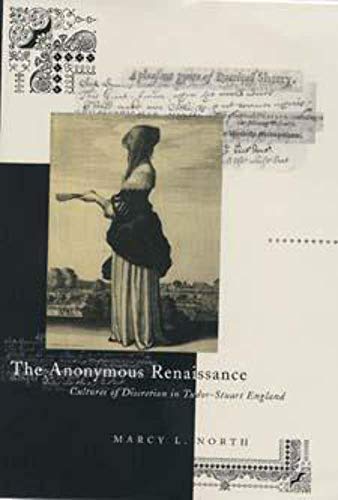
The Renaissance was in many ways the beginning of modern and self-conscious authorship, a time when individual genius was celebrated and an author's name could become a book trade commodity. Why, then, did anonymous authorship flourish during the Renaissance rather than disappear? In addressing this puzzle, Marcy L. North reveals the rich history and popularity of anonymity during this period. The book trade, she argues, created many intriguing and paradoxical uses for anonymity, even as the authorial name became more marketable. Among ecclesiastical debaters, for instance, anonymity worked to conceal identity, but it could also be used to identify the moral character of the author being concealed. In court and coterie circles, meanwhile, authors turned name suppression into a tool for the preservation of social boundaries. Finally, in both print and manuscript, anonymity promised to liberate an authentic female voice, yet made it impossible to authenticate the gender of an author, in sum, the writers and book producers who helped to create England's literary culture viewed anonymity as a meaningful and useful practice. Written with precision and grace, "The Anonymous Renaissance" should fill a prominent gap in the study of authorship and English literary history.
"Sinopsis" puede pertenecer a otra edición de este libro.
Acerca del autor
Marcy L. North is an assistant professor of English at Florida State University.
De la solapa interior
"The Anonymous Renaissance offers a paradigm-shifting look at print culture in early modern England. North demonstrates through sound historical discussions and readings that anonymity was one of the defining practices of Renaissance authorship. It is difficult to overstate the originality and importance of this new study."-Jennifer Summit, Stanford University
The Renaissance was in many ways the beginning of modern and self-conscious authorship, a time when individual genius was celebrated and an author's name could become a book trade commodity. Why, then, did anonymous authorship flourish during the Renaissance rather than disappear? In addressing this puzzle, Marcy L. North reveals the rich history and popularity of anonymity during this period.
The book trade, she argues, created many intriguing and paradoxical uses for anonymity, even as the authorial name became more marketable. Among ecclesiastical debaters, for instance, anonymity worked to conceal identity, but it could also be used to identify the moral character of the author being concealed. In court and coterie circles, meanwhile, authors turned name suppression into a tool for the preservation of social boundaries. Finally, in both print and manuscript, anonymity promised to liberate an authentic female voice, and yet made it impossible to authenticate the gender of an author. In sum, the writers and book producers who helped to create England's literary culture viewed anonymity as a meaningful and useful practice.
Written with clarity and grace, The Anonymous Renaissance will fill a prominent gap in the study of authorship and English literary history.
The Renaissance was in many ways the beginning of modern and self-conscious authorship, a time when individual genius was celebrated and an author's name could become a book trade commodity. Why, then, did anonymous authorship flourish during the Renaissance rather than disappear? In addressing this puzzle, Marcy L. North reveals the rich history and popularity of anonymity during this period.
The book trade, she argues, created many intriguing and paradoxical uses for anonymity, even as the authorial name became more marketable. Among ecclesiastical debaters, for instance, anonymity worked to conceal identity, but it could also be used to identify the moral character of the author being concealed. In court and coterie circles, meanwhile, authors turned name suppression into a tool for the preservation of social boundaries. Finally, in both print and manuscript, anonymity promised to liberate an authentic female voice, and yet made it impossible to authenticate the gender of an author. In sum, the writers and book producers who helped to create England's literary culture viewed anonymity as a meaningful and useful practice.
Written with clarity and grace, The Anonymous Renaissance will fill a prominent gap in the study of authorship and English literary history.
"Sobre este título" puede pertenecer a otra edición de este libro.
Resultados de la búsqueda para The Anonymous Renaissance: Cultures of Discretion in...

Imagen de archivo
The Anonymous Renaissance: Cultures of Discretion in Tudor-Stuart England
Publicado por
The University of Chicago Press, 2003
ISBN 10: 0226594378
ISBN 13: 9780226594378
Antiguo o usado
Tapa dura
Librería: World of Books (was SecondSale), Montgomery, IL, Estados Unidos de America
Calificación del vendedor: 5 de 5 estrellas

Hardback. Condición: Very Good. Marcy L. North addresses the question of why anonymous authorship flourished more during the renaissance when individual genius was celebrated, than at any other time? Examining the book trade and issues of morality and gender this work reveals a complex history. Nº de ref. del artículo: CIN0226594378VG
Comprar usado
EUR 145,94
Gastos de envío gratis
Se envía dentro de Estados Unidos de America
Se envía dentro de Estados Unidos de America
Cantidad disponible: 1 disponibles
Imagen de archivo
The Anonymous Renaissance: Cultures of Discretion in Tudor-Stuart England
Publicado por
The University of Chicago Press, 2003
ISBN 10: 0226594378
ISBN 13: 9780226594378
Antiguo o usado
Tapa dura
Librería: World of Books Inc, Montgomery, IL, Estados Unidos de America
Calificación del vendedor: 4 de 5 estrellas

Hardback. Condición: Very Good. Marcy L. North addresses the question of why anonymous authorship flourished more during the renaissance when individual genius was celebrated, than at any other time? Examining the book trade and issues of morality and gender this work reveals a complex history. Nº de ref. del artículo: CIN0226594378VG
Comprar usado
EUR 153,24
Gastos de envío gratis
Se envía dentro de Estados Unidos de America
Se envía dentro de Estados Unidos de America
Cantidad disponible: 1 disponibles