
Importe total (1 artículo artículos):
Destino del pedido:

robust network compressive sensing de xue guangtao (16 resultados)
Ir a los resultados principales
Filtros de búsqueda
Tipo de artículo
- Todos los tipos de productos
- Libros (16)
- Revistas y publicaciones (No hay ningún otro resultado que coincida con este filtro.)
- Cómics (No hay ningún otro resultado que coincida con este filtro.)
- Partituras (No hay ningún otro resultado que coincida con este filtro.)
- Arte, grabados y pósters (No hay ningún otro resultado que coincida con este filtro.)
- Fotografías (No hay ningún otro resultado que coincida con este filtro.)
- Mapas (No hay ningún otro resultado que coincida con este filtro.)
- Manuscritos y coleccionismo de papel (No hay ningún otro resultado que coincida con este filtro.)
Condición Más información
- Nuevo (14)
- Como nuevo, Excelente o Muy bueno (2)
- Bueno o Aceptable (No hay ningún otro resultado que coincida con este filtro.)
- Regular o Pobre (No hay ningún otro resultado que coincida con este filtro.)
- Tal como se indica (No hay ningún otro resultado que coincida con este filtro.)
Encuadernación
- Todas
- Tapa dura (No hay ningún otro resultado que coincida con este filtro.)
- Tapa blanda (16)
Más atributos
- Primera edición (No hay ningún otro resultado que coincida con este filtro.)
- Firmado (No hay ningún otro resultado que coincida con este filtro.)
- Sobrecubierta (No hay ningún otro resultado que coincida con este filtro.)
- Con imágenes (9)
- No impresión bajo demanda (12)
Idioma (1)
Precio
- Cualquier precio
- Menos de EUR 20 (No hay ningún otro resultado que coincida con este filtro.)
- EUR 20 a EUR 45 (No hay ningún otro resultado que coincida con este filtro.)
- Más de EUR 45
Gastos de envío gratis
- Envío gratis a Estados Unidos de America (No hay ningún otro resultado que coincida con este filtro.)
Ubicación del vendedor
Valoración de los vendedores
-

Robust Network Compressive Sensing
Librería: GreatBookPrices, Columbia, MD, Estados Unidos de America
Calificación del vendedor: 5 de 5 estrellas

EUR 53,69
EUR 2,27 gastos de envío en Estados Unidos de AmericaCantidad disponible: 15 disponibles
Añadir al carritoCondición: New.
-

Robust Network Compressive Sensing (SpringerBriefs in Computer Science)
Librería: Lucky's Textbooks, Dallas, TX, Estados Unidos de America
Calificación del vendedor: 5 de 5 estrellas
EUR 52,49
EUR 3,44 gastos de envío en Estados Unidos de AmericaCantidad disponible: Más de 20 disponibles
Añadir al carritoCondición: New.
-

Robust Network Compressive Sensing
Librería: GreatBookPrices, Columbia, MD, Estados Unidos de America
Calificación del vendedor: 5 de 5 estrellas
EUR 57,14
EUR 2,27 gastos de envío en Estados Unidos de AmericaCantidad disponible: 15 disponibles
Añadir al carritoCondición: As New. Unread book in perfect condition.
-
Robust Network Compressive Sensing (SpringerBriefs in Computer Science)
Librería: Ria Christie Collections, Uxbridge, Reino Unido
Calificación del vendedor: 5 de 5 estrellas
EUR 51,93
EUR 13,63 gastos de envío desde Reino Unido a Estados Unidos de AmericaCantidad disponible: Más de 20 disponibles
Añadir al carritoCondición: New. In.
-
Robust Network Compressive Sensing
Librería: Chiron Media, Wallingford, Reino Unido
Calificación del vendedor: 4 de 5 estrellas

EUR 49,34
EUR 17,63 gastos de envío desde Reino Unido a Estados Unidos de AmericaCantidad disponible: 10 disponibles
Añadir al carritoPF. Condición: New.
-

Robust Network Compressive Sensing
Librería: GreatBookPricesUK, Woodford Green, Reino Unido
Calificación del vendedor: 5 de 5 estrellas
EUR 51,92
EUR 17,07 gastos de envío desde Reino Unido a Estados Unidos de AmericaCantidad disponible: Más de 20 disponibles
Añadir al carritoCondición: New.
-

Robust Network Compressive Sensing
Librería: GreatBookPricesUK, Woodford Green, Reino Unido
Calificación del vendedor: 5 de 5 estrellas
EUR 58,28
EUR 17,07 gastos de envío desde Reino Unido a Estados Unidos de AmericaCantidad disponible: Más de 20 disponibles
Añadir al carritoCondición: As New. Unread book in perfect condition.
-
Robust Network Compressive Sensing
Librería: Books Puddle, New York, NY, Estados Unidos de America
Calificación del vendedor: 4 de 5 estrellas
EUR 74,78
EUR 3,44 gastos de envío en Estados Unidos de AmericaCantidad disponible: 4 disponibles
Añadir al carritoCondición: New.
-
Robust Network Compressive Sensing
Publicado por Springer-Nature New York Inc, 2022
ISBN 10: 3031168283 ISBN 13: 9783031168284
Idioma: Inglés
Librería: Revaluation Books, Exeter, Reino Unido
Calificación del vendedor: 5 de 5 estrellas
EUR 75,34
EUR 11,38 gastos de envío desde Reino Unido a Estados Unidos de AmericaCantidad disponible: 2 disponibles
Añadir al carritoPaperback. Condición: Brand New. 100 pages. 9.25x6.10x0.21 inches. In Stock.
-

Robust Network Compressive Sensing
Publicado por Springer International Publishing, Springer International Publishing Okt 2022, 2022
ISBN 10: 3031168283 ISBN 13: 9783031168284
Idioma: Inglés
Librería: buchversandmimpf2000, Emtmannsberg, BAYE, Alemania
Calificación del vendedor: 5 de 5 estrellas
EUR 53,49
EUR 60,00 gastos de envío desde Alemania a Estados Unidos de AmericaCantidad disponible: 2 disponibles
Añadir al carritoTaschenbuch. Condición: Neu. Neuware -This book investigates compressive sensing techniques to provide a robust and general framework for network data analytics. The goal is to introduce a compressive sensing framework for missing data interpolation, anomaly detection, data segmentation and activity recognition, and to demonstrate its benefits. Chapter 1 introduces compressive sensing, including its definition, limitation, and how it supports different network analysis applications. Chapter 2 demonstrates the feasibility of compressive sensing in network analytics, the authors we apply it to detect anomalies in the customer care call dataset from a Tier 1 ISP in the United States. A regression-based model is applied to find the relationship between calls and events. The authors illustrate that compressive sensing is effective in identifying important factors and can leverage the low-rank structure and temporal stability to improve the detection accuracy. Chapter 3 discusses that there are several challenges in applying compressive sensing to real-world data. Understanding the reasons behind the challenges is important for designing methods and mitigating their impact. The authors analyze a wide range of real-world traces. The analysis demonstrates that there are different factors that contribute to the violation of the low-rank property in real data. In particular, the authors find that (1) noise, errors, and anomalies, and (2) asynchrony in the time and frequency domains lead to network-induced ambiguity and can easily cause low-rank matrices to become higher-ranked. To address the problem of noise, errors and anomalies in Chap. 4, the authors propose a robust compressive sensing technique. It explicitly accounts for anomalies by decomposing real-world data represented in matrix form into a low-rank matrix, a sparse anomaly matrix, an error term and a small noise matrix. Chapter 5 addresses the problem of lack of synchronization, and the authors propose a data-driven synchronization algorithm.It can eliminate misalignment while taking into account the heterogeneity of real-world data in both time and frequency domains. The data-driven synchronization can be applied to any compressive sensing technique and is general to any real-world data. The authors illustrates that the combination of the two techniques can reduce the ranks of real-world data, improve the effectiveness of compressive sensing and have a wide range of applications.The networks are constantly generating a wealth of rich and diverse information. This information creates exciting opportunities for network analysis and provides insight into the complex interactions between network entities. However, network analysis often faces the problems of (1) under-constrained, where there is too little data due to feasibility and cost issues in collecting data, or (2) over-constrained, where there is too much data, so the analysis becomes unscalable. Compressive sensing is an effective technique to solve both problems. It utilizes the underlying data structure for analysis. Specifically, to solve the under-constrained problem, compressive sensing technologies can be applied to reconstruct the missing elements or predict the future data. Also, to solve the over-constraint problem, compressive sensing technologies can be applied to identify significant elementsTo support compressive sensing in network data analysis, a robust and general framework is needed to support diverse applications. Yet this can be challenging for real-world data where noise, anomalies and lack of synchronization are common. First, the number of unknowns for network analysis can be much larger than the number of measurements. For example, traffic engineering requires knowing the complete traffic matrix between all source and destination pairs, in order to properly configure traffic and avoid congestion. However, measuring the flow between aSpringer Verlag GmbH, Tiergartenstr. 17, 69121 Heidelberg 100 pp. Englisch.
-

Robust Network Compressive Sensing
Publicado por Springer International Publishing, 2022
ISBN 10: 3031168283 ISBN 13: 9783031168284
Idioma: Inglés
Librería: AHA-BUCH GmbH, Einbeck, Alemania
Calificación del vendedor: 5 de 5 estrellas
EUR 53,49
EUR 60,83 gastos de envío desde Alemania a Estados Unidos de AmericaCantidad disponible: 1 disponibles
Añadir al carritoTaschenbuch. Condición: Neu. Druck auf Anfrage Neuware - Printed after ordering - This book investigates compressive sensing techniques to provide a robust and general framework for network data analytics. The goal is to introduce a compressive sensing framework for missing data interpolation, anomaly detection, data segmentation and activity recognition, and to demonstrate its benefits. Chapter 1 introduces compressive sensing, including its definition, limitation, and how it supports different network analysis applications. Chapter 2 demonstrates the feasibility of compressive sensing in network analytics, the authors we apply it to detect anomalies in the customer care call dataset from a Tier 1 ISP in the United States. A regression-based model is applied to find the relationship between calls and events. The authors illustrate that compressive sensing is effective in identifying important factors and can leverage the low-rank structure and temporal stability to improve the detection accuracy. Chapter 3 discusses that there are several challenges in applying compressive sensing to real-world data. Understanding the reasons behind the challenges is important for designing methods and mitigating their impact. The authors analyze a wide range of real-world traces. The analysis demonstrates that there are different factors that contribute to the violation of the low-rank property in real data. In particular, the authors find that (1) noise, errors, and anomalies, and (2) asynchrony in the time and frequency domains lead to network-induced ambiguity and can easily cause low-rank matrices to become higher-ranked. To address the problem of noise, errors and anomalies in Chap. 4, the authors propose a robust compressive sensing technique. It explicitly accounts for anomalies by decomposing real-world data represented in matrix form into a low-rank matrix, a sparse anomaly matrix, an error term and a small noise matrix. Chapter 5 addresses the problem of lack of synchronization, and the authors propose a data-driven synchronization algorithm.It can eliminate misalignment while taking into account the heterogeneity of real-world data in both time and frequency domains. The data-driven synchronization can be applied to any compressive sensing technique and is general to any real-world data. The authors illustrates that the combination of the two techniques can reduce the ranks of real-world data, improve the effectiveness of compressive sensing and have a wide range of applications.The networks are constantly generating a wealth of rich and diverse information. This information creates exciting opportunities for network analysis and provides insight into the complex interactions between network entities. However, network analysis often faces the problems of (1) under-constrained, where there is too little data due to feasibility and cost issues in collecting data, or (2) over-constrained, where there is too much data, so the analysis becomes unscalable. Compressive sensing is an effective technique to solve both problems. It utilizes the underlying data structure for analysis.Specifically, to solve the under-constrained problem, compressive sensing technologies can be applied to reconstruct the missing elements or predict the future data. Also, to solve the over-constraint problem, compressive sensing technologies can be applied to identify significant elementsTo support compressive sensing in network data analysis, a robust and general framework is needed to support diverse applications. Yet this can be challenging for real-world data where noise, anomalies and lack of synchronization are common. First, the number of unknowns for network analysis can be much larger than the number of measurements. For example, traffic engineering requires knowing the complete traffic matrix between all source and destination pairs, in order to properly configure traffic and avoid congestion. However, measuring the flow between all source and destination pairs is very expensive.
-
Robust Network Compressive Sensing
Librería: preigu, Osnabrück, Alemania
Calificación del vendedor: 5 de 5 estrellas
EUR 50,95
EUR 70,00 gastos de envío desde Alemania a Estados Unidos de AmericaCantidad disponible: 5 disponibles
Añadir al carritoTaschenbuch. Condición: Neu. Robust Network Compressive Sensing | Guangtao Xue (u. a.) | Taschenbuch | x | Englisch | 2022 | Springer | EAN 9783031168284 | Verantwortliche Person für die EU: Springer Verlag GmbH, Tiergartenstr. 17, 69121 Heidelberg, juergen[dot]hartmann[at]springer[dot]com | Anbieter: preigu.
-

Robust Network Compressive Sensing
Publicado por Springer International Publishing Okt 2022, 2022
ISBN 10: 3031168283 ISBN 13: 9783031168284
Idioma: Inglés
Librería: BuchWeltWeit Ludwig Meier e.K., Bergisch Gladbach, Alemania
Calificación del vendedor: 5 de 5 estrellas
EUR 53,49
EUR 23,00 gastos de envío desde Alemania a Estados Unidos de AmericaCantidad disponible: 2 disponibles
Añadir al carritoTaschenbuch. Condición: Neu. This item is printed on demand - it takes 3-4 days longer - Neuware -This book investigates compressive sensing techniques to provide a robust and general framework for network data analytics. The goal is to introduce a compressive sensing framework for missing data interpolation, anomaly detection, data segmentation and activity recognition, and to demonstrate its benefits. Chapter 1 introduces compressive sensing, including its definition, limitation, and how it supports different network analysis applications. Chapter 2 demonstrates the feasibility of compressive sensing in network analytics, the authors we apply it to detect anomalies in the customer care call dataset from a Tier 1 ISP in the United States. A regression-based model is applied to find the relationship between calls and events. The authors illustrate that compressive sensing is effective in identifying important factors and can leverage the low-rank structure and temporal stability to improve the detection accuracy. Chapter 3 discusses that there are several challenges in applying compressive sensing to real-world data. Understanding the reasons behind the challenges is important for designing methods and mitigating their impact. The authors analyze a wide range of real-world traces. The analysis demonstrates that there are different factors that contribute to the violation of the low-rank property in real data. In particular, the authors find that (1) noise, errors, and anomalies, and (2) asynchrony in the time and frequency domains lead to network-induced ambiguity and can easily cause low-rank matrices to become higher-ranked. To address the problem of noise, errors and anomalies in Chap. 4, the authors propose a robust compressive sensing technique. It explicitly accounts for anomalies by decomposing real-world data represented in matrix form into a low-rank matrix, a sparse anomaly matrix, an error term and a small noise matrix. Chapter 5 addresses the problem of lack of synchronization, and the authors propose a data-driven synchronization algorithm.It can eliminate misalignment while taking into account the heterogeneity of real-world data in both time and frequency domains. The data-driven synchronization can be applied to any compressive sensing technique and is general to any real-world data. The authors illustrates that the combination of the two techniques can reduce the ranks of real-world data, improve the effectiveness of compressive sensing and have a wide range of applications.The networks are constantly generating a wealth of rich and diverse information. This information creates exciting opportunities for network analysis and provides insight into the complex interactions between network entities. However, network analysis often faces the problems of (1) under-constrained, where there is too little data due to feasibility and cost issues in collecting data, or (2) over-constrained, where there is too much data, so the analysis becomes unscalable. Compressive sensing is an effective technique to solve both problems. It utilizes the underlying data structure for analysis.Specifically, to solve the under-constrained problem, compressive sensing technologies can be applied to reconstruct the missing elements or predict the future data. Also, to solve the over-constraint problem, compressive sensing technologies can be applied to identify significant elementsTo support compressive sensing in network data analysis, a robust and general framework is needed to support diverse applications. Yet this can be challenging for real-world data where noise, anomalies and lack of synchronization are common. First, the number of unknowns for network analysis can be much larger than the number of measurements. For example, traffic engineering requires knowing the complete traffic matrix between all source and destination pairs, in order to properly configure traffic and avoid congestion. However, measuring the flow between all source and destination pairs is.
-
Robust Network Compressive Sensing
Librería: Majestic Books, Hounslow, Reino Unido
Calificación del vendedor: 4 de 5 estrellas
EUR 77,69
EUR 7,40 gastos de envío desde Reino Unido a Estados Unidos de AmericaCantidad disponible: 4 disponibles
Añadir al carritoCondición: New. Print on Demand.
-
Robust Network Compressive Sensing
Librería: Biblios, Frankfurt am main, HESSE, Alemania
Calificación del vendedor: 4 de 5 estrellas
EUR 78,75
EUR 9,95 gastos de envío desde Alemania a Estados Unidos de AmericaCantidad disponible: 4 disponibles
Añadir al carritoCondición: New. PRINT ON DEMAND.
-
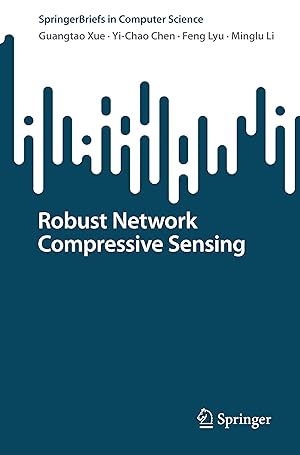
Robust Network Compressive Sensing
Publicado por Springer, Berlin|Springer International Publishing|Springer, 2022
ISBN 10: 3031168283 ISBN 13: 9783031168284
Idioma: Inglés
Librería: moluna, Greven, Alemania
Calificación del vendedor: 4 de 5 estrellas
EUR 48,37
EUR 48,99 gastos de envío desde Alemania a Estados Unidos de AmericaCantidad disponible: Más de 20 disponibles
Añadir al carritoKartoniert / Broschiert. Condición: New. Dieser Artikel ist ein Print on Demand Artikel und wird nach Ihrer Bestellung fuer Sie gedruckt. This book investigates compressive sensing techniques to provide a robust and general framework for network data analytics. The goal is to introduce a compressive sensing framework for missing data interpolation, anomaly detection, data segmentation and .


