

Importe total (1 artículo artículos):
Destino del pedido:

image pattern recognition de kovalevsky v a (17 resultados)
Ir a los resultados principales
Filtros de búsqueda
Tipo de artículo
- Todos los tipos de productos
- Libros (17)
- Revistas y publicaciones (No hay ningún otro resultado que coincida con este filtro.)
- Cómics (No hay ningún otro resultado que coincida con este filtro.)
- Partituras (No hay ningún otro resultado que coincida con este filtro.)
- Arte, grabados y pósters (No hay ningún otro resultado que coincida con este filtro.)
- Fotografías (No hay ningún otro resultado que coincida con este filtro.)
- Mapas (No hay ningún otro resultado que coincida con este filtro.)
- Manuscritos y coleccionismo de papel (No hay ningún otro resultado que coincida con este filtro.)
Condición Más información
- Nuevo (11)
- Como nuevo, Excelente o Muy bueno (No hay ningún otro resultado que coincida con este filtro.)
- Bueno o Aceptable (4)
- Regular o Pobre (No hay ningún otro resultado que coincida con este filtro.)
- Tal como se indica (2)
Encuadernación
Más atributos
- Primera edición (3)
- Firmado (No hay ningún otro resultado que coincida con este filtro.)
- Sobrecubierta (No hay ningún otro resultado que coincida con este filtro.)
- Con imágenes (6)
- No impresión bajo demanda (11)
Idioma (2)
Gastos de envío gratis
- Envío gratis a Estados Unidos de America (No hay ningún otro resultado que coincida con este filtro.)
Ubicación del vendedor
Valoración de los vendedores
-

Image Pattern Recognition
Librería: Munster & Company LLC, ABAA/ILAB, Corvallis, OR, Estados Unidos de America
Miembro de asociación: ABAA CBA ILAB
Calificación del vendedor: 5 de 5 estrellas

Original o primera edición
EUR 13,49
Envío por EUR 1,68
Se envía dentro de Estados Unidos de AmericaCantidad disponible: 1 disponibles
Añadir al carritoCondición: Good. Springer Verlag, 1980. This Book is in Good Condition; First printing with full number line. Normal wear to covers and edges, previous owner's bookplate on front pastedown, text is clean with no marks, binding tight. Not Ex-Library or Remaindered. 100% Guaranteed. hardcover. Good.
-
IMAGE PATTERN RECOGNITION
Librería: Cape Cod Booksellers, Yarmouth, MA, Estados Unidos de America
Calificación del vendedor: 5 de 5 estrellas
Original o primera edición
EUR 16,42
Envío por EUR 3,40
Se envía dentro de Estados Unidos de AmericaCantidad disponible: 1 disponibles
Añadir al carritoHard Cover. Condición: Good+. No Jacket. First Edition. Springer-Verlag, 1980, First Edition, 8vo, 241 pages. Hardcover edition, no dust jacket, Ex-Libris, with usual markings, tape pull bottom of front board, else book in good+ condition. Size: 8vo - over 7¾" - 9¾" tall.
-
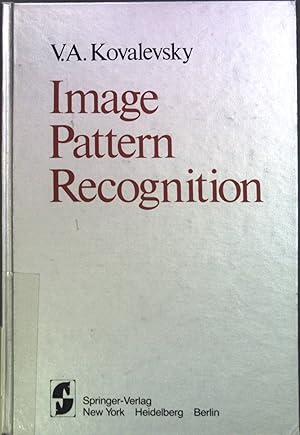
Image Pattern Recognition
Librería: books4less (Versandantiquariat Petra Gros GmbH & Co. KG), Welling, Alemania
Calificación del vendedor: 5 de 5 estrellas
EUR 11,45
Envío por EUR 15,95
Se envía de Alemania a Estados Unidos de AmericaCantidad disponible: 1 disponibles
Añadir al carritogebundene Ausgabe. Condición: Gut. 238 Seiten; Das hier angebotene Buch stammt aus einer teilaufgelösten wissenschaftlichen Bibliothek und trägt die entsprechenden Kennzeichnungen (Rückenschild, Instituts-Stempel.); leichte altersbedingte Anbräunung des Papiers; der Buchzustand ist ansonsten ordentlich und dem Alter entsprechend gut. Sprache: Englisch Gewicht in Gramm: 530.
-

Image Pattern Recognition
Publicado por Springer Verlag 1980, 1980
ISBN 10: 0387904409 ISBN 13: 9780387904405
Librería: Tacoma Book Center, Tacoma, WA, Estados Unidos de America
Calificación del vendedor: 4 de 5 estrellas

Original o primera edición
EUR 19,52
Envío por EUR 4,74
Se envía dentro de Estados Unidos de AmericaCantidad disponible: 1 disponibles
Añadir al carritoISBN 0-387-90440-9. Hardback. No Dustjacket. First Printing. Light edgewear, previous owner's name on front free endpaper, otherwise a Tight sound unmarked copy in Very Good condition.
-

Image pattern recognition. V. A. Kovalevsky. Transl. from the Russ. by Arthur Brown
Idioma: Inglés
Publicado por New York, Heidelberg, Berlin : Springer, 1980
ISBN 10: 3540904409 ISBN 13: 9783540904403
Librería: NEPO UG, Rüsselsheim am Main, Alemania
Calificación del vendedor: 5 de 5 estrellas
EUR 11,94
Envío por EUR 24,00
Se envía de Alemania a Estados Unidos de AmericaCantidad disponible: 1 disponibles
Añadir al carritoPp. Condición: Gut. XI, 241 S. : Ill., graph. Darst. , 25 cm Sofort verfügbar Versand spätestens am nächsten Arbeitstag Rechnung mit ausgewiesener MwSt. liegt bei daily shipping worldwide with invoice ex library in good condition aus Bibliothek in guten Zustand Metody optimal'nych resenij v raspoznavanii izobrazenij , Literaturverz. S. 228 - 234. Sprache: Englisch Gewicht in Gramm: 550.
-
Image pattern recognition. Transalated from the Russian by Arthur Brown
Publicado por Springer New York 1977, 1977
Librería: Antiquariat Thomas & Reinhard, Recklinghausen, NRW, Alemania
Calificación del vendedor: 5 de 5 estrellas
EUR 24,00
Envío por EUR 19,00
Se envía de Alemania a Estados Unidos de AmericaCantidad disponible: 1 disponibles
Añadir al carritoFormat groß 8°, kartoniert, Ecken leicht berieben, 241 Seiten, kleines Fleckchen auf dme Vorderschnitt, dies ist ein regulär ausgesondertes Bibliotheksexemplar aus einer wissenschaftlichen Bibliothek, keine Markierungen / Anmerkungen, das Buch befindet sich in einem guten Zustand --- Hardcover, 241 pages, corners slightlyrubbed, little dot on front cut, Lib.Ex., no marks, the book is in a good condition. Shipping to abroad insured with tracking number.
-

Image Pattern Recognition
Librería: Ria Christie Collections, Uxbridge, Reino Unido
Calificación del vendedor: 5 de 5 estrellas
EUR 60,14
Envío por EUR 13,87
Se envía de Reino Unido a Estados Unidos de AmericaCantidad disponible: Más de 20 disponibles
Añadir al carritoCondición: New. In.
-
Image Pattern Recognition
Librería: Chiron Media, Wallingford, Reino Unido
Calificación del vendedor: 5 de 5 estrellas
EUR 56,97
Envío por EUR 17,94
Se envía de Reino Unido a Estados Unidos de AmericaCantidad disponible: 10 disponibles
Añadir al carritoPaperback. Condición: New.
-
Image Pattern Recognition
Librería: Books Puddle, New York, NY, Estados Unidos de America
Calificación del vendedor: 4 de 5 estrellas
EUR 77,44
Envío por EUR 3,44
Se envía dentro de Estados Unidos de AmericaCantidad disponible: 4 disponibles
Añadir al carritoCondición: New. pp. 256.
-

Image Pattern Recognition
Librería: preigu, Osnabrück, Alemania
Calificación del vendedor: 5 de 5 estrellas
EUR 50,25
Envío por EUR 70,00
Se envía de Alemania a Estados Unidos de AmericaCantidad disponible: 5 disponibles
Añadir al carritoTaschenbuch. Condición: Neu. Image Pattern Recognition | V. A. Kovalevsky | Taschenbuch | 241 S. | Englisch | 2011 | Springer | EAN 9781461260356 | Verantwortliche Person für die EU: Springer Verlag GmbH, Tiergartenstr. 17, 69121 Heidelberg, juergen[dot]hartmann[at]springer[dot]com | Anbieter: preigu.
-

Image Pattern Recognition
Librería: AHA-BUCH GmbH, Einbeck, Alemania
Calificación del vendedor: 5 de 5 estrellas
EUR 58,39
Envío por EUR 61,97
Se envía de Alemania a Estados Unidos de AmericaCantidad disponible: 1 disponibles
Añadir al carritoTaschenbuch. Condición: Neu. Druck auf Anfrage Neuware - Printed after ordering - During the last twenty years the problem of pattern recognition (specifically, image recognition) has been studied intensively by many investigators, yet it is far from being solved. The number of publications increases yearly, but all the experimental results-with the possible exception of some dealing with recognition of printed characters-report a probability of error significantly higher than that reported for the same images by humans. It is widely agreed that ideally the recognition problem could be thought of as a problem in testing statistical hypotheses. However, in most applications the immediate use of even the simplest statistical device runs head on into grave computational difficulties, which cannot be eliminated by recourse to general theory. We must accept the fact that it is impossible to build a universal machine which can learn an arbitrary classification of multidimensional signals. Therefore the solution of the recognition problem must be based on a priori postulates (concerning the sets of signals to be recognized) that will narrow the set of possible classifications, i.e., the set of decision functions. This notion can be taken as the methodological basis for the approach adopted in this book.
-
Image Pattern Recognition (eng)
Librería: Brook Bookstore On Demand, Napoli, NA, Italia
Calificación del vendedor: 4 de 5 estrellas
EUR 46,22
Envío por EUR 5,50
Se envía de Italia a Estados Unidos de AmericaCantidad disponible: Más de 20 disponibles
Añadir al carritoCondición: new. Questo è un articolo print on demand.
-

Image Pattern Recognition
Idioma: Inglés
Publicado por Springer, Humana Okt 2011, 2011
ISBN 10: 1461260353 ISBN 13: 9781461260356
Librería: BuchWeltWeit Ludwig Meier e.K., Bergisch Gladbach, Alemania
Calificación del vendedor: 5 de 5 estrellas
EUR 53,49
Envío por EUR 23,00
Se envía de Alemania a Estados Unidos de AmericaCantidad disponible: 2 disponibles
Añadir al carritoTaschenbuch. Condición: Neu. This item is printed on demand - it takes 3-4 days longer - Neuware -During the last twenty years the problem of pattern recognition (specifically, image recognition) has been studied intensively by many investigators, yet it is far from being solved. The number of publications increases yearly, but all the experimental results-with the possible exception of some dealing with recognition of printed characters-report a probability of error significantly higher than that reported for the same images by humans. It is widely agreed that ideally the recognition problem could be thought of as a problem in testing statistical hypotheses. However, in most applications the immediate use of even the simplest statistical device runs head on into grave computational difficulties, which cannot be eliminated by recourse to general theory. We must accept the fact that it is impossible to build a universal machine which can learn an arbitrary classification of multidimensional signals. Therefore the solution of the recognition problem must be based on a priori postulates (concerning the sets of signals to be recognized) that will narrow the set of possible classifications, i.e., the set of decision functions. This notion can be taken as the methodological basis for the approach adopted in this book. 256 pp. Englisch.
-
Image Pattern Recognition
Librería: Majestic Books, Hounslow, Reino Unido
Calificación del vendedor: 4 de 5 estrellas
EUR 77,16
Envío por EUR 7,53
Se envía de Reino Unido a Estados Unidos de AmericaCantidad disponible: 4 disponibles
Añadir al carritoCondición: New. Print on Demand pp. 256 49:B&W 6.14 x 9.21 in or 234 x 156 mm (Royal 8vo) Perfect Bound on White w/Gloss Lam.
-
Image Pattern Recognition
Librería: Biblios, Frankfurt am main, HESSE, Alemania
Calificación del vendedor: 4 de 5 estrellas
EUR 77,87
Envío por EUR 9,95
Se envía de Alemania a Estados Unidos de AmericaCantidad disponible: 4 disponibles
Añadir al carritoCondición: New. PRINT ON DEMAND pp. 256.
-

Image Pattern Recognition
Librería: moluna, Greven, Alemania
Calificación del vendedor: 5 de 5 estrellas
EUR 48,37
Envío por EUR 48,99
Se envía de Alemania a Estados Unidos de AmericaCantidad disponible: Más de 20 disponibles
Añadir al carritoCondición: New. Dieser Artikel ist ein Print on Demand Artikel und wird nach Ihrer Bestellung fuer Sie gedruckt. During the last twenty years the problem of pattern recognition (specifically, image recognition) has been studied intensively by many investigators, yet it is far from being solved. The number of publications increases yearly, but all the experimental resu.
-

Image Pattern Recognition
Idioma: Inglés
Publicado por Springer, Springer Okt 2011, 2011
ISBN 10: 1461260353 ISBN 13: 9781461260356
Librería: buchversandmimpf2000, Emtmannsberg, BAYE, Alemania
Calificación del vendedor: 5 de 5 estrellas
EUR 53,49
Envío por EUR 60,00
Se envía de Alemania a Estados Unidos de AmericaCantidad disponible: 1 disponibles
Añadir al carritoTaschenbuch. Condición: Neu. This item is printed on demand - Print on Demand Titel. Neuware -During the last twenty years the problem of pattern recognition (specifically, image recognition) has been studied intensively by many investigators, yet it is far from being solved. The number of publications increases yearly, but all the experimental results-with the possible exception of some dealing with recognition of printed characters-report a probability of error significantly higher than that reported for the same images by humans. It is widely agreed that ideally the recognition problem could be thought of as a problem in testing statistical hypotheses. However, in most applications the immediate use of even the simplest statistical device runs head on into grave computational difficulties, which cannot be eliminated by recourse to general theory. We must accept the fact that it is impossible to build a universal machine which can learn an arbitrary classification of multidimensional signals. Therefore the solution of the recognition problem must be based on a priori postulates (concerning the sets of signals to be recognized) that will narrow the set of possible classifications, i.e., the set of decision functions. This notion can be taken as the methodological basis for the approach adopted in this book.Springer-Verlag KG, Sachsenplatz 4-6, 1201 Wien 256 pp. Englisch.


