
Importe total (1 artículo artículos):
Destino del pedido:

general purpose optimization information maximization de lockett alan (25 resultados)
Ir a los resultados principales
Filtros de búsqueda
Tipo de artículo
- Todos los tipos de productos
- Libros (25)
- Revistas y publicaciones (No hay ningún otro resultado que coincida con este filtro.)
- Cómics (No hay ningún otro resultado que coincida con este filtro.)
- Partituras (No hay ningún otro resultado que coincida con este filtro.)
- Arte, grabados y pósters (No hay ningún otro resultado que coincida con este filtro.)
- Fotografías (No hay ningún otro resultado que coincida con este filtro.)
- Mapas (No hay ningún otro resultado que coincida con este filtro.)
- Manuscritos y coleccionismo de papel (No hay ningún otro resultado que coincida con este filtro.)
Condición Más información
- Nuevo (23)
- Como nuevo, Excelente o Muy bueno (2)
- Bueno o Aceptable (No hay ningún otro resultado que coincida con este filtro.)
- Regular o Pobre (No hay ningún otro resultado que coincida con este filtro.)
- Tal como se indica (No hay ningún otro resultado que coincida con este filtro.)
Encuadernación
Más atributos
- Primera edición (No hay ningún otro resultado que coincida con este filtro.)
- Firmado (No hay ningún otro resultado que coincida con este filtro.)
- Sobrecubierta (No hay ningún otro resultado que coincida con este filtro.)
- Con imágenes (13)
- No impresión bajo demanda (20)
Idioma (1)
Precio
- Cualquier precio
- Menos de EUR 20 (No hay ningún otro resultado que coincida con este filtro.)
- EUR 20 a EUR 45 (No hay ningún otro resultado que coincida con este filtro.)
- Más de EUR 45
Gastos de envío gratis
Ubicación del vendedor
Valoración de los vendedores
-

General-Purpose Optimization Through Information Maximization (Natural Computing Series)
Librería: Lucky's Textbooks, Dallas, TX, Estados Unidos de America
Calificación del vendedor: 5 de 5 estrellas

EUR 204,09
EUR 3,43 shipping
Ships within Estados Unidos de AmericaCantidad disponible: Más de 20 disponibles
Añadir al carritoCondición: New.
-

General-purpose Optimization Through Information Maximization
Librería: GreatBookPrices, Columbia, MD, Estados Unidos de America
Calificación del vendedor: 5 de 5 estrellas
EUR 205,48
EUR 2,27 shipping
Ships within Estados Unidos de AmericaCantidad disponible: Más de 20 disponibles
Añadir al carritoCondición: New.
-

General-Purpose Optimization Through Information Maximization (Hardcover)
Publicado por Springer-Verlag Berlin and Heidelberg GmbH & Co. KG, Berlin, 2020
ISBN 10: 3662620065 ISBN 13: 9783662620069
Idioma: Inglés
Librería: Grand Eagle Retail, Bensenville, IL, Estados Unidos de America
Calificación del vendedor: 5 de 5 estrellas
EUR 207,83
Gastos de envío gratis
Ships within Estados Unidos de AmericaCantidad disponible: 1 disponibles
Añadir al carritoHardcover. Condición: new. Hardcover. This book examines the mismatch between discrete programs, which lie at the center of modern applied mathematics, and the continuous space phenomena they simulate. The author considers whether we can imagine continuous spaces of programs, and asks what the structure of such spaces would be and how they would be constituted. He proposes a functional analysis of program spaces focused through the lens of iterative optimization.The author begins with the observation that optimization methods such as Genetic Algorithms, Evolution Strategies, and Particle Swarm Optimization can be analyzed as Estimation of Distributions Algorithms (EDAs) in that they can be formulated as conditional probability distributions. The probabilities themselves are mathematical objects that can be compared and operated on, and thus many methods in Evolutionary Computation can be placed in a shared vector space and analyzed using techniques of functionalanalysis. The core ideas of this book expand from that concept, eventually incorporating all iterative stochastic search methods, including gradient-based methods. Inspired by work on Randomized Search Heuristics, the author covers all iterative optimization methods and not just evolutionary methods. The No Free Lunch Theorem is viewed as a useful introduction to the broader field of analysis that comes from developing a shared mathematical space for optimization algorithms. The author brings in intuitions from several branches of mathematics such as topology, probability theory, and stochastic processes and provides substantial background material to make the work as self-contained as possible.The book will be valuable for researchers in the areas of global optimization, machine learning, evolutionary theory, and control theory. Shipping may be from multiple locations in the US or from the UK, depending on stock availability.
-
General-Purpose Optimization Through Information Maximization (Natural Computing Series)
Librería: Lucky's Textbooks, Dallas, TX, Estados Unidos de America
Calificación del vendedor: 5 de 5 estrellas
EUR 204,35
EUR 3,43 shipping
Ships within Estados Unidos de AmericaCantidad disponible: Más de 20 disponibles
Añadir al carritoCondición: New.
-
General-Purpose Optimization Through Information Maximization (Natural Computing Series)
Librería: Ria Christie Collections, Uxbridge, Reino Unido
Calificación del vendedor: 5 de 5 estrellas
EUR 217,63
EUR 13,73 shipping
Ships from Reino Unido to Estados Unidos de AmericaCantidad disponible: Más de 20 disponibles
Añadir al carritoCondición: New. In.
-
General-Purpose Optimization Through Information Maximization (Natural Computing Series)
Librería: Ria Christie Collections, Uxbridge, Reino Unido
Calificación del vendedor: 5 de 5 estrellas
EUR 217,63
EUR 13,73 shipping
Ships from Reino Unido to Estados Unidos de AmericaCantidad disponible: Más de 20 disponibles
Añadir al carritoCondición: New. In.
-

General-purpose Optimization Through Information Maximization
Librería: GreatBookPricesUK, Woodford Green, Reino Unido
Calificación del vendedor: 5 de 5 estrellas
EUR 217,62
EUR 17,20 shipping
Ships from Reino Unido to Estados Unidos de AmericaCantidad disponible: Más de 20 disponibles
Añadir al carritoCondición: New.
-

General-Purpose Optimization Through Information Maximization
Publicado por Springer, Berlin|Springer Berlin Heidelberg|Springer, 2021
ISBN 10: 366262009X ISBN 13: 9783662620090
Idioma: Inglés
Librería: moluna, Greven, Alemania
Calificación del vendedor: 4 de 5 estrellas

EUR 180,07
EUR 48,99 shipping
Ships from Alemania to Estados Unidos de AmericaCantidad disponible: Más de 20 disponibles
Añadir al carritoCondición: New.
-

General-purpose Optimization Through Information Maximization
Librería: GreatBookPrices, Columbia, MD, Estados Unidos de America
Calificación del vendedor: 5 de 5 estrellas
EUR 241,75
EUR 2,27 shipping
Ships within Estados Unidos de AmericaCantidad disponible: Más de 20 disponibles
Añadir al carritoCondición: As New. Unread book in perfect condition.
-
General-Purpose Optimization Through Information Maximization (Natural Computing Series)
Librería: California Books, Miami, FL, Estados Unidos de America
Calificación del vendedor: 5 de 5 estrellas
EUR 250,37
Gastos de envío gratis
Ships within Estados Unidos de AmericaCantidad disponible: Más de 20 disponibles
Añadir al carritoCondición: New.
-

General-Purpose Optimization Through Information Maximization
Librería: preigu, Osnabrück, Alemania
Calificación del vendedor: 5 de 5 estrellas
EUR 187,40
EUR 70,00 shipping
Ships from Alemania to Estados Unidos de AmericaCantidad disponible: 5 disponibles
Añadir al carritoTaschenbuch. Condición: Neu. General-Purpose Optimization Through Information Maximization | Alan J. Lockett | Taschenbuch | xviii | Englisch | 2021 | Springer Berlin | EAN 9783662620090 | Verantwortliche Person für die EU: Springer Verlag GmbH, Tiergartenstr. 17, 69121 Heidelberg, juergen[dot]hartmann[at]springer[dot]com | Anbieter: preigu.
-

General-purpose Optimization Through Information Maximization
Librería: GreatBookPricesUK, Woodford Green, Reino Unido
Calificación del vendedor: 5 de 5 estrellas
EUR 248,25
EUR 17,20 shipping
Ships from Reino Unido to Estados Unidos de AmericaCantidad disponible: Más de 20 disponibles
Añadir al carritoCondición: As New. Unread book in perfect condition.
-
General-Purpose Optimization Through Information Maximization (Natural Computing Series)
Librería: Books Puddle, New York, NY, Estados Unidos de America
Calificación del vendedor: 4 de 5 estrellas
EUR 273,93
EUR 3,43 shipping
Ships within Estados Unidos de AmericaCantidad disponible: 4 disponibles
Añadir al carritoCondición: New. 1st ed. 2020 edition NO-PA16APR2015-KAP.
-

General-Purpose Optimization Through Information Maximization
Publicado por Springer Berlin Heidelberg, Springer Berlin Heidelberg Aug 2020, 2020
ISBN 10: 3662620065 ISBN 13: 9783662620069
Idioma: Inglés
Librería: buchversandmimpf2000, Emtmannsberg, BAYE, Alemania
Calificación del vendedor: 5 de 5 estrellas
EUR 213,99
EUR 60,00 shipping
Ships from Alemania to Estados Unidos de AmericaCantidad disponible: 2 disponibles
Añadir al carritoBuch. Condición: Neu. Neuware -This book examines the mismatch between discrete programs, which lie at the center of modern applied mathematics, and the continuous space phenomena they simulate. The author considers whether we can imagine continuous spaces of programs, and asks what the structure of such spaces would be and how they would be constituted. He proposes a functional analysis of program spaces focused through the lens of iterative optimization.The author begins with the observation that optimization methods such as Genetic Algorithms, Evolution Strategies, and Particle Swarm Optimization can be analyzed as Estimation of Distributions Algorithms (EDAs) in that they can be formulated as conditional probability distributions. The probabilities themselves are mathematical objects that can be compared and operated on, and thus many methods in Evolutionary Computation can be placed in a shared vector space and analyzed using techniques of functionalanalysis. The core ideas of this book expand from that concept, eventually incorporating all iterative stochastic search methods, including gradient-based methods. Inspired by work on Randomized Search Heuristics, the author covers all iterative optimization methods and not just evolutionary methods. The No Free Lunch Theorem is viewed as a useful introduction to the broader field of analysis that comes from developing a shared mathematical space for optimization algorithms. The author brings in intuitions from several branches of mathematics such as topology, probability theory, and stochastic processes and provides substantial background material to make the work as self-contained as possible.The book will be valuable for researchers in the areas of global optimization, machine learning, evolutionary theory, and control theory.Springer Verlag GmbH, Tiergartenstr. 17, 69121 Heidelberg 580 pp. Englisch.
-

General-Purpose Optimization Through Information Maximization
Publicado por Springer Berlin Heidelberg, Springer Berlin Heidelberg Aug 2021, 2021
ISBN 10: 366262009X ISBN 13: 9783662620090
Idioma: Inglés
Librería: buchversandmimpf2000, Emtmannsberg, BAYE, Alemania
Calificación del vendedor: 5 de 5 estrellas
EUR 213,99
EUR 60,00 shipping
Ships from Alemania to Estados Unidos de AmericaCantidad disponible: 2 disponibles
Añadir al carritoTaschenbuch. Condición: Neu. Neuware -This book examines the mismatch between discrete programs, which lie at the center of modern applied mathematics, and the continuous space phenomena they simulate. The author considers whether we can imagine continuous spaces of programs, and asks what the structure of such spaces would be and how they would be constituted. He proposes a functional analysis of program spaces focused through the lens of iterative optimization.The author begins with the observation that optimization methods such as Genetic Algorithms, Evolution Strategies, and Particle Swarm Optimization can be analyzed as Estimation of Distributions Algorithms (EDAs) in that they can be formulated as conditional probability distributions. The probabilities themselves are mathematical objects that can be compared and operated on, and thus many methods in Evolutionary Computation can be placed in a shared vector space and analyzed using techniques of functionalanalysis. The core ideas of this book expand from that concept, eventually incorporating all iterative stochastic search methods, including gradient-based methods. Inspired by work on Randomized Search Heuristics, the author covers all iterative optimization methods and not just evolutionary methods. The No Free Lunch Theorem is viewed as a useful introduction to the broader field of analysis that comes from developing a shared mathematical space for optimization algorithms. The author brings in intuitions from several branches of mathematics such as topology, probability theory, and stochastic processes and provides substantial background material to make the work as self-contained as possible.The book will be valuable for researchers in the areas of global optimization, machine learning, evolutionary theory, and control theory.Springer Verlag GmbH, Tiergartenstr. 17, 69121 Heidelberg 580 pp. Englisch.
-

General-Purpose Optimization Through Information Maximization
Publicado por Springer Berlin Heidelberg, 2021
ISBN 10: 366262009X ISBN 13: 9783662620090
Idioma: Inglés
Librería: AHA-BUCH GmbH, Einbeck, Alemania
Calificación del vendedor: 5 de 5 estrellas
EUR 213,99
EUR 64,34 shipping
Ships from Alemania to Estados Unidos de AmericaCantidad disponible: 1 disponibles
Añadir al carritoTaschenbuch. Condición: Neu. Druck auf Anfrage Neuware - Printed after ordering - This book examines the mismatch betweendiscrete programs,which lie at the center ofmodern applied mathematics, and the continuous space phenomena they simulate. The author considers whether we can imagine continuous spacesof programs, and asks what thestructure of such spaceswould beand how they would beconstituted. He proposesa functional analysisof program spaces focused through the lens of iterative optimization.The author begins with the observation that optimization methods such as Genetic Algorithms, Evolution Strategies, and Particle Swarm Optimization can be analyzed as Estimation of Distributions Algorithms (EDAs) in that they can be formulated as conditional probability distributions. The probabilities themselves are mathematical objects that can be compared and operated on, and thus many methods in Evolutionary Computation can be placed in a shared vector space and analyzed using techniques of functionalanalysis. The core ideas of this book expand from that concept, eventually incorporating all iterative stochastic search methods, including gradient-based methods. Inspired by work on Randomized Search Heuristics, the author covers all iterative optimization methods and not just evolutionary methods. The No Free Lunch Theorem is viewed as a useful introduction to the broader field of analysis that comes from developing a shared mathematical space for optimization algorithms. The author brings in intuitions from several branches of mathematics such as topology, probability theory, and stochastic processes and provides substantial background material to make the work as self-contained as possible.The book will be valuable for researchers in the areas of global optimization, machine learning, evolutionary theory, and control theory.
-

General-Purpose Optimization Through Information Maximization
Publicado por Springer Berlin Heidelberg, 2020
ISBN 10: 3662620065 ISBN 13: 9783662620069
Idioma: Inglés
Librería: AHA-BUCH GmbH, Einbeck, Alemania
Calificación del vendedor: 5 de 5 estrellas
EUR 213,99
EUR 65,14 shipping
Ships from Alemania to Estados Unidos de AmericaCantidad disponible: 1 disponibles
Añadir al carritoBuch. Condición: Neu. Druck auf Anfrage Neuware - Printed after ordering - This book examines the mismatch betweendiscrete programs,which lie at the center ofmodern applied mathematics, and the continuous space phenomena they simulate. The author considers whether we can imagine continuous spacesof programs, and asks what thestructure of such spaceswould beand how they would beconstituted. He proposesa functional analysisof program spaces focused through the lens of iterative optimization.The author begins with the observation that optimization methods such as Genetic Algorithms, Evolution Strategies, and Particle Swarm Optimization can be analyzed as Estimation of Distributions Algorithms (EDAs) in that they can be formulated as conditional probability distributions. The probabilities themselves are mathematical objects that can be compared and operated on, and thus many methods in Evolutionary Computation can be placed in a shared vector space and analyzed using techniques of functionalanalysis. The core ideas of this book expand from that concept, eventually incorporating all iterative stochastic search methods, including gradient-based methods. Inspired by work on Randomized Search Heuristics, the author covers all iterative optimization methods and not just evolutionary methods. The No Free Lunch Theorem is viewed as a useful introduction to the broader field of analysis that comes from developing a shared mathematical space for optimization algorithms. The author brings in intuitions from several branches of mathematics such as topology, probability theory, and stochastic processes and provides substantial background material to make the work as self-contained as possible.The book will be valuable for researchers in the areas of global optimization, machine learning, evolutionary theory, and control theory.
-
General-purpose Optimization Through Information Maximization
Publicado por Springer-Nature New York Inc, 2021
ISBN 10: 366262009X ISBN 13: 9783662620090
Idioma: Inglés
Librería: Revaluation Books, Exeter, Reino Unido
Calificación del vendedor: 5 de 5 estrellas
EUR 303,03
EUR 14,33 shipping
Ships from Reino Unido to Estados Unidos de AmericaCantidad disponible: 2 disponibles
Añadir al carritoPaperback. Condición: Brand New. 579 pages. 9.25x6.10x1.17 inches. In Stock.
-
General-Purpose Optimization Through Information Maximization
Librería: Revaluation Books, Exeter, Reino Unido
Calificación del vendedor: 5 de 5 estrellas
EUR 305,12
EUR 17,20 shipping
Ships from Reino Unido to Estados Unidos de AmericaCantidad disponible: 2 disponibles
Añadir al carritoHardcover. Condición: Brand New. 579 pages. 9.25x6.10x1.25 inches. In Stock.
-
General-Purpose Optimization Through Information Maximization (Hardcover)
Publicado por Springer-Verlag Berlin and Heidelberg GmbH & Co. KG, Berlin, 2020
ISBN 10: 3662620065 ISBN 13: 9783662620069
Idioma: Inglés
Librería: AussieBookSeller, Truganina, VIC, Australia
Calificación del vendedor: 5 de 5 estrellas
EUR 301,50
EUR 31,78 shipping
Ships from Australia to Estados Unidos de AmericaCantidad disponible: 1 disponibles
Añadir al carritoHardcover. Condición: new. Hardcover. This book examines the mismatch between discrete programs, which lie at the center of modern applied mathematics, and the continuous space phenomena they simulate. The author considers whether we can imagine continuous spaces of programs, and asks what the structure of such spaces would be and how they would be constituted. He proposes a functional analysis of program spaces focused through the lens of iterative optimization.The author begins with the observation that optimization methods such as Genetic Algorithms, Evolution Strategies, and Particle Swarm Optimization can be analyzed as Estimation of Distributions Algorithms (EDAs) in that they can be formulated as conditional probability distributions. The probabilities themselves are mathematical objects that can be compared and operated on, and thus many methods in Evolutionary Computation can be placed in a shared vector space and analyzed using techniques of functionalanalysis. The core ideas of this book expand from that concept, eventually incorporating all iterative stochastic search methods, including gradient-based methods. Inspired by work on Randomized Search Heuristics, the author covers all iterative optimization methods and not just evolutionary methods. The No Free Lunch Theorem is viewed as a useful introduction to the broader field of analysis that comes from developing a shared mathematical space for optimization algorithms. The author brings in intuitions from several branches of mathematics such as topology, probability theory, and stochastic processes and provides substantial background material to make the work as self-contained as possible.The book will be valuable for researchers in the areas of global optimization, machine learning, evolutionary theory, and control theory. Shipping may be from our Sydney, NSW warehouse or from our UK or US warehouse, depending on stock availability.
-

General-Purpose Optimization Through Information Maximization
Publicado por Springer Berlin Heidelberg, 2020
ISBN 10: 3662620065 ISBN 13: 9783662620069
Idioma: Inglés
Librería: moluna, Greven, Alemania
Calificación del vendedor: 4 de 5 estrellas
EUR 180,07
EUR 48,99 shipping
Ships from Alemania to Estados Unidos de AmericaCantidad disponible: Más de 20 disponibles
Añadir al carritoCondición: New. Dieser Artikel ist ein Print on Demand Artikel und wird nach Ihrer Bestellung fuer Sie gedruckt. The book will be valuable for researchers in the areas of global optimization, machine learning, evolutionary theory, and control theoryOptimization is a fundamental problem that recurs across scientific disciplines and is pervasive in informatics.
-
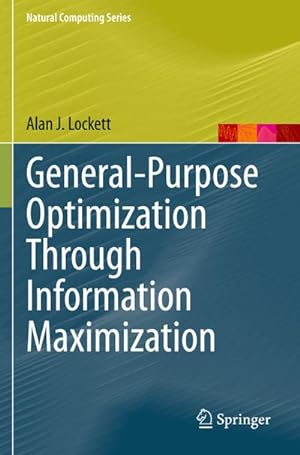
General-Purpose Optimization Through Information Maximization
Publicado por Springer Berlin Heidelberg Aug 2021, 2021
ISBN 10: 366262009X ISBN 13: 9783662620090
Idioma: Inglés
Librería: BuchWeltWeit Ludwig Meier e.K., Bergisch Gladbach, Alemania
Calificación del vendedor: 5 de 5 estrellas
EUR 213,99
EUR 23,00 shipping
Ships from Alemania to Estados Unidos de AmericaCantidad disponible: 2 disponibles
Añadir al carritoTaschenbuch. Condición: Neu. This item is printed on demand - it takes 3-4 days longer - Neuware -This book examines the mismatch betweendiscrete programs,which lie at the center ofmodern applied mathematics, and the continuous space phenomena they simulate. The author considers whether we can imagine continuous spacesof programs, and asks what thestructure of such spaceswould beand how they would beconstituted. He proposesa functional analysisof program spaces focused through the lens of iterative optimization.The author begins with the observation that optimization methods such as Genetic Algorithms, Evolution Strategies, and Particle Swarm Optimization can be analyzed as Estimation of Distributions Algorithms (EDAs) in that they can be formulated as conditional probability distributions. The probabilities themselves are mathematical objects that can be compared and operated on, and thus many methods in Evolutionary Computation can be placed in a shared vector space and analyzed using techniques of functional analysis. The core ideas of this book expand from that concept, eventually incorporating all iterative stochastic search methods, including gradient-based methods. Inspired by work on Randomized Search Heuristics, the author covers all iterative optimization methods and not just evolutionary methods. The No Free Lunch Theorem is viewed as a useful introduction to the broader field of analysis that comes from developing a shared mathematical space for optimization algorithms. The author brings in intuitions from several branches of mathematics such as topology, probability theory, and stochastic processes and provides substantial background material to make the work as self-contained as possible.The book will be valuable for researchers in the areas of global optimization, machine learning, evolutionary theory, and control theory. 580 pp. Englisch.
-

General-Purpose Optimization Through Information Maximization
Publicado por Springer Berlin Heidelberg Aug 2020, 2020
ISBN 10: 3662620065 ISBN 13: 9783662620069
Idioma: Inglés
Librería: BuchWeltWeit Ludwig Meier e.K., Bergisch Gladbach, Alemania
Calificación del vendedor: 5 de 5 estrellas
EUR 213,99
EUR 23,00 shipping
Ships from Alemania to Estados Unidos de AmericaCantidad disponible: 2 disponibles
Añadir al carritoBuch. Condición: Neu. This item is printed on demand - it takes 3-4 days longer - Neuware -This book examines the mismatch betweendiscrete programs,which lie at the center ofmodern applied mathematics, and the continuous space phenomena they simulate. The author considers whether we can imagine continuous spacesof programs, and asks what thestructure of such spaceswould beand how they would beconstituted. He proposesa functional analysisof program spaces focused through the lens of iterative optimization.The author begins with the observation that optimization methods such as Genetic Algorithms, Evolution Strategies, and Particle Swarm Optimization can be analyzed as Estimation of Distributions Algorithms (EDAs) in that they can be formulated as conditional probability distributions. The probabilities themselves are mathematical objects that can be compared and operated on, and thus many methods in Evolutionary Computation can be placed in a shared vector space and analyzed using techniques of functional analysis. The core ideas of this book expand from that concept, eventually incorporating all iterative stochastic search methods, including gradient-based methods. Inspired by work on Randomized Search Heuristics, the author covers all iterative optimization methods and not just evolutionary methods. The No Free Lunch Theorem is viewed as a useful introduction to the broader field of analysis that comes from developing a shared mathematical space for optimization algorithms. The author brings in intuitions from several branches of mathematics such as topology, probability theory, and stochastic processes and provides substantial background material to make the work as self-contained as possible.The book will be valuable for researchers in the areas of global optimization, machine learning, evolutionary theory, and control theory. 580 pp. Englisch.
-
General-Purpose Optimization Through Information Maximization (Natural Computing Series)
Librería: Majestic Books, Hounslow, Reino Unido
Calificación del vendedor: 4 de 5 estrellas
EUR 294,05
EUR 7,45 shipping
Ships from Reino Unido to Estados Unidos de AmericaCantidad disponible: 4 disponibles
Añadir al carritoCondición: New. Print on Demand.
-
General-Purpose Optimization Through Information Maximization (Natural Computing Series)
Librería: Biblios, Frankfurt am main, HESSE, Alemania
Calificación del vendedor: 4 de 5 estrellas
EUR 294,83
EUR 9,95 shipping
Ships from Alemania to Estados Unidos de AmericaCantidad disponible: 4 disponibles
Añadir al carritoCondición: New. PRINT ON DEMAND.

