

Importe total (1 artículo artículos):
Destino del pedido:

9781441936660 - Handbook of Combinatorial Optimization: Supplement Volume B (6 resultados)
Ir a los resultados principales
Filtros de búsqueda
Tipo de artículo
- Todos los tipos de productos
- Libros (6)
- Revistas y publicaciones (No hay ningún otro resultado que coincida con este filtro.)
- Cómics (No hay ningún otro resultado que coincida con este filtro.)
- Partituras (No hay ningún otro resultado que coincida con este filtro.)
- Arte, grabados y pósters (No hay ningún otro resultado que coincida con este filtro.)
- Fotografías (No hay ningún otro resultado que coincida con este filtro.)
- Mapas (No hay ningún otro resultado que coincida con este filtro.)
- Manuscritos y coleccionismo de papel (No hay ningún otro resultado que coincida con este filtro.)
Condición Más información
- Nuevo (6)
- Como nuevo, Excelente o Muy bueno (No hay ningún otro resultado que coincida con este filtro.)
- Bueno o Aceptable (No hay ningún otro resultado que coincida con este filtro.)
- Regular o Pobre (No hay ningún otro resultado que coincida con este filtro.)
- Tal como se indica (No hay ningún otro resultado que coincida con este filtro.)
Encuadernación
- Todas
- Tapa dura (No hay ningún otro resultado que coincida con este filtro.)
- Tapa blanda (6)
Más atributos
- Primera edición (No hay ningún otro resultado que coincida con este filtro.)
- Firmado (No hay ningún otro resultado que coincida con este filtro.)
- Sobrecubierta (No hay ningún otro resultado que coincida con este filtro.)
- Con imágenes (4)
- No impresión bajo demanda (4)
Idioma (1)
Precio
- Cualquier precio
- Menos de EUR 20 (No hay ningún otro resultado que coincida con este filtro.)
- EUR 20 a EUR 45 (No hay ningún otro resultado que coincida con este filtro.)
- Más de EUR 45
Gastos de envío gratis
- Envío gratis a Estados Unidos de America (No hay ningún otro resultado que coincida con este filtro.)
Ubicación del vendedor
Valoración de los vendedores
-
Handbook of Combinatorial Optimization | Supplement Volume B
Librería: preigu, Osnabrück, Alemania
Calificación del vendedor: 5 de 5 estrellas

EUR 140,00
Envío por EUR 70,00
Se envía de Alemania a Estados Unidos de AmericaCantidad disponible: 5 disponibles
Añadir al carritoTaschenbuch. Condición: Neu. Handbook of Combinatorial Optimization | Supplement Volume B | Ding-Zhu Du | Taschenbuch | viii | Englisch | 2011 | Springer Us | EAN 9781441936660 | Verantwortliche Person für die EU: Springer Verlag GmbH, Tiergartenstr. 17, 69121 Heidelberg, juergen[dot]hartmann[at]springer[dot]com | Anbieter: preigu.
-
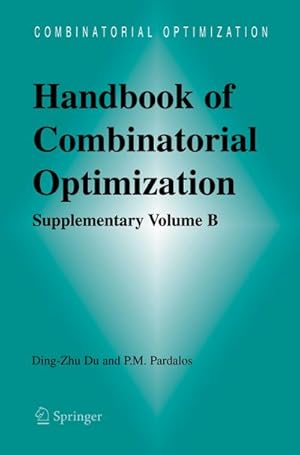
Handbook of Combinatorial Optimization : Supplement Volume B
Librería: AHA-BUCH GmbH, Einbeck, Alemania
Calificación del vendedor: 5 de 5 estrellas
EUR 168,73
Envío por EUR 63,05
Se envía de Alemania a Estados Unidos de AmericaCantidad disponible: 1 disponibles
Añadir al carritoTaschenbuch. Condición: Neu. Druck auf Anfrage Neuware - Printed after ordering - Combinatorial (or discrete) optimization is one of the most active fields in the interface of operations research, computer science, and applied ma- ematics. Combinatorial optimization problems arise in various applications, including communications network design, VLSI design, machine vision, a- line crew scheduling, corporate planning, computer-aided design and m- ufacturing, database query design, cellular telephone frequency assignment, constraint directed reasoning, and computational biology. Furthermore, combinatorial optimization problems occur in many diverse areas such as linear and integer programming, graph theory, artificial intelligence, and number theory. All these problems, when formulated mathematically as the minimization or maximization of a certain function defined on some domain, have a commonality of discreteness. Historically, combinatorial optimization starts with linear programming. Linear programming has an entire range of important applications including production planning and distribution, personnel assignment, finance, allo- tion of economic resources, circuit simulation, and control systems. Leonid Kantorovich and Tjalling Koopmans received the Nobel Prize (1975) for their work on the optimal allocation of resources. Two important discov- ies, the ellipsoid method (1979) and interior point approaches (1984) both provide polynomial time algorithms for linear programming. These al- rithms have had a profound effect in combinatorial optimization. Many polynomial-time solvable combinatorial optimization problems are special cases of linear programming (e.g. matching and maximum flow). In ad- tion, linear programming relaxations are often the basis for many appro- mation algorithms for solving NP-hard problems (e.g. dual heuristics).
-

Handbook of Combinatorial Optimization: Supplement Volume B
Librería: Revaluation Books, Exeter, Reino Unido
Calificación del vendedor: 5 de 5 estrellas
EUR 235,24
Envío por EUR 14,45
Se envía de Reino Unido a Estados Unidos de AmericaCantidad disponible: 2 disponibles
Añadir al carritoPaperback. Condición: Brand New. supplement edition. 408 pages. 9.61x6.61x1.97 inches. In Stock.
-
Handbook of Combinatorial Optimization: Supplement Volume B
Librería: Ria Christie Collections, Uxbridge, Reino Unido
Calificación del vendedor: 5 de 5 estrellas
EUR 219,41
Envío por EUR 13,85
Se envía de Reino Unido a Estados Unidos de AmericaCantidad disponible: Más de 20 disponibles
Añadir al carritoCondición: New. In.
-

Handbook of Combinatorial Optimization
Librería: moluna, Greven, Alemania
Calificación del vendedor: 4 de 5 estrellas

EUR 149,75
Envío por EUR 48,99
Se envía de Alemania a Estados Unidos de AmericaCantidad disponible: Más de 20 disponibles
Añadir al carritoCondición: New. Dieser Artikel ist ein Print on Demand Artikel und wird nach Ihrer Bestellung fuer Sie gedruckt. The material presented in this supplement to the 3-volume Handbook of Combinatorial Optimization will be useful for any researcher who uses combinatorial optimization methods to solve problemsThe material presented in this supplement to the 3-volume .
-

Handbook of Combinatorial Optimization
Librería: BuchWeltWeit Ludwig Meier e.K., Bergisch Gladbach, Alemania
Calificación del vendedor: 5 de 5 estrellas
EUR 160,49
Envío por EUR 23,00
Se envía de Alemania a Estados Unidos de AmericaCantidad disponible: 2 disponibles
Añadir al carritoTaschenbuch. Condición: Neu. This item is printed on demand - it takes 3-4 days longer - Neuware -This is a supplementary volume to the major three-volume Handbook of Combinatorial Optimizationset. It can also be regarded as a stand-alone volume presenting chapters dealing with various aspects of the subject in a self-contained way. 404 pp. Englisch.


