

Importe total (1 artículo artículos):
Destino del pedido:

johnson partridge e b (2 resultados)
Ir a los resultados principales
Filtros de búsqueda
Tipo de artículo
- Todos los tipos de productos
- Libros (2)
- Revistas y publicaciones (No hay ningún otro resultado que coincida con este filtro.)
- Cómics (No hay ningún otro resultado que coincida con este filtro.)
- Partituras (No hay ningún otro resultado que coincida con este filtro.)
- Arte, grabados y pósters (No hay ningún otro resultado que coincida con este filtro.)
- Fotografías (No hay ningún otro resultado que coincida con este filtro.)
- Mapas (No hay ningún otro resultado que coincida con este filtro.)
- Manuscritos y coleccionismo de papel (No hay ningún otro resultado que coincida con este filtro.)
Condición Más información
- Nuevo (No hay ningún otro resultado que coincida con este filtro.)
- Como nuevo, Excelente o Muy bueno (No hay ningún otro resultado que coincida con este filtro.)
- Bueno o Aceptable (No hay ningún otro resultado que coincida con este filtro.)
- Regular o Pobre (1)
- Tal como se indica (1)
Encuadernación
Más atributos
- Primera edición (1)
- Firmado (No hay ningún otro resultado que coincida con este filtro.)
- Sobrecubierta (No hay ningún otro resultado que coincida con este filtro.)
- Con imágenes (1)
- No impresión bajo demanda (2)
Idioma (1)
Gastos de envío gratis
- Envío gratis a Estados Unidos de America (No hay ningún otro resultado que coincida con este filtro.)
Ubicación del vendedor
Valoración de los vendedores
-

Bartholomew Fair
Publicado por Edward Arnold, 1964
Librería: Anybook.com, Lincoln, Reino Unido
Calificación del vendedor: 5 de 5 estrellas

EUR 6,56
Envío por EUR 15,75
Se envía de Reino Unido a Estados Unidos de AmericaCantidad disponible: 1 disponibles
Añadir al carritoCondición: Poor. This is an ex-library book and may have the usual library/used-book markings inside.This book has soft covers. In poor condition, suitable as a reading copy. Please note the Image in this listing is a stock photo and may not match the covers of the actual item,350grams, ISBN:
-
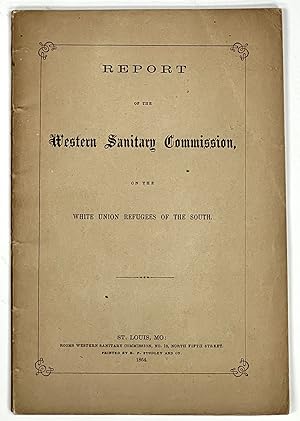
REPORT Of The WESTERN SANITARY COMMISSION, On the White Union Refugees of the South, Their Persecutions, Sufferings, Destitute Condition, and the Necessity of Giving Aid and Relief on Their Coming to Our Military Posts
Publicado por Rooms Western Sanitary Commission, No. 10, North Fifth Street. Printed by R. P. Studley and Co, St. Louis, Mo, 1864
Librería: Tavistock Books, ABAA, Reno, NV, Estados Unidos de America
Miembro de asociación: ABAA ESA ILAB IOBA
Calificación del vendedor: 5 de 5 estrellas
Original o primera edición
EUR 219,61
Envío por EUR 6,46
Se envía dentro de Estados Unidos de AmericaCantidad disponible: 1 disponibles
Añadir al carrito1st Printing. 44 pp. 8vo. 8-3/4" x 5-7/8" "The Western Sanitary Commission was a private agency based in St. Louis that was a rival of the larger U.S. Sanitary Commission. It operated in the west during the American Civil War to help the U.S. Army deal with sick and wounded soldiers. It was led by abolitionists and focused on the needs of Freedmen. It was founded in St. Louis August 1861 under the protection of General John C. Frà mont and under the leadership of Reverend William Greenleaf Eliot and James E. Yeatman. Its first mission was to care for the wounded from the Battle of Wilson's Creek. In its first six weeks it established four large general hospitals with over two thousand beds. It later set up convalescent facilities. A major activity was acquiring adequate stocks of medicines and medical supplies for the hospitals run by the U.S. Army. Working with Dorothea Dix it took charge of finding women to be civilian nurses and nurses' aides in Army facilities. The Western Sanitary Commission generally handled all sanitary affairs west of the Mississippi, and operated on a budget of $50,000 a month (about one-fourth the size of the rival national organization). The money came from private fundraising in the city of St. Louis, as well as from donors in California and New England. Parrish explains it selected nurses, provided hospital supplies, set up several hospitals, and outfitted several hospital ships. It also provided clothing and places to stay for freedmen and refugees, and set up schools for black children. It continued to finance various philanthropic projects until 1886." [Wiki] Age-toning. Rear cover almost detached. With a nod to the rear cover, a VG copy. Original publisher's printed light brown paper covers. Now housed in an archival mylar sleeve.

