
Artículos relacionados a Macroclimate and Plant Forms: An Introduction to Predictive...
Macroclimate and Plant Forms: An Introduction to Predictive Modeling in Phytogeography: 1 (Tasks for Vegetation Science, 1) - Tapa dura
Sinopsis
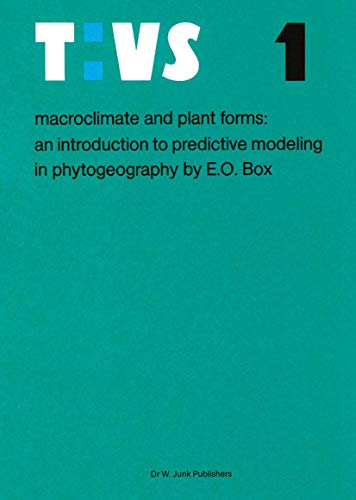
This study arose out ofthe old question of what actually determines vegetation structure and distributions. Is climate the overriding control, as one would suppose from reading the more geographically oriented literature? Or is climate only incidental, as suggested by more site and/ or taxon-oriented writers? The question might be phrased more realistically: How much does climate control vegetation processes, structures, and distributions? It seemed to me, as an ambitious doctoral student, that one way to attempt an answer might be to try to predict world vegetation from climate alone and then compare the predicted results with actual vegetation patterns. If climatic data were sufficient to reproduce the world’s actual vegetation patterns, then one could conclude that climate is the main control. This book represents an expanded, second-generation version of that original thesis. It presents world-scale vegetation and ecoclimatic models and a methodology for applying such models to predict vegetation and for evaluating model results. This approach also provides a means of geographical simulation of vegetation patterns and changes, which represent necessary data inputs in other fields such as atmospheric chemistry and biogeochemical cycling. It has been fairly well accepted that climatic and other environmental conditions are associated with the evolution of particular aspects of plant form (convergent evolution). The particular configurations of plant size, photosynthetic surface area and structure (e. g. sclerophylly, stomatal ’resistance’), and their seasonal variations represent what one can recognize fairly readily as distinct growth forms.
"Sinopsis" puede pertenecer a otra edición de este libro.
Reseña del editor
This study arose out ofthe old question of what actually determines vegetation structure and distributions. Is climate the overriding control, as one would suppose from reading the more geographically oriented literature? Or is climate only incidental, as suggested by more site and/ or taxon-oriented writers? The question might be phrased more realistically: How much does climate control vegetation processes, structures, and distributions? It seemed to me, as an ambitious doctoral student, that one way to attempt an answer might be to try to predict world vegetation from climate alone and then compare the predicted results with actual vegetation patterns. If climatic data were sufficient to reproduce the world's actual vegetation patterns, then one could conclude that climate is the main control. This book represents an expanded, second-generation version of that original thesis. It presents world-scale vegetation and ecoclimatic models and a methodology for applying such models to predict vegetation and for evaluating model results. This approach also provides a means of geographical simulation of vegetation patterns and changes, which represent necessary data inputs in other fields such as atmospheric chemistry and biogeochemical cycling. It has been fairly well accepted that climatic and other environmental conditions are associated with the evolution of particular aspects of plant form (convergent evolution). The particular configurations of plant size, photosynthetic surface area and structure (e. g. sclerophylly, stomatal 'resistance'), and their seasonal variations represent what one can recognize fairly readily as distinct growth forms.
"Sobre este título" puede pertenecer a otra edición de este libro.
Resultados de la búsqueda para Macroclimate and Plant Forms: An Introduction to Predictive...

Imagen de archivo
Macroclimate and Plant Forms
Publicado por
Dr W Junk Publishers, The Hague Netherlands, 1981
ISBN 10: 9061939410
ISBN 13: 9789061939412
Antiguo o usado
Tapa dura
Librería: Chequamegon Books, Washburn, WI, Estados Unidos de America
Calificación del vendedor: 5 de 5 estrellas

Hardcover. Condición: Very Good with no dust jacket. ".An introduction to predictive moderling in phytogeography, or, How much does climate control vegetation processes, structures, and distributions?" The usual library markings on covers and page edges, numbers inked on spine, corners slightly bumped. Text block Near Fine condition.; Ex University Library; 8 x 10 1/2 ". Nº de ref. del artículo: 104217
Comprar usado
EUR 45,79
Envío por EUR 5,78
Se envía dentro de Estados Unidos de America
Se envía dentro de Estados Unidos de America
Cantidad disponible: 1 disponibles
Imagen del vendedor
Macroclimate and Plant Forms: An Introduction to Predictive Modeling in Phytogeography (Tasks for Vegetation Science, 1)
Librería: -OnTimeBooks-, Phoenix, AZ, Estados Unidos de America
Calificación del vendedor: 5 de 5 estrellas
Condición: good. A copy that has been read, remains in good condition. All pages are intact, and the cover is intact. The spine and cover show signs of wear. Pages can include notes and highlighting and show signs of wear, and the copy can include "From the library of" labels or previous owner inscriptions. 100% GUARANTEE! Shipped with delivery confirmation, if you're not satisfied with purchase please return item! Ships via media mail. Nº de ref. del artículo: OTV.9061939410.G
Comprar usado
EUR 127,73
Gastos de envío gratis
Se envía dentro de Estados Unidos de America
Se envía dentro de Estados Unidos de America
Cantidad disponible: 1 disponibles
Imagen de archivo
Macroclimate and Plant Forms: An Introduction to Predictive Modeling in Phytogeography (Tasks for Vegetation Science)
Librería: Nauka Japan LLC, Tokyo, Japon
Calificación del vendedor: 4 de 5 estrellas

Condición: New. [ak 1790]. Nº de ref. del artículo: NJ002751
Comprar nuevo
EUR 225,66
Envío por EUR 13,34
Se envía de Japon a Estados Unidos de America
Se envía de Japon a Estados Unidos de America
Cantidad disponible: 1 disponibles
Imagen del vendedor
Macroclimate and Plant Forms : An Introduction to Predictive Modeling in Phytogeography
Librería: GreatBookPrices, Columbia, MD, Estados Unidos de America
Calificación del vendedor: 5 de 5 estrellas
Condición: New. Nº de ref. del artículo: 6417460-n
Comprar nuevo
EUR 236,96
Envío por EUR 2,35
Se envía dentro de Estados Unidos de America
Se envía dentro de Estados Unidos de America
Cantidad disponible: Más de 20 disponibles
Imagen del vendedor
Macroclimate and Plant Forms : An Introduction to Predictive Modeling in Phytogeography
Librería: GreatBookPrices, Columbia, MD, Estados Unidos de America
Calificación del vendedor: 5 de 5 estrellas
Condición: As New. Unread book in perfect condition. Nº de ref. del artículo: 6417460
Comprar usado
EUR 244,53
Envío por EUR 2,35
Se envía dentro de Estados Unidos de America
Se envía dentro de Estados Unidos de America
Cantidad disponible: Más de 20 disponibles
Imagen del vendedor
Macroclimate and Plant Forms : An Introduction to Predictive Modeling in Phytogeography
Librería: GreatBookPricesUK, Woodford Green, Reino Unido
Calificación del vendedor: 5 de 5 estrellas
Condición: New. Nº de ref. del artículo: 6417460-n
Comprar nuevo
EUR 245,57
Envío por EUR 17,60
Se envía de Reino Unido a Estados Unidos de America
Se envía de Reino Unido a Estados Unidos de America
Cantidad disponible: Más de 20 disponibles
Imagen de archivo
Macroclimate and Plant Forms: An Introduction to Predictive Modeling in Phytogeography (Tasks for Vegetation Science, 1)
Librería: Ria Christie Collections, Uxbridge, Reino Unido
Calificación del vendedor: 5 de 5 estrellas
Condición: New. In English. Nº de ref. del artículo: ria9789061939412_new
Comprar nuevo
EUR 251,59
Envío por EUR 13,25
Se envía de Reino Unido a Estados Unidos de America
Se envía de Reino Unido a Estados Unidos de America
Cantidad disponible: Más de 20 disponibles
Imagen del vendedor
Macroclimate and Plant Forms : An Introduction to Predictive Modeling in Phytogeography
Librería: GreatBookPricesUK, Woodford Green, Reino Unido
Calificación del vendedor: 5 de 5 estrellas
Condición: As New. Unread book in perfect condition. Nº de ref. del artículo: 6417460
Comprar usado
EUR 250,04
Envío por EUR 17,60
Se envía de Reino Unido a Estados Unidos de America
Se envía de Reino Unido a Estados Unidos de America
Cantidad disponible: Más de 20 disponibles
Imagen del vendedor
Macroclimate and Plant Forms
Librería: moluna, Greven, Alemania
Calificación del vendedor: 5 de 5 estrellas
Gebunden. Condición: New. This study arose out ofthe old question of what actually determines vegetation structure and distributions. Is climate the overriding control, as one would suppose from reading the more geographically oriented literature? Or is climate only incidental, as s. Nº de ref. del artículo: 5823230
Comprar nuevo
EUR 246,91
Envío por EUR 48,99
Se envía de Alemania a Estados Unidos de America
Se envía de Alemania a Estados Unidos de America
Cantidad disponible: Más de 20 disponibles
Imagen de archivo
Macroclimate and Plant Forms: An Introduction to Predictive Modeling in Phytogeography
Librería: Revaluation Books, Exeter, Reino Unido
Calificación del vendedor: 5 de 5 estrellas
Hardcover. Condición: Brand New. 10.50x8.00x0.75 inches. In Stock. Nº de ref. del artículo: x-9061939410
Comprar nuevo
EUR 310,94
Envío por EUR 14,67
Se envía de Reino Unido a Estados Unidos de America
Se envía de Reino Unido a Estados Unidos de America
Cantidad disponible: 2 disponibles