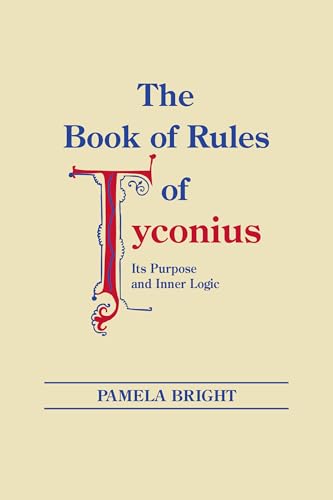
Book of Rules of Tyconius, The: Its Purpose and Inner Logic (Christianity and Judaism in Antiquity) - Tapa blanda
Sinopsis
The Liber Regularum, written by Tyconius in the Fourth Century A.D., was the first system of biblical interpretation proposed by a Latin theologian. Augustine was very interested in this work and included an extraordinary summation of it in his De doctrina christiana. Although this treatment insured the preservation of the work and its lasting fame, Augustine’s summary became better known than the original. Pamela Bright’s The Book of Rules of Tyconius: Its Purpose and Inner Logic reintroduces this neglected classic of early church literature. Bright asserts that although Augustine was greatly influenced by the Liber Regularum, his philosophical differences caused him to misunderstand its meaning. Bright reexamines the meaning of "prophecy" and "rule" from Tyconius’s perspective and reveals that the purpose of the book was not to provide a general guide to scriptural interpretation, but rather a way to interpret apocalyptic texts. She cites Tyconius’s intense concern with evil in the church as the genesis of his interest in the apocalypse and subsequently the meaning of the scripture concerning it. Tyconius speaks of the "seven mystical rules" of scripture that with the grace of the Holy Spirit reveal the true meaning of prophecy. If an interpreter follows the "logic" of these rules, the nature of the church as composed by both good and evil membership is revealed. Bright argues that Tyconius was not illogical or incompetent in the work’s composition as many critics have claimed but rather that he organized his material in a concentric pattern so that Rule Four, the center of the seven rules, is also the central development of his theory. Of interest to theologians, students of biblical interpretation and of Augustine, The Book of Rules of Tyconius focuses attention upon a work that had great influence on the understanding of the nature of the church, on interpreting scripture, and its meaning for the Church of its day.
"Sinopsis" puede pertenecer a otra edición de este libro.
Acerca del autor
Dr. Pamela Bright was the Chair of the Theological Studies Department at Concordia University from 1995 until 2006 and a Professor of Historical Theology. Her undergraduate studies were in classics, history and theology at the University of Queensland, Australia. She graduated from the University of Notre Dame, Indiana, with an MA in 1983 and then a PhD in 1987.
"Sobre este título" puede pertenecer a otra edición de este libro.
Otras ediciones populares con el mismo título

Resultados de la búsqueda para Book of Rules of Tyconius, The: Its Purpose and Inner...

Imagen de archivo
Book of Rules of Tyconius, The: Its Purpose and Inner Logic (ND Christianity & Judaism Anitqui) (Christianity and Judaism in Antiquity)
Publicado por
University of Notre Dame Press, 1994
ISBN 10: 0268022194
ISBN 13: 9780268022198
Antiguo o usado
paperback
Librería: HPB-Red, Dallas, TX, Estados Unidos de America
Calificación del vendedor: 5 de 5 estrellas

paperback. Condición: Good. Connecting readers with great books since 1972! Used textbooks may not include companion materials such as access codes, etc. May have some wear or writing/highlighting. We ship orders daily and Customer Service is our top priority! Nº de ref. del artículo: S_438988401
Comprar usado
EUR 18,36
Gastos de envío:
EUR 3,22
A Estados Unidos de America
Cantidad disponible: 1 disponibles
Imagen de archivo
Book of Rules of Tyconius, The: Its Purpose and Inner Logic (ND Christianity Judaism Anitqui) (Christianity and Judaism in Antiquity)
Publicado por
University of Notre Dame Press, 1994
ISBN 10: 0268022194
ISBN 13: 9780268022198
Nuevo
Paperback
Librería: Toscana Books, AUSTIN, TX, Estados Unidos de America
Calificación del vendedor: 5 de 5 estrellas
Paperback. Condición: new. Excellent Condition.Excels in customer satisfaction, prompt replies, and quality checks. Nº de ref. del artículo: Scanned0268022194
Comprar nuevo
EUR 25,76
Gastos de envío:
EUR 3,69
A Estados Unidos de America
Cantidad disponible: 1 disponibles
Imagen de archivo
Book of Rules of Tyconius, The: Its Purpose and Inner Logic (ND Christianity & Judaism Anitqui)
Publicado por
University of Notre Dame Press, 1994
ISBN 10: 0268022194
ISBN 13: 9780268022198
Nuevo
Tapa blanda
Librería: Lucky's Textbooks, Dallas, TX, Estados Unidos de America
Calificación del vendedor: 5 de 5 estrellas
Condición: New. Nº de ref. del artículo: ABLIING23Feb2215580085488
Comprar nuevo
EUR 42,70
Gastos de envío:
EUR 3,43
A Estados Unidos de America
Cantidad disponible: Más de 20 disponibles
Imagen del vendedor
Book of Rules of Tyconius : Its Purpose and Inner Logic
Publicado por
University of Notre Dame Press, 1994
ISBN 10: 0268022194
ISBN 13: 9780268022198
Nuevo
Tapa blanda
Librería: GreatBookPrices, Columbia, MD, Estados Unidos de America
Calificación del vendedor: 5 de 5 estrellas
Condición: New. Nº de ref. del artículo: 6524535-n
Comprar nuevo
EUR 43,88
Gastos de envío:
EUR 2,27
A Estados Unidos de America
Cantidad disponible: Más de 20 disponibles
Imagen de archivo
The Book of Rules of Tyconius: Its Purpose and Inner Logic
Publicado por
University of Notre Dame Press, 2009
ISBN 10: 0268022194
ISBN 13: 9780268022198
Antiguo o usado
Tapa blanda
Librería: Anybook.com, Lincoln, Reino Unido
Calificación del vendedor: 5 de 5 estrellas
Condición: Good. This is an ex-library book and may have the usual library/used-book markings inside.This book has soft covers. In good all round condition. Library sticker on front cover. Please note the Image in this listing is a stock photo and may not match the covers of the actual item,400grams, ISBN:9780268022198. Nº de ref. del artículo: 5572638
Comprar usado
EUR 31,86
Gastos de envío:
EUR 15,34
De Reino Unido a Estados Unidos de America
Cantidad disponible: 1 disponibles
Imagen del vendedor
Book of Rules of Tyconius : Its Purpose and Inner Logic
Publicado por
University of Notre Dame Press, 1994
ISBN 10: 0268022194
ISBN 13: 9780268022198
Antiguo o usado
Tapa blanda
Librería: GreatBookPrices, Columbia, MD, Estados Unidos de America
Calificación del vendedor: 5 de 5 estrellas
Condición: As New. Unread book in perfect condition. Nº de ref. del artículo: 6524535
Comprar usado
EUR 49,43
Gastos de envío:
EUR 2,27
A Estados Unidos de America
Cantidad disponible: Más de 20 disponibles
Imagen de archivo
The Book of Rules of Tyconius: Its Purpose and Inner Logic (ND Christianity & Judaism Anitqui)
Publicado por
University of Notre Dame Press, 2009
ISBN 10: 0268022194
ISBN 13: 9780268022198
Nuevo
Tapa blanda
Original o primera edición
Librería: Kennys Bookshop and Art Galleries Ltd., Galway, GY, Irlanda
Calificación del vendedor: 5 de 5 estrellas
Condición: New. Series: Christianity and Judaism in Antiquity. Num Pages: 208 pages. BIC Classification: 3D; HRCG3. Category: (U) Tertiary Education (US: College). Dimension: 229 x 152 x 13. Weight in Grams: 340. . 2009. 1st Edition. Paperback. . . . . Nº de ref. del artículo: V9780268022198
Comprar nuevo
EUR 41,38
Gastos de envío:
EUR 10,50
De Irlanda a Estados Unidos de America
Cantidad disponible: 1 disponibles
Imagen de archivo
The Book of Rules of Tyconius: Its Purpose and Inner Logic: Vol 2
Publicado por
Univ of Notre Dame Pr, 2009
ISBN 10: 0268022194
ISBN 13: 9780268022198
Nuevo
Paperback
Librería: Revaluation Books, Exeter, Reino Unido
Calificación del vendedor: 5 de 5 estrellas
Paperback. Condición: Brand New. 1st edition. 208 pages. 8.90x6.00x0.70 inches. In Stock. This item is printed on demand. Nº de ref. del artículo: __0268022194
Comprar nuevo
EUR 40,79
Gastos de envío:
EUR 11,45
De Reino Unido a Estados Unidos de America
Cantidad disponible: 1 disponibles
Imagen de archivo
Book of Rules of Tyconius, The (Paperback)
Publicado por
University of Notre Dame Press, Notre Dame IN, 2009
ISBN 10: 0268022194
ISBN 13: 9780268022198
Nuevo
Paperback
Librería: Grand Eagle Retail, Bensenville, IL, Estados Unidos de America
Calificación del vendedor: 5 de 5 estrellas
Paperback. Condición: new. Paperback. The Liber Regularum, written by Tyconius in the Fourth Century A.D., was the first system of biblical interpretation proposed by a Latin theologian. Augustine was very interested in this work and included an extraordinary summation of it in his De doctrina christiana. Although this treatment insured the preservation of the work and its lasting fame, Augustine's summary became better known than the original. Pamela Bright's The Book of Rules of Tyconius: Its Purpose and Inner Logic reintroduces this neglected classic of early church literature. Bright asserts that although Augustine was greatly influenced by the Liber Regularum, his philosophical differences caused him to misunderstand its meaning. Bright reexamines the meaning of "prophecy" and "rule" from Tyconius's perspective and reveals that the purpose of the book was not to provide a general guide to scriptural interpretation, but rather a way to interpret apocalyptic texts. She cites Tyconius's intense concern with evil in the church as the genesis of his interest in the apocalypse and subsequently the meaning of the scripture concerning it. Tyconius speaks of the "seven mystical rules" of scripture that with the grace of the Holy Spirit reveal the true meaning of prophecy. If an interpreter follows the "logic" of these rules, the nature of the church as composed by both good and evil membership is revealed. Bright argues that Tyconius was not illogical or incompetent in the work's composition as many critics have claimed but rather that he organized his material in a concentric pattern so that Rule Four, the center of the seven rules, is also the central development of his theory. Of interest to theologians, students of biblical interpretation and of Augustine, The Book of Rules of Tyconius focuses attention upon a work that had great influence on the understanding of the nature of the church, on interpreting scripture, and its meaning for the Church of its day. "[Bright]. puts Tyconius in the context of his own time and carefully describes his seven rules of scriptural interpretation, clearly analyzing and affirming their unity. Though at times painstaking to read. the effort is rewarding as it discloses Tyconius' intention to give the sincere reader an understanding of the obscurities in what he calls the 'immense forest of prophecy'. Bright lets Tyconius be Tyconius, a man clearly intent on orienting his biblical hermeneutics to his pastoral situation. His exegetical method is not the method of our times, which is the result of 1900 years of exploring and explaining the scriptures. But his overall conviction that the scriptures derive from the Holy Spirit has a relevance for all seasons, maybe particularly today when biblical criticism has been coming under attack for its seeming lack of spiritual nourishment." - Patristics" Shipping may be from multiple locations in the US or from the UK, depending on stock availability. Nº de ref. del artículo: 9780268022198
Comprar nuevo
EUR 53,38
Gastos de envío:
GRATIS
A Estados Unidos de America
Cantidad disponible: 1 disponibles
Imagen de archivo
Book of Rules of Tyconius, the
Publicado por
University of Notre Dame Press, 2009
ISBN 10: 0268022194
ISBN 13: 9780268022198
Nuevo
PAP
Librería: PBShop.store UK, Fairford, GLOS, Reino Unido
Calificación del vendedor: 5 de 5 estrellas
PAP. Condición: New. New Book. Shipped from UK. Established seller since 2000. Nº de ref. del artículo: FW-9780268022198
Comprar nuevo
EUR 49,01
Gastos de envío:
EUR 4,76
De Reino Unido a Estados Unidos de America
Cantidad disponible: 1 disponibles