
Artículos relacionados a Reasons and Rationalizations: The Limits to Organizational...
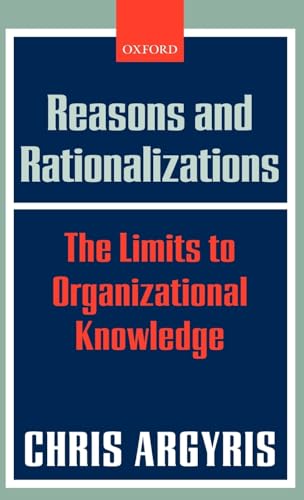
Sinopsis
What is the purpose of social science and management research? Do scholars/researchers have a responsibility to generate insights and knowledge that are of practical (implementable) value and validity?
We are told we live in turbulent and changing times, should this not provide an important opportunity for management researchers to provide understanding and guidance? Yet there is widespread concern about the efficacy of much research:
These are some of the puzzles/pressing problems that Chris Argyris addresses in this short book.
Argyris is one of the best known management scholars in the world - a leading light whose work has consistently addressed fundamental organizational questions, and who has provided some of the key concepts and building blocks of our understanding of organizational learning - single and double learning, theory in use, and espoused theory etc.
In this book he questions many of the assumptions of organizational theory and research, and his investigation is not confined to academic analysis. He also scrutinizes that capacity for 'unproductive reasoning' (self-deception and rationalization) that is common amongst managers, consultants, and indeed more generally. As well as engaging with the work of leading organizational researchers (Sennett, Gabriel, Burgelman, Czarniawska, Grint, for example)he also ponders the work of the consultants, commentators, and accountants who endorsed Enron.
Throughout his purpose is to affirm the goal and values of useful knowledge. His style/enquiry is direct but fair, challenging, if at times uncompromising. Drawing on his own wealth of experience of researching and working with organizations, this book will be a reference point for all concerned to develop useful knowledge and confront the defences and deceptions that are only too commonplace in the business and academic worlds.
"Sinopsis" puede pertenecer a otra edición de este libro.
Acerca del autor
Chris Argyris received his PhD in organizational behavior from Cornell University and served on the Yale University faculty for the next twenty years. He then became the James Bryant Conant Professor of Education and Organizational Behavior at Harvard University and held joint appointments over time at the Business, Law, and Kennedy Schools. His early research dealt with organizational structures and organizational change. His primary research methodology has been intervention, and his ongoing concern has been the applicability of knowledge.
"Sobre este título" puede pertenecer a otra edición de este libro.
Resultados de la búsqueda para Reasons and Rationalizations: The Limits to Organizational...

Imagen de archivo
Reasons and Rationalizations: The Limits to Organizational Knowledge
Publicado por
Oxford University Press, 2004
ISBN 10: 019926807X
ISBN 13: 9780199268078
Antiguo o usado
Tapa dura
Librería: -OnTimeBooks-, Phoenix, AZ, Estados Unidos de America
Calificación del vendedor: 5 de 5 estrellas

Condición: good. A copy that has been read, remains in good condition. All pages are intact, and the cover is intact. The spine and cover show signs of wear. Pages can include notes and highlighting and show signs of wear, and the copy can include "From the library of" labels or previous owner inscriptions. 100% GUARANTEE! Shipped with delivery confirmation, if you're not satisfied with purchase please return item! Ships via media mail. Nº de ref. del artículo: OTV.019926807X.G
Comprar usado
EUR 12,51
Gastos de envío gratis
Se envía dentro de Estados Unidos de America
Se envía dentro de Estados Unidos de America
Cantidad disponible: 1 disponibles
Imagen de archivo
Reasons and Rationalizations: The Limits to Organizational Knowledge
Publicado por
Oxford University Press, 2004
ISBN 10: 019926807X
ISBN 13: 9780199268078
Antiguo o usado
Tapa dura
Librería: ThriftBooks-Dallas, Dallas, TX, Estados Unidos de America
Calificación del vendedor: 5 de 5 estrellas
Hardcover. Condición: Fair. No Jacket. Readable copy. Pages may have considerable notes/highlighting. ~ ThriftBooks: Read More, Spend Less. Nº de ref. del artículo: G019926807XI5N00
Comprar usado
EUR 13,47
Gastos de envío gratis
Se envía dentro de Estados Unidos de America
Se envía dentro de Estados Unidos de America
Cantidad disponible: 1 disponibles
Imagen de archivo
Reasons and Rationalizations: The Limits to Organizational Knowledge
Publicado por
Oxford University Press, 2004
ISBN 10: 019926807X
ISBN 13: 9780199268078
Antiguo o usado
Tapa dura
Librería: ThriftBooks-Dallas, Dallas, TX, Estados Unidos de America
Calificación del vendedor: 5 de 5 estrellas
Hardcover. Condición: Good. No Jacket. Pages can have notes/highlighting. Spine may show signs of wear. ~ ThriftBooks: Read More, Spend Less. Nº de ref. del artículo: G019926807XI3N00
Comprar usado
EUR 13,47
Gastos de envío gratis
Se envía dentro de Estados Unidos de America
Se envía dentro de Estados Unidos de America
Cantidad disponible: 1 disponibles
Imagen de archivo
Reasons and Rationalizations : The Limits to Organizational Knowledge
Publicado por
Oxford University Press, Incorporated, 2004
ISBN 10: 019926807X
ISBN 13: 9780199268078
Antiguo o usado
Tapa dura
Original o primera edición
Librería: Better World Books, Mishawaka, IN, Estados Unidos de America
Calificación del vendedor: 5 de 5 estrellas
Condición: Very Good. 1st Edition. Former library copy. Pages intact with possible writing/highlighting. Binding strong with minor wear. Dust jackets/supplements may not be included. Includes library markings. Stock photo provided. Product includes identifying sticker. Better World Books: Buy Books. Do Good. Nº de ref. del artículo: 333143-6
Comprar usado
EUR 14,85
Gastos de envío gratis
Se envía dentro de Estados Unidos de America
Se envía dentro de Estados Unidos de America
Cantidad disponible: 1 disponibles
Imagen de archivo
Reasons and Rationalizations : The Limits to Organizational Knowledge
Publicado por
Oxford University Press, Incorporated, 2004
ISBN 10: 019926807X
ISBN 13: 9780199268078
Antiguo o usado
Tapa dura
Original o primera edición
Librería: Better World Books, Mishawaka, IN, Estados Unidos de America
Calificación del vendedor: 5 de 5 estrellas
Condición: Very Good. 1st Edition. Pages intact with possible writing/highlighting. Binding strong with minor wear. Dust jackets/supplements may not be included. Stock photo provided. Product includes identifying sticker. Better World Books: Buy Books. Do Good. Nº de ref. del artículo: 333142-6
Comprar usado
EUR 14,85
Gastos de envío gratis
Se envía dentro de Estados Unidos de America
Se envía dentro de Estados Unidos de America
Cantidad disponible: 1 disponibles
Imagen de archivo
Reasons and Rationalizations: The Limits to Organizational Knowledge
Publicado por
Oxford University Press, 2004
ISBN 10: 019926807X
ISBN 13: 9780199268078
Antiguo o usado
Tapa dura
Librería: Anybook.com, Lincoln, Reino Unido
Calificación del vendedor: 5 de 5 estrellas
Condición: Fair. This is an ex-library book and may have the usual library/used-book markings inside.This book has hardback covers. In fair condition, suitable as a study copy. Dust Jacket in fair condition. Please note the Image in this listing is a stock photo and may not match the covers of the actual item,550grams, ISBN:9780199268078. Nº de ref. del artículo: 9018798
Comprar usado
EUR 4,80
Envío por EUR 15,57
Se envía de Reino Unido a Estados Unidos de America
Se envía de Reino Unido a Estados Unidos de America
Cantidad disponible: 1 disponibles
Imagen del vendedor
Reasons and Rationalizations (Hardcover)
Publicado por
Oxford University Press, Oxford, 2004
ISBN 10: 019926807X
ISBN 13: 9780199268078
Nuevo
Tapa dura
Librería: AussieBookSeller, Truganina, VIC, Australia
Calificación del vendedor: 5 de 5 estrellas
Hardcover. Condición: new. Hardcover. What is the purpose of social science and management research? Do scholars/researchers have a responsibility to generate insights and knowledge that are of practical (implementable) value and validity?We are told we live in turbulent and changing times, should this not provide an important opportunity for management researchers to provide understanding and guidance? Yet there is widespread concern about the efficacy of much research:These are some of the puzzles/pressing problems that Chris Argyris addresses in this short book.Argyris is one of the best known management scholars in the world - aleading light whose work has consistently addressed fundamental organizational questions, and who has provided some of the key concepts and building blocks of our understanding of organizational learning - single and double learning, theory in use, and espoused theory etc.In this book he questions many of the assumptions of organizational theory and research, and his investigation is not confined to academic analysis. He also scrutinizes that capacity for 'unproductivereasoning' (self-deception and rationalization) that is common amongst managers, consultants, and indeed more generally. As well as engaging with the work of leading organizational researchers (Sennett,Gabriel, Burgelman, Czarniawska, Grint, for example)he also ponders the work of the consultants, commentators, and accountants who endorsed Enron.Throughout his purpose is to affirm the goal and values of useful knowledge. His style/enquiry is direct but fair, challenging, if at times uncompromising. Drawing on his own wealth of experience of researching and working with organizations, this book will be a reference point for all concerned to develop useful knowledge andconfront the defences and deceptions that are only too commonplace in the business and academic worlds. This is a book about how social sciences can be improved in ways that its relevance is expanded, the applicability of its knowledge is enlarged and increased, and the commitment to questioning the status quo is strengthened. This item is printed on demand. Shipping may be from our Sydney, NSW warehouse or from our UK or US warehouse, depending on stock availability. Nº de ref. del artículo: 9780199268078
Comprar nuevo
EUR 105,77
Envío por EUR 33,11
Se envía de Australia a Estados Unidos de America
Se envía de Australia a Estados Unidos de America
Cantidad disponible: 1 disponibles
Imagen de archivo
Reasons and Rationalizations: The Limits to Organizational Knowledge (eng)
Publicado por
Oxford University Press, 2004
ISBN 10: 019926807X
ISBN 13: 9780199268078
Nuevo
Tapa dura
Librería: Brook Bookstore On Demand, Napoli, NA, Italia
Calificación del vendedor: 5 de 5 estrellas
Condición: new. Questo è un articolo print on demand. Nº de ref. del artículo: 2c1a76423121b6603cc6c837f41c9f89
Comprar nuevo
EUR 137,12
Envío por EUR 5,50
Se envía de Italia a Estados Unidos de America
Se envía de Italia a Estados Unidos de America
Cantidad disponible: Más de 20 disponibles
Imagen del vendedor
Reasons and Rationalizations : The Limits to Organizational Knowledge
Publicado por
Oxford University Press, 2004
ISBN 10: 019926807X
ISBN 13: 9780199268078
Nuevo
Tapa dura
Librería: GreatBookPrices, Columbia, MD, Estados Unidos de America
Calificación del vendedor: 5 de 5 estrellas
Condición: New. Nº de ref. del artículo: 2024564-n
Comprar nuevo
EUR 148,35
Envío por EUR 2,36
Se envía dentro de Estados Unidos de America
Se envía dentro de Estados Unidos de America
Cantidad disponible: Más de 20 disponibles
Imagen del vendedor
Reasons and Rationalizations : The Limits to Organizational Knowledge
Publicado por
Oxford University Press, 2004
ISBN 10: 019926807X
ISBN 13: 9780199268078
Nuevo
Tapa dura
Librería: GreatBookPricesUK, Woodford Green, Reino Unido
Calificación del vendedor: 5 de 5 estrellas
Condición: New. Nº de ref. del artículo: 2024564-n
Comprar nuevo
EUR 147,66
Envío por EUR 17,91
Se envía de Reino Unido a Estados Unidos de America
Se envía de Reino Unido a Estados Unidos de America
Cantidad disponible: Más de 20 disponibles